How Long Does Asphalt Last? Lifespan and 7 Warning Signs

Every property owner asks the same question before they sign: how long does asphalt last? Most of the answer gets decided under the surface, during the week you pave it.
We pulled the numbers from federal pavement guidance, state DOT research, and NCAT test sections. Below you get lifespans by surface type, the seven warning signs of failure, and the maintenance that buys real years.
How Long Does Asphalt Last?
Asphalt lasts 15 to 25 years in most applications. The National Park Service puts a typical asphalt road segment at 15 to 20 years before it needs major rehabilitation, and the same failure mechanics play out on a retail lot or a driveway.
Water finds a way in, the binder stiffens with age, and repeated loads flex the surface until it cracks.
The spread inside that range is wide for a reason. Two lots paved the same summer can sit a decade apart in condition, and the gap almost always traces back to base support, compaction, and drainage.
When a lot does wear out, name the fix precisely: patching, resurfacing, and reconstruction are three different jobs at three different price points. Contractors who use asphalt terminology the way an engineer does tend to have much shorter arguments about scope later. A lot's tax depreciation life is a separate number from its physical lifespan.
Asphalt lifespan by surface type
Driveways top that list because passenger cars barely register as a load. Engineers count traffic in equivalent single axle loads, and one fully loaded 80,000-pound truck does the pavement damage of roughly 9,600 cars.
That single fact explains why the delivery lane behind a grocery store fails while the customer parking stalls 40 feet away still look new. It also belongs in your bidding workflow, back when thickness and base decisions still have room to move.
What Determines How Long Asphalt Lasts
Base support, compaction, drainage, mat thickness, load weight, and climate determine how long asphalt lasts. Your crew locks in the first four before it pulls off the site, so a big share of a job's lifespan comes down to the days you spend building it.
The base and the drainage do the real work
Asphalt is flexible by design, so it spreads load down into the aggregate base and the subgrade below. A soft or saturated base lets the surface flex farther than the mix can tolerate, and you see cracking in the wheel paths long before year 15. Drainage carries equal weight.
Water that sits on the surface, or worse, underneath it, turns a 20-year lot into a 10-year lot, and no surface treatment on earth reverses that.
Compaction on paving day
Density is where good crews separate themselves from cheap bids. FHWA's density program cites studies showing that a 1% increase in density can extend asphalt pavement service life by at least 10%.
That's one percentage point, decided by a roller pattern and mat temperature in a single afternoon, and it follows the pavement for two decades. Before paving day, estimate how many trucks the job needs so the paver never sits waiting on hot mix.
Crews who log roller passes, mat temps, and load tickets as part of daily project tracking can point to real records when a customer questions why one section aged differently than another.
Climate, sun, and freeze-thaw
Asphalt binder keeps aging after the crew leaves, mostly through oxidation from sun and air exposure.
The binder stiffens, loses flexibility, and starts to crack under loads it shrugged off in year three. In freeze-thaw country, water that gets into those cracks expands and pries them wider every cold snap, so a Michigan lot and a California lot with the same spec sheet age on completely different schedules.
Heat brings the opposite problem.
In July 2026, TxDOT said extreme heat was the primary factor when a stretch of US 69 in Hunt County softened under stopped traffic, and updated climate data is pushing toward stiffer binders: a 2024 University of California Pavement Research Center report for Caltrans recommends bumping California's Inland Valley from PG 64-10 to PG 70-10.
Good paving project management accounts for local climate in the maintenance schedule you hand over at closeout, not two winters later when the customer calls angry.
Install quality, thickness, and mix
Thin mats over weak bases fail early, and no maintenance program saves them. A 2-inch surface course over a marginal base might look identical to a properly built section on day one, and the difference shows up later as wheel path cracking. Longitudinal joints deserve attention too, since poorly compacted joints let water straight into the structure and often crack first.
Today's mixes carry more recycled material without giving up life. Reclaimed asphalt made up 22.9% of the average U.S. mix in 2024, and NAPA's latest industry survey cites long-term data showing overlays with at least 30% recycled content performed as well as all-new mixes.
Warm-mix technologies, which can lower production and compaction temperatures, made up 40.2% of the market in 2024. As for recycled plastic, an NCHRP study found that adding it through the dry process isn't expected to improve performance.
Estimators who carry spec decisions into the job plan protect the lifespan they promised while the numbers are still on paper. Our free asphalt tonnage calculator shows how much more hot mix a thicker lift needs before you quote it.
7 Warning Signs Your Asphalt Is Running Out of Life
Pavement gives you plenty of notice before it fails, and the first job is telling cosmetic signs from structural ones. Surface-level distress still leaves you options and a reasonable repair budget, but structural distress means the clock has almost run out.
Walk commercial lots at least twice a year, in spring and fall, so you catch these signs while the repairs are still small.
1. The surface turns gray and dry
Fresh asphalt is nearly black. A gray, washed-out surface signals that oxidation has pulled the life out of the binder at the top of the mat. This is cosmetic on its own, but it tells you the surface has lost flexibility and cracking comes next.
2. Hairline cracks widen into linear cracks
Cracks that grow past about a quarter inch stop being cosmetic and start acting like a funnel for water. Longitudinal cracks outside the wheel path usually point to joint construction or shrinkage, and transverse cracks often come from thermal cycling. Both are cheap to seal now and expensive to ignore.
3. Alligator cracking appears in the wheel paths
Alligator cracking, also called fatigue cracking, shows up as interconnected cracks that typically start in the wheel paths. It means the pavement has failed structurally under repeated loads, usually because the base underneath has lost support, so sealing won't hold and the fix is removing and replacing that section.
4. Potholes come back in the same spot
A pothole that reopens after a proper patch is telling you the problem sits below the surface. Base failure, a broken drain line, or trapped water under the mat will keep destroying the same three square feet no matter how many times you fill it.
5. Water sits on the surface after rain
Birdbaths and standing water mean the grade has settled or the original job missed positive drainage. Standing water accelerates every other failure mode on this list, and it usually gets worse each season as the saturated base loses strength.
6. Loose aggregate collects along the edges
Raveling shows up as stones working loose from the surface, and it points to a binder that has aged out or a crew that placed the mix too cold. Loose aggregate is an early call for a thin overlay before the raveling works deeper into the mat.
7. Ruts, dips, and soft spots show up
Rutting in the wheel paths and depressions near loading areas tell you traffic has overloaded the pavement structure or the subgrade has started to move. Soft spots that flex underfoot on a warm day almost always mean full-depth repair.
When to Patch, Resurface, or Replace Asphalt
Patch when damage stays on the surface, resurface when cracking spreads over a sound base, and replace when the base itself has failed. Timing drives the cost of each. Pavement condition drops about 40% over the first 75% of its life, then falls another 40% in roughly the next 12%.
So a lot that looks fine at year 15 can be a reconstruction candidate by year 18, which is exactly the window where property owners tend to defer work.
- Patch and seal when distress stops at cracks, isolated potholes, and surface wear on a structurally sound lot. Patching means filling potholes and localized damaged areas with hot mix, cold patch, or specialized repair products. Crews typically clean the area, sometimes cut it square, then fill and compact it back to grade.
- Mill and overlay when the surface has widespread cracking and raveling but the base still holds. You remove the top layer, correct the profile, and place new asphalt over a sound structure. This is the sweet spot for most commercial lots around year 15 to 18.
- Full-depth reconstruction when alligator cracking covers a meaningful share of the driving lanes, potholes keep returning, and the base has lost strength.
It costs far more than an overlay, and asphalt prices add pressure: the Bureau of Labor Statistics' producer price index for asphalt paving mixture and block manufacturing rose 7.7% from September 2025 to September 2026, based on preliminary data.
Steering customers toward earlier work protects both your margin and their budget. Keeping condition history in one system helps here, since the repair-or-replace call lands better when you can show dated photos going back three seasons.
How to Make Asphalt Last Longer
Preventive work returns more than any repair ever will, and a written asphalt maintenance schedule makes sure it happens. Studies referenced by the National Park Service put the payback at $6 to $10 in avoided rehabilitation for every dollar spent on preservation at the right moment.
The key is that phrase, "at the right moment": preservation pays off while the surface and the base underneath are still sound. Here's what the treatment ladder looks like in practice, with the average life extension each one added in the first phase of Iowa's 2026 preservation guide:
- Crack sealing: about 6 extra years (the guide's smaller second phase found closer to 1.5). NCAT's 2024 preservation study found that pairing it with a chip seal appeared to be the most effective option for slowing cracking.
- Slurry seals and chip seals: about 4 to 5 extra years, though chip seal shows up on roads and highways far more often than on commercial lots or driveways.
- Micro surfacing: about 4 extra years, and it works well once minor rutting shows up alongside surface defects.
- Thin HMA overlays: about 9 to 10 extra years.
Spray-on rejuvenators are the earliest rung. A 2026 Virginia DOT research report, summarizing a survey of Minnesota local agencies, found they got better results spraying them on pavement about 1 to 3 years old, as an early preventive treatment.
Sealcoating deserves a clear-eyed explanation for customers. It shields the surface from UV degradation and oxidation, which is real value on a lot baking in the sun. It does little against water infiltration unless you seal the cracks first, and it fixes nothing structural.
Spec a low-PAH sealer, too: coal-tar sealers are now banned from driveways and parking lots in at least six states, and Maryland and Virginia ban other high-PAH sealers as well. Virginia's application ban, the most recent, took effect July 1, 2025.
Keep prep dry: power washing introduces water into the surface, so crews clean asphalt with blowers, brooms, and wire brushes.
A typical maintenance timeline
Inspect first and let condition set the timing, but the work usually falls into a pattern like this:
- Years 2 to 5: the first sealcoat on a commercial lot
- Around year 4: crack sealing between seal coats (PennDOT's usual timing on non-freeway roads)
- Mid-life: slurry seal, chip seal, or microsurfacing as surface wear spreads
- About 75% of service life: mill and overlay, before the steep drop in condition
- Past that point: full-depth reconstruction becomes the likely fix
Contractors who sell a condition-based maintenance plan upfront, with each treatment timed to what the pavement shows at inspection, turn one paving job into two decades of scheduled revenue. Modern contractor platforms make those follow-ups easy to track across a few hundred properties.
Book a Demo, and we'll show you how OneCrew keeps maintenance reminders and visits attached to each customer.
Asphalt vs. Concrete Lifespan
Concrete generally outlasts asphalt, especially under heavy static loads like dumpster pads and truck docks. Wisconsin DOT's pavement design manual puts concrete's initial service life at 25 years against 18 for traditional asphalt, or 31 against 22 on drained bases.
Asphalt wins on installation cost, repair economics, and how fast a surface returns to service, which is why it dominates parking lots and driveways.
The honest comparison comes down to what the surface has to carry, so here's how asphalt's lifespan profile shakes out.
Asphalt pros
- Cheaper to install and resurface: an overlay renews the driving surface without touching the base.
- Repairs stay local: you fix the failed 200 square feet without disturbing the rest of the lot.
- Fast return to service: a fresh asphalt lot reopens to traffic sooner than new concrete, which retail and medical clients care about deeply.
- Fully recyclable: milled material carries salvage value that offsets removal cost.
- Flexes with the subgrade: minor soil movement cracks concrete slabs but often shows up as manageable surface distress in asphalt.
Asphalt cons
- Shorter service life: concrete runs several years longer on the same site conditions.
- Needs a real maintenance cadence: leave cracks unsealed and water seeps into the base, which can cost years of service life.
- Softens in high heat: static loads leave depressions on hot days, especially near loading zones.
- Sensitive to standing water: poor drainage shortens asphalt life faster than it does concrete.
- Fuel and oil damage: leaks break down the binder in ways that concrete tolerates better.
Know the Lifespan, Then Run the Job That Delivers It
OneCrew is a platform built specifically for commercial asphalt and concrete paving contractors running project-based work. It keeps every job connected from the first call to the final invoice, so the specs and maintenance plan you quoted are what your crews deliver. Here's what OneCrew covers:
- Price thickness, base decisions, and maintenance cycles on margin with the math in front of you: OneCrew's estimating tools let you build estimates from site measurement or PDF plan takeoff with configurable calculators for labor, materials, equipment, and subs.
- Keep the maintenance work you sold on the books so the plan actually gets done: OneCrew's scheduling feature drops each signed job into the queue automatically. Multi-service projects stay there until every phase is on the calendar, so a crack-seal visit sold with the original job still gets a date and a crew.
- Capture field progress and issues before the truck rolls to the next site: The field management tools push mobile work orders and job specs to crew phones and pull time, photos, and daily actuals back to the office.
- Send proposals that spell out base spec, lift thickness, and the maintenance schedule so nobody argues later about what was built: OneCrew's proposal feature generates professional, branded proposals directly from your estimate.
- Track every property and maintenance cycle so the first crack-sealing call happens before the customer notices the cracks: OneCrew's CRM keeps each job site as its own record, with work history, custom properties, and follow-up reminders that stay with the location.
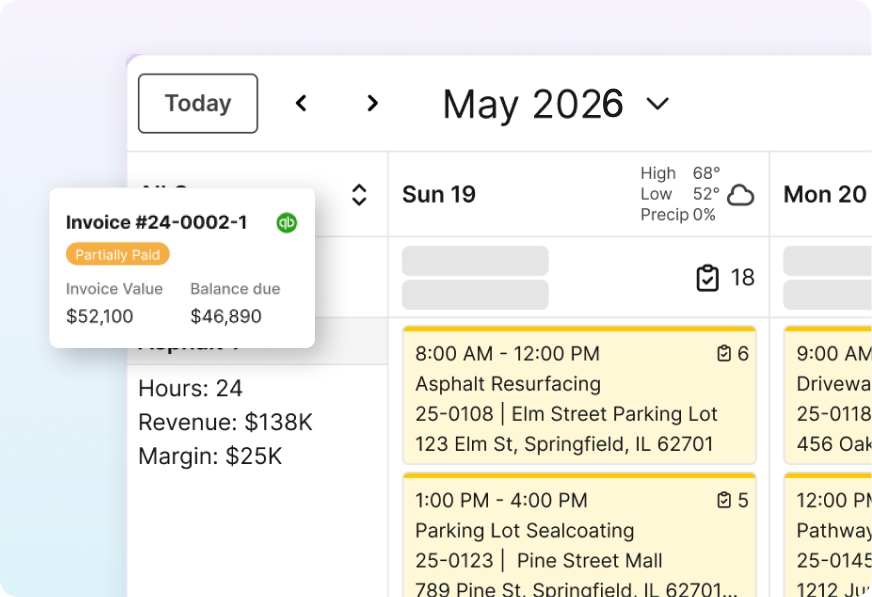
- Invoice from completed field records without double entry: OneCrew's invoicing tools generate invoices from the line items already in the platform and sync invoicing and payment data with QuickBooks Online.
When a customer asks "how long does asphalt last?", they'll hold you to the answer you give. Book a Demo to see how OneCrew ties estimating, scheduling, job site records, and invoicing together, from the first takeoff to the final maintenance cycle.
FAQs
1. How long does asphalt last on a driveway?
Asphalt lasts 20 to 25 years on a residential driveway when it's built on a solid base and gets crack sealed every few years. Driveways outlast commercial lots because passenger cars apply almost no structural load compared with delivery trucks.
2. How long does asphalt last without any maintenance?
Asphalt often lasts more than a decade without maintenance, but it gives up years it would otherwise keep. Cracks stay open, water reaches the base, and the surface moves from cosmetic distress to structural failure years ahead of schedule.
3. Can you pave new asphalt over old asphalt?
Yes, you can pave new asphalt over old asphalt with an overlay, as long as the existing base is sound and the profile allows for added thickness. Overlays generally last 10 to 15 years, and you should remove and replace any alligator cracking first because it reflects straight through new pavement.
4. How often should asphalt be sealcoated?
Most commercial lots need sealcoating every two to four years, depending on sun exposure, traffic, and surface condition. New pavement usually goes about two to five years before its first coat; climate and the quality of the original work set where it lands. Sealcoating slows UV and oxidation damage, while crack sealing keeps water out, so pairing the two does far more for lifespan than sealcoat alone.
5. What is the difference between resurfacing and replacing asphalt?
The main difference between resurfacing and replacing asphalt is how much of the structure gets rebuilt. Resurfacing mills off the top layer and places new asphalt over the existing base, while replacement removes the full depth and rebuilds the base underneath.
6. How long does a commercial parking lot last?
A commercial parking lot typically lasts 15 to 20 years, but delivery lanes and loading areas usually wear out first because they carry the heavy trucks. Lots that get regular crack sealing and sealcoating stay closer to the top of that range.
7. How long before you can drive on new asphalt?
Most crews keep cars off new asphalt for two to three days, and heavy trucks off longer, while the mat cools and stiffens. Hot weather stretches that window, so put the timing in writing at closeout.
8. What ruins asphalt fastest?
Water does the most damage, especially when it gets under the surface through open cracks or sits in low spots after rain. Heavy truck traffic, sun-driven oxidation, fuel and oil leaks, and poor compaction on paving day do the rest.