What Is Project Tracking? A Guide for Project Managers

Project tracking is the continuous process of measuring actual project progress against a defined baseline plan, covering tasks, timelines, milestones, and resources in real time. It’s the difference between knowing your paving crew is three days behind on a commercial lot and finding out when the client calls. Where project management handles planning and strategy, project tracking handles execution visibility. Core metrics include schedule variance, cost variance, milestone achievement rate, and scope completion percentage. Methods like Gantt charts, Agile sprint tracking, and Critical Path Method (CPM) each serve different project types, and the right choice depends on how predictable your work actually is.
What is project tracking and how does it work?
Project tracking works by comparing what was planned to what’s actually happening, then using that gap to make decisions. You set a baseline at the start of a project: tasks defined, timelines locked, resources assigned. From there, you measure actual performance against that baseline at regular intervals. Without a baseline, tracking only records activity. It tells you what happened, not whether you’re ahead or behind.
The process runs on a few core inputs: task completion rates, time logged against estimates, budget consumed versus budget planned, and milestone status. Agile teams add sprint velocity and burndown charts to that list. Construction managers lean harder on schedule variance and float consumption. The specific metrics shift by industry, but the underlying logic stays the same: compare actual to planned, identify the gap, and act on it.
Project tracking is also proactive signal detection, not a reporting formality. When you catch a variance early, you have options. You can reallocate a crew, compress a task, or reset a client’s expectations before a deadline passes. When you catch it late, you’re managing a crisis instead of a schedule.
How to track projects effectively: a 5-step process
Effective project tracking follows five steps, and consistency matters more than the sophistication of the tool you use.
- Define every task clearly. Break the project into specific, assignable work items. Vague tasks like “site prep” create tracking blind spots. “Grade and compact subbase on Lot 7” gives you something measurable.
- Set timelines and milestones. Attach a start date, end date, and duration to each task. Milestones mark the moments that matter most: permit approval, material delivery, first pour, final inspection. These become your checkpoints.
- Assign ownership. Every task needs one person responsible for its completion. Shared ownership means no ownership. When a task slips, you need to know exactly who to talk to.
- Update progress on a regular schedule. Weekly reviews work well for most projects. Daily check-ins make sense for high-risk phases or fast-moving Agile sprints. The update cadence should match the pace of the work, not the comfort level of the team.
- Adjust plans when reality diverges from the baseline. Tracking without adjustment is just record-keeping. When a variance appears, update the schedule, communicate the change, and document the reason. That history becomes valuable on the next project.
Pro Tip: Match your tracking frequency to project risk. A routine residential paving job might need weekly check-ins. A multi-phase commercial project with subcontractors and weather dependencies needs daily monitoring on critical tasks.
How do scheduling techniques shape your tracking approach?
The method you use to schedule a project directly determines how you track it. Three techniques dominate professional project management: CPM, PERT, and Agile.
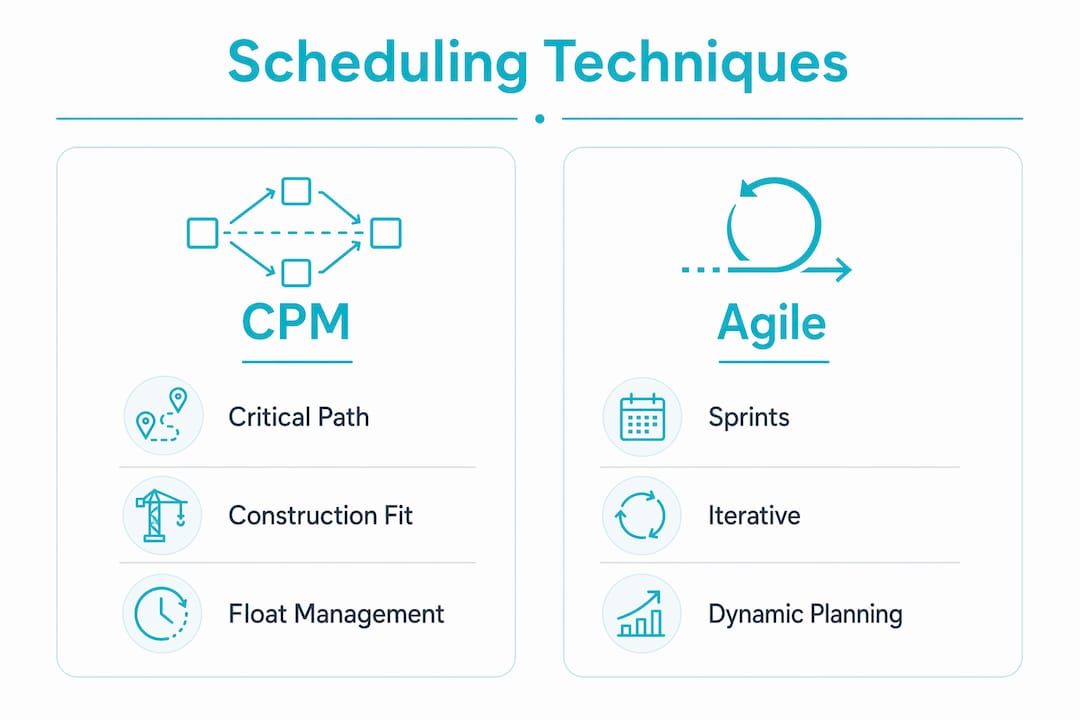
CPM identifies the critical path and float for every task in a project. The critical path is the sequence of tasks that determines the project’s minimum duration. Any delay on a critical path task delays the whole project. Float measures how much slack a non-critical task has before it becomes a problem. Construction projects almost always use CPM because the work is sequential and deterministic.
PERT (Program Evaluation and Review Technique) adds probabilistic forecasting to the mix. Instead of one duration estimate per task, PERT uses three: optimistic, most likely, and pessimistic. This suits projects where durations are genuinely uncertain, like research phases or first-time builds with unfamiliar materials.
Agile scheduling works in short, fixed iterations called sprints, typically one to four weeks. Teams plan only the current sprint in detail and revisit the broader roadmap at each cycle. This approach fits software development and product work where requirements shift frequently.
Pro Tip: Leverage float strategically by shifting crew or equipment from non-critical tasks to critical ones when delays appear. Expert managers treat float as a resource, not just a buffer.
What metrics and tools make project tracking work?
Four metrics carry the most weight in day-to-day tracking. Schedule variance tells you whether tasks are completing on time. Cost variance tells you whether you’re spending what you planned. Milestone achievement rate shows how reliably the project is hitting its key checkpoints. Scope completion percentage gives you a high-level view of overall progress.
Modern project tracking software centralizes all of this in one place, replacing fragmented spreadsheets and status emails with real-time dashboards. Look for tools that offer:
- Gantt charts for visualizing task sequences and dependencies
- Kanban boards for managing task flow in Agile or hybrid environments
- Real-time dashboards that update as field data comes in
- Automated alerts when tasks fall behind or budgets approach limits
- Mobile access so field crews can log progress without returning to the office
For construction managers, construction project management software built for field teams adds another layer: GPS-tagged updates, photo documentation, and crew-level time tracking that feeds directly into cost variance calculations.
Pro Tip: Written status updates inside your tracking tool replace most status meetings. Stakeholders get self-serve visibility, and your team spends less time preparing reports and more time doing the work.
What are the most common project tracking mistakes?
The biggest mistake is treating tracking as a periodic task rather than a continuous one. Monthly tracking cycles are too infrequent for active delivery projects. By the time a monthly review catches a problem, the window to fix it cheaply has already closed.
Three other mistakes show up repeatedly:
- Misaligned update frequency. Tracking a fast-moving Agile sprint on a weekly cycle means you’re always one sprint behind on the data. Tracking frequency must match project risk and pace.
- Data overload without prioritization. Tracking 40 metrics when five drive 90% of your decisions creates noise, not clarity. Start with schedule variance, cost variance, and milestone status.
- Parallel manual systems. When teams maintain a separate spreadsheet alongside the official tracking tool, data diverges fast. A single source of truth where actual work happens prevents duplicate entry and keeps everyone aligned.
For construction teams specifically, construction project reporting practices that integrate field data directly into the project record eliminate most of these problems at the source.
Pro Tip: Treat tracking as a continuous lifecycle process. Set it up before work starts, maintain it through every phase, and close it out with a documented record. That record is your most valuable input for estimating the next job accurately.
Key takeaways
Effective project tracking requires a defined baseline, consistent updates, and metrics that match the project type.
See how OneCrew handles tracking for field teams
If you manage paving or asphalt crews, you already know that tracking a job from the office is only half the picture. OneCrew brings scheduling, field management, and project reporting into one platform built specifically for paving contractors. Your crew logs progress from the field, your dashboard updates in real time, and your cost variance numbers stay accurate without manual reconciliation.
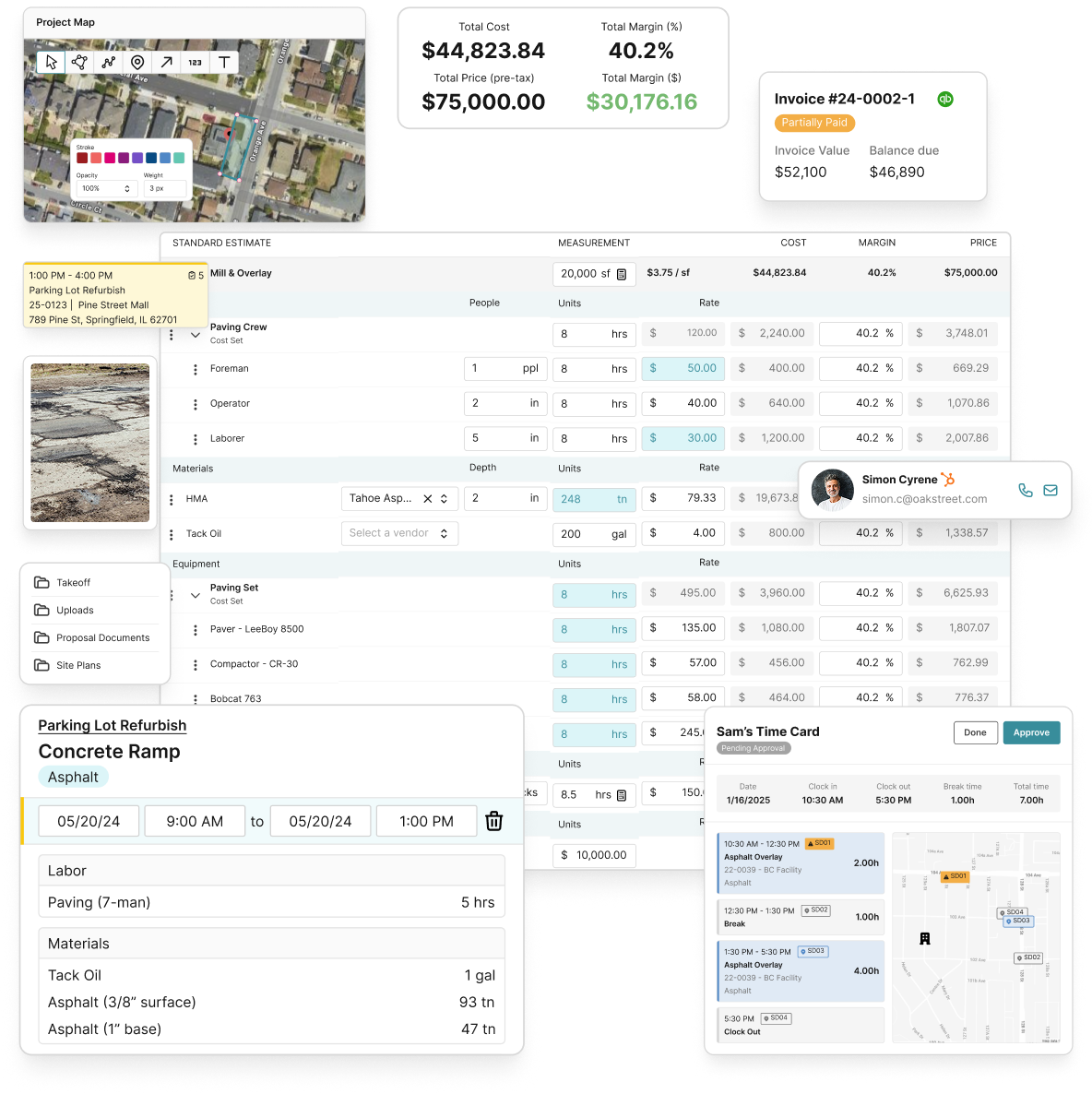
OneCrew’s mobile field management app gives crews a simple way to submit updates, photos, and time data on-site. That data flows directly into your project record, so you’re always working from current numbers. If you’re ready to replace the spreadsheets and status calls with a system that actually fits how paving work gets done, explore the OneCrew platform and book a demo.
FAQ
What is project tracking in simple terms?
Project tracking is the process of comparing actual project progress to the original plan, covering tasks, timelines, costs, and milestones. It gives project managers real-time visibility into whether a project is on schedule and within budget.
How is project tracking different from project management?
Project management covers planning, scoping, and strategy. Project tracking focuses on execution visibility, measuring what’s actually happening against what was planned and flagging variances early.
What are the most important project tracking metrics?
Schedule variance, cost variance, milestone achievement rate, and scope completion percentage are the four metrics that drive most tracking decisions. Agile teams also track sprint velocity and burndown charts.
How often should you update a project tracker?
Tracking frequency should match project risk and pace. High-risk or fast-moving projects need daily updates on critical tasks. Stable, lower-risk projects can run on weekly check-ins without losing visibility.
What tools are used for project tracking?
Project tracking tools range from Gantt chart software and Kanban boards to real-time dashboards with mobile field access. Construction-specific platforms like OneCrew add crew-level time tracking, photo documentation, and direct integration with job costing and scheduling.