Chip Seal vs. Asphalt: Cost, Lifespan, and When to Bid Each

Chip seal vs. asphalt comes down to two different jobs. Chip seal is a surface treatment that protects pavement you already have, and asphalt is the pavement itself.
Chip seal is the cheaper treatment and buys a few more years of surface life. Asphalt costs more up front and carries traffic loads for decades. Here's how price, lifespan, and application break down on a bid.
TL;DR
Chip seal sprays asphalt emulsion onto an existing surface, then locks crushed stone into that binder to create a fresh wearing course. Asphalt paving lays hot mix in courses and compacts it into a structure that carries weight.
The Minnesota Department of Transportation puts chip sealing at roughly one-fourth to one-fifth the cost of a conventional asphalt overlay, with five to seven years of added pavement life.
Key difference: Chip seal renews the surface, and asphalt renews the structure. Property owners mix these two up on walkthroughs, the same way they blur the line between pavement and asphalt.
Get that straight, and the rest of this comparison gets a lot easier to explain to a client.
Chip Seal vs. Asphalt: At a Glance
What Is Chip Seal?
Chip seal is a pavement surface treatment that combines sprayed asphalt emulsion with a layer of crushed stone rolled into the binder.
Contractors also call it seal coat, tar and chip, or bituminous surface treatment, and it sits in the same asphalt maintenance rotation as crack sealing and patching.
The process moves quickly:
- Binder: A distributor truck sprays emulsified asphalt, which is liquid asphalt cut with roughly 30% water.
- Chips: A chip spreader follows right behind with crushed gravel no larger than 3/8 inch.
- Rolling: Pneumatic rollers press the chips into the binder.
- Opening to traffic: The surface needs up to two days to cure before it takes normal traffic.
FP2 recommends chip sealing while a road is still in good condition, with only minor surface problems, so it belongs on pavement that still has life left in it.
Binder choice drives how well it holds up, and the asphalt grade you spec changes how the treatment behaves through summer heat and winter freeze cycles.
Crews also run double or triple applications directly over a base course, which turns a gravel road into a drivable paved surface for a fraction of the cost of paving it.
Counties lean on that approach when a route sees a couple dozen vehicles a day, and nobody can justify a full pavement section.
Asphalt millings fill a similar low-budget niche on private drives and lots, though they compact into a looser, less predictable surface than a properly rolled chip seal.
Chip seal belongs on roads. The same FP2 guidance covers everything from low-volume rural roads to heavily trafficked highways, but rules out rutted, potholed, or badly distressed surfaces.
County routes and rural highways use it constantly. Residential driveways and commercial parking lots rarely do.
What Is Asphalt?
Asphalt is a pavement built from hot mix asphalt: aggregate bound with asphalt cement, laid in courses and compacted to carry traffic. Thickness carries the load here, which is the whole departure from a surface treatment.
A typical build stacks three layers, and each layer spreads vehicle weight across a wider area of subgrade, so loaded trucks don't punch through:
- Compacted base
- Binder course
- Surface course
Get the depth right, and the pavement lasts a long time.
The Asphalt Pavement Alliance's Perpetual Pavement Award only recognizes pavements at least 35 years old that have gone 13 years or more between resurfacings, and winners average around 50 years of service.
Asphalt also recycles better than almost anything else on a job site. Milled material goes straight back into new mix, which is why sustainable asphalt practices cut material cost and haul-off at the same time.
Reclaimed asphalt pavement shows up in most mixes running through plants today. Plants price those mixes differently depending on how much recycled material they can work in, so get the mix price from your supplier before you quote the job.
The tradeoff is scope. An asphalt job often runs across several days and more than one crew:
- Grading and base work
- Tack coat
- Paving and compaction
- Striping
That's why paving project management on a reconstruction looks nothing like scheduling a two-day chip seal.
Chip Seal vs. Asphalt: Key Differences
Six things separate these two in the field: price, service life, structural capacity, ride quality, installation window, and repair options.
None of them settles a bid on its own, and the property in front of you usually answers the question faster than a spreadsheet will. Contractors who bid both learn to read a site quickly, and keeping estimates, costs, and field notes in one place is what keeps that read honest across a whole season.
Cost per square yard
Chip seal costs about a dollar per square yard on public road work. Indiana DOT prices it a little above $1 per square yard, against $3 to $9 per square yard for other preservation treatments and resurfacing projects.
That gap is the whole reason chip seal dominates county road budgets year after year.
Your bid isn't the material, though. Mobilization, traffic control, crack sealing beforehand, and the sweeper coming back for loose stone all land in the number, and project tracking against the original estimate is what tells you whether $1.10 per square yard held up in the field.
Asphalt pricing runs on tonnage, where small depth errors compound quickly. A screed running a hair thick doesn't feel like a problem on the job, and nobody catches it until the plant tickets come back.
A quarter inch of extra mat across a 4,000 square yard lot turns into real money, so your asphalt yield math belongs in the estimate and not in somebody's head. Build margin on measured tonnage, or an overrun eats the job.
Our free asphalt tonnage calculator turns area and depth into tons, and the asphalt labor calculator works out crew hours from the same job size.
Service life and durability
Chip seal delivers five to eight years of surface life, depending on traffic and environmental conditions, according to the Asphalt Institute. A thin hot mix overlay placed on pavement in good condition stretches much further, with 6 to 17 years of life extension, and full-depth asphalt on a sound base outlasts both.
The catch is that chip seal life drops off fast under load.
Stone works loose from the binder in wheel paths and turning areas, so a route carrying delivery trucks and school buses chews through a chip seal well before a quiet rural road does. Traffic volume usually decides when you're back out there before the calendar does.
Structural capacity
This is the difference that weighs most on a bid. Chip seal adds no structural strength. It seals minor cracks, restores texture, and slows oxidation, and it cannot rebuild a weak base or correct rutting.
Asphalt adds depth, and depth carries load. Running the asphalt thickness numbers tells you whether a lot needs a two-inch overlay or a full reconstruction.
Seal over a failing base and the callback moves to next spring.
Ride quality, noise, and loose stone
Chip seal feels different under tires. The coarse texture gives strong skid resistance, which is exactly why agencies like it on rural curves, and that same texture generates more road noise than a paved asphalt surface. Homeowners notice. Property managers notice faster.
It changes the look of the road too. Montgomery County's transportation department says a chip seal fills in slight imperfections and gives a street a uniform color and texture.
Loose chips are the operational headache. WSDOT drops posted speeds to 35 mph between spreading the gravel and sweeping the excess, because faster traffic throws rock at windshields.
The Asphalt Institute calls for power-broom sweeping within 24 hours of placement, and skipping it turns into a claims problem, which makes asphalt safety planning part of the bid and not an afterthought.
Installation window and cure time
Chip seal needs heat. The Asphalt Institute wants pavement surface temperature at 70 degrees F or higher, holding for three to five days after placement so the emulsion sets and cures properly.
In most northern states, that shrinks the practical chip seal season to June through August, which puts real pressure on scheduling.
Asphalt gives you a wider calendar and a tighter execution standard. Mat temperature, roller pattern, and pass count decide whether the pavement hits density. Solid roller operator training keeps those three consistent from one crew to the next.
Repair options after placement
Both surfaces need upkeep, and the menu looks different. On chip seal, you re-chip. Agencies reapply the treatment as many times as they need to, as long as the road underneath stays structurally sound, sometimes adding a fog seal a few weeks later to lock down whatever stone is still loose.
Asphalt hands you more tools. Crack sealing, patching, and sealcoating each target a specific failure. Patching means cutting out the damaged section, cleaning it, filling it with hot mix or cold patch, and compacting it back to grade.
Sealcoating shields the binder from UV and oxidation, and it does little against water unless you crack seal first.
When to Use Chip Seal vs. Asphalt
Use chip seal when:
- The pavement is structurally sound with only minor cracking or raveling
- Traffic stays low to moderate, without heavy trucks turning in the same spots
- The job is a rural road, county route, or highway shoulder, not a parking lot
- You need traction and a sealed surface at the lowest possible cost per square yard
- You can count on pavement temperatures at 70 degrees F or higher for several days running
Use asphalt when:
- The base, subgrade, or drainage needs correction before any surface work happens
- The surface shows rutting, potholes, alligator cracking, or wide cracks
- The site handles heavy turning movements, delivery trucks, or standing loads
- The property needs detailed striping, smooth ride quality, and a clean finished look
- The owner expects 15 years or more out of the surface
The hard calls sit in the middle, usually on a road that reads borderline structurally. Our rule: if you can't confirm the base is sound, price the asphalt.
A chip seal vs. asphalt comparison only means something when both proposals cover identical scope, and that gets much easier when your bidding tools carry the same line items across every treatment you sell.
Manage Chip Seal and Asphalt Projects With OneCrew
OneCrew is a platform built specifically for project-based asphalt and concrete paving contractors, and it covers chip seal and asphalt work side by side in one system from the first phone call to the final invoice.
Here's what OneCrew covers:
- Estimate both treatments with margin built in: OneCrew's estimating tools let you measure jobs from monthly satellite images or uploaded blueprints, auto-calculate tonnage, materials, and trucks, and set default margins so every estimate starts at your target pricing.
- Schedule the whole chip seal train without conflicts: OneCrew's scheduling feature assigns specific crew members and equipment to each job and flags double-bookings before they reach the field.
- Log field data before the crew moves on: The field management tools push mobile work orders and job specs to crew phones and pull time, production quantities, and field photos back to the office as each phase closes out.
- Get same-day signatures: OneCrew's proposals feature generates professional, branded proposals directly from your estimate.
- Keep every customer's history in one place: OneCrew's CRM tracks contacts, accounts, and job sites across projects, with property records and follow-up reminders.
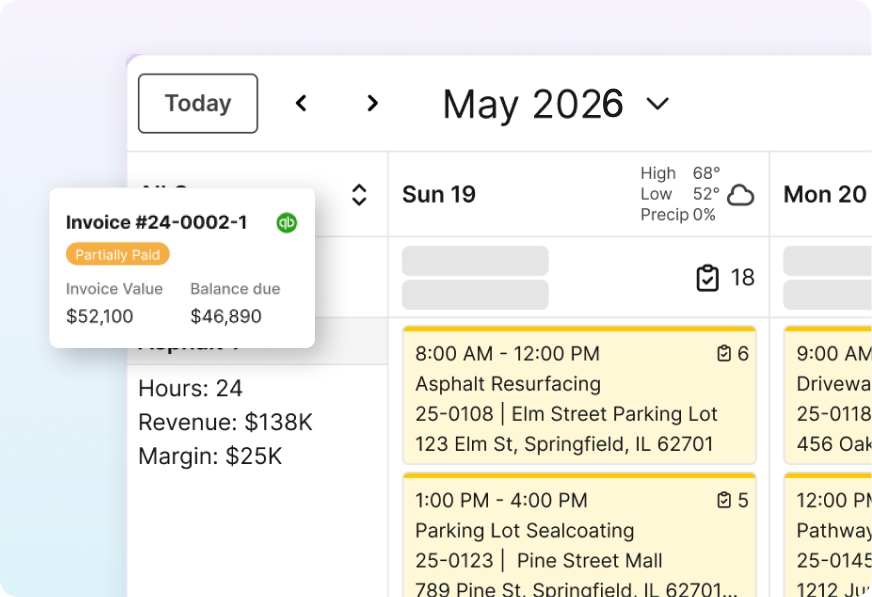
- Invoice without double entry: OneCrew's invoicing tools generate invoices from the line items already in the platform and sync invoicing and payment data with QuickBooks Online.
You need one platform that connects the estimate to the crew to the invoice so both treatments price correctly and both jobs get paid. Book a demo and see how OneCrew handles paving work from takeoff to final payment.
FAQs
1. Is chip seal (tar and chip) cheaper than asphalt?
Yes, chip seal costs far less than asphalt. Indiana DOT prices chip seal a little above $1 per square yard against $3 to $9 per square yard for other preservation and resurfacing jobs. That saving only holds when the pavement underneath is already structurally sound.
2. How long does chip seal last compared to asphalt?
Chip seal lasts five to eight years. Well-built asphalt lasts decades with periodic resurfacing, and award-winning pavements average about 50 years. Traffic drives most of that gap, since heavy and turning traffic strips stone out of a chip seal quickly.
3. Can you chip seal a commercial parking lot?
You can, but most parking lots make poor candidates.
Chip seal is built for roads and highways. Lots with carts, detailed striping, and delivery traffic usually need a designed asphalt surface.
4. Does chip seal fix cracks and potholes?
No, chip seal does not fix cracks or potholes. It seals minor surface openings and restores texture, and it adds no structural strength. Crews crack seal and patch damaged areas months ahead of a chip seal so the new surface has something solid to bond to.
5. Is chip seal the same as sealcoating?
No. Some state DOTs call a chip seal a "seal coat," but sealcoating a lot is a different job.
Chip seal sprays asphalt binder and embeds crushed stone to create a new wearing surface, and sealcoating applies a thin coating that shields the existing binder from UV and oxidation. Sealcoat does little against water unless you crack seal first.