Asphalt Milling Machines: Contractor Buyer's Guide for 2026

Most paving contractors should choose a compact or mid-size asphalt milling machine from brands like Wirtgen, Caterpillar, Roadtec, or BOMAG. New compact and mid-size machines typically cost $250,000 to $500,000.
In this guide, learn more about top manufacturers, machine types, pricing, and whether buying or renting makes sense for your crew.
Asphalt Milling Machine: Quick Comparison
Note: Prices reflect approximate new machine ranges. Actual pricing varies by configuration, dealer location, and market conditions. Contact your local dealer for quotes.
How I Researched These Asphalt Milling Machines
I compared spec sheets, dealer listings, and real-world contractor use cases across top cold planer manufacturers to find out which machines perform best on each type of paving job.
In my research, I focused on:
- Model range: How many size classes each manufacturer covers, from small rear-loaders to full-lane machines
- Drum technology: Interchangeability, cutting patterns, and tooth systems that affect milling quality
- Operator experience: Cab comfort, control layout, and sight lines that impact daily productivity
- Service access: Dealer network density, parts availability, and diagnostic capabilities
- Resale value: How well each brand holds its value on the secondary market
This approach helped me identify the clear strengths of each manufacturer, so you can match the right asphalt milling machine to the work your crew actually does.
3 Types of Asphalt Milling Machines by Size
Your milling machine size directly affects your costs, transport, and productivity. Here’s how the three main types compare:
1. Small asphalt milling machines (rear-loaders)
Milling width: 1–3 ft | Engine power: 60–250 HP | Weight: 10,000–30,000 lbs
Small asphalt milling machines work best for parking lots, utility cuts, and tight spaces like driveways. You can usually trailer them behind a standard truck.
- Best for: Patch milling, utility trenching, small commercial lots, and shoulder work. If your crew handles maintenance and repair work on parking lots and local roads, a small asphalt milling machine covers most of what you'll need.
- Models to look at: Wirtgen W 35 Ri, Wirtgen W 50 Ri, BOMAG BM 500/15, Roadtec RX-100
2. Compact (mid-size) asphalt milling machines
Milling width: 3–5 ft | Engine power: 300–500 HP | Weight: 30,000–55,000 lbs
Compact asphalt milling machines handle most commercial and municipal jobs. They generally run on tracks and load material from the front, so your trucks can stage ahead of the machine, not behind it.
- Best for: Medium and large parking lots, subdivision streets, airport taxiways, and municipal road rehab. If you're doing a mix of commercial overlay and smaller road jobs, this class of asphalt milling machine gives you the most flexibility.
- Models to look at: Wirtgen W 100 Fi, Wirtgen W 120 Fi, Caterpillar PM312, BOMAG BM 1000/30, Roadtec RX-300
3. Large (half-lane and full-lane) asphalt milling machines
Milling width: 6–12+ ft | Engine power: 500–1,000+ HP | Weight: 55,000–100,000+ lbs
Large asphalt milling machines are built for highway and high-volume road work. Dual engines, high-capacity conveyors, and advanced-grade control systems make them productive, but they carry serious transport and mobilization costs.
If you understand how to calculate asphalt thickness before milling, you can set the right cut depth and avoid removing more material than the job requires.
- Best for: Highway resurfacing, Department of Transportation (DOT) contracts, airport runways, and any job where you're milling thousands of tons per day.
If you're not consistently landing jobs that justify the operating cost, renting the machine or subbing out the milling work makes more sense.
- Models to look at: Wirtgen W 200 Fi, Wirtgen W 210 XF, Caterpillar PM620/PM622, Caterpillar PM822, Roadtec RX-505, Roadtec RX-700, BOMAG BM 2000/65
1. Wirtgen: Best for Full-Service Paving Contractors Who Need Every Size Class Covered
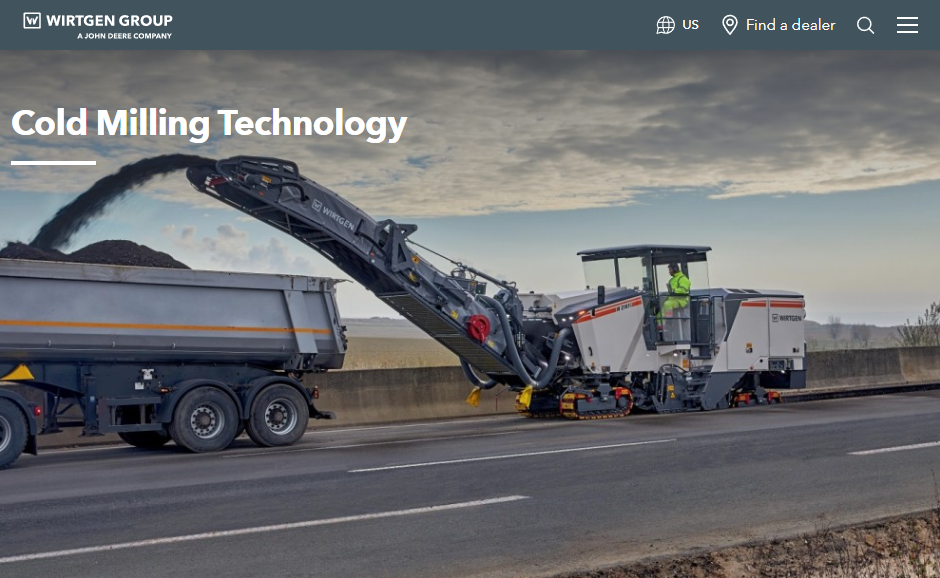
What it does: Wirtgen manufactures the widest range of cold milling machines in the industry, from 14-inch rear-loaders to 14-foot, full-lane machines.
Best for: Paving contractors running multiple crew sizes across different project types.
Key features
- HT22 PLUS toolholder system: Higher wear resistance and a longer service life reduce pick replacement frequency and lower per-ton operating costs
- Flexible drum options: ECO cutters, fine milling drums, and standard drums swap in and out for different job requirements.
- Level Pro Plus grade control: This includes an automatic leveling system with sonic averaging and slope sensors, so you get precise depth and cross-slope accuracy.
Pros
- Largest model range in the industry
- Strong resale value backed by the Wirtgen Group dealer network
- Best-in-class drum technology, with the HT22 PLUS toolholder
Cons
- Pricing is premium across the board.
- Parts can be expensive, and lead times vary by dealer location.
- Smaller dealers may not stock Wirtgen-specific components locally.
Pricing
Wirtgen doesn't publish list prices. New machines may range from roughly $200,000 for a compact W 100 Fi to well over $1 million for a fully equipped W 250 XF.
Used W 100 models start around $80,000 to $150,000, depending on hours and condition. Used W 200 machines with 3,000–5,000 hours typically list between $200,000 and $500,000 on PavingEquipment.com and MachineryTrader.
Bottom line
If you want the widest selection of asphalt milling machines from one manufacturer, and you don't mind paying a premium for it, Wirtgen is the standard. You'll get better resale value when it's time to trade up, and their drum technology is hard to beat.
Smaller contractors who only mill occasionally should look at the more budget-friendly options below.
2. Caterpillar: Best for Contractors Who Rely on Dealer Service and Fleet Management
What it does: Caterpillar builds mid-size and large cold planers, with a strong emphasis on operator comfort, remote diagnostics, and service accessibility. It stands out for its dealer network, service support, and fleet management tools.
Best for: Paving contractors who already run Cat equipment and want one dealer relationship for their entire fleet.
Key features
- Cat Remote Services: Remote diagnostics and over-the-air software updates reduce downtime without pulling machines off the job.
- VisionLink Productivity: Track machine hours, location, fuel consumption, and maintenance alerts, and delivers near real-time jobsite productivity data for the PM620, PM622, PM820, PM822, and PM825.
- 2025 updated operator station: This includes movable grade-control mounts, flush-mounted control panels, and improved sight lines.
Pros
- Unmatched dealer and parts network across North America
- Remote diagnostics and software updates to keep the machine running between service intervals
- Strong financing and rental options through Cat Financial and The Cat Rental Store
Cons
- Smaller model range than Wirtgen (no small rear-loader class)
- Less drum variety, compared with Wirtgen and Roadtec
- Can be more expensive to purchase than Roadtec or BOMAG for similar specs
Pricing
Cat doesn't publish pricing for cold planers. New half-lane models (PM620/PM622) typically run $400,000 to $600,000+. Full-lane models (PM822/PM825) exceed $800,000, depending on configuration.
Used cold planers are available through Cat Used and dealer listings on MachineryTrader. A 2020 PM-822 with low hours recently listed around $580,000 on MachineryTrader.
You can also rent Cat cold planers through The Cat Rental Store at daily, weekly, or monthly rates. Call 1-800-RENT-CAT for current availability and pricing.
Bottom line
I'd recommend Cat milling machines for contractors who already have Cat equipment and value fast service above everything else.
The machines perform well, the 2025 updates are meaningful, and the dealer network is unbeatable. But if you need smaller asphalt milling machines for parking lot and patch work, look at Wirtgen or BOMAG instead, since Cat doesn't play in that space.
3. Roadtec (Astec): Best for Contractors Who Need Drum Flexibility and American-Made Machines
What it does: Roadtec, part of Astec Industries, manufactures cold planers in the small, compact, and full-lane size classes.
Best for: Paving contractors who handle multiple cut widths and want to swap drum configurations without changing the entire housing.
Key features
- Variable cutter system (VCS): Available on select machines, the VCS lets you change cutting width by switching drums within the same housing.
- ACE grade and slope automation: The automated cut control system has Guardian telematics for remote monitoring.
- Rear object detection: This safety system stops the cold planer if it detects a person or object behind it in reverse. On busy job sites, this feature matters more than you'd think. For more on keeping crews safe around heavy equipment, check out this asphalt safety guide.
Pros
- VCS system saves thousands on drum changes for contractors doing varied work
- Manufactured in the United States, with domestic parts support
- Strong Guardian telematics platform for remote fleet monitoring
Cons
- The dealer network is smaller than that of Cat or Wirtgen.
- The RX-100 is Roadtec's only small or utility-class machine, so contractors who need multiple options for tight-space work have fewer choices than with Wirtgen.
- The resale value doesn't hold as well as Wirtgen’s in most markets.
Pricing
New half-lane models like the RX-505 (610 HP) typically list between $400,000 and $600,000. The RX-700 (800 HP) ranges from $500,000 to $700,000+, depending on drum configuration and options. A 2020 RX-505E was recently listed at $529,900 on ConstructionEquipmentGuide.com.
Used RX-700 models with higher hours can be found for $50,000 to $200,000. Lower-hour examples list closer to $275,000 on MachineryTrader.
Bottom line
Roadtec is a strong pick for paving contractors who need one asphalt milling machine that can handle multiple cut widths.
The VCS system is a genuine differentiator. But if you're mostly doing highway work at a single width, the VCS advantage shrinks, and you're better off comparing against Cat and Wirtgen on a spec-for-spec basis.
4. BOMAG: Best for Mid-Size Commercial Paving Contractors

What it does: BOMAG builds compact rear-loaders to large half-lane milling machines, with an emphasis on quick-change drum technology and low operating costs.
Best for: Commercial paving contractors who need a reliable, mid-range asphalt milling machine without the premium pricing of Wirtgen.
Key features
- Quick-change milling drums: Swap drum configurations faster than competitors, reducing downtime between different applications.
- Accessible service points: Engine hoods open to expose the entire service area, and all maintenance points are grouped for fast access.
- Extended warranty options: Up to 60 months of protection are available on new machines.
Pros
- Competitive pricing, especially in the compact class
- Quick-change drums, limiting downtime
- Lower vibration levels at the operator station, compared with several competitors
Cons
- The North American dealer network is smaller than Cat’s or Wirtgen’s.
- Less market share means fewer used options are on the secondary market.
- Parts availability can lag in some regions.
Pricing
BOMAG doesn't publish list prices for cold planers. New compact models (BM 500/15, BM 600/15-2) typically start around $150,000 to $250,000.
Mid-size models (BM 1000/30, BM 1300/30) range from $250,000 to $450,000. Large models (BM 2000/65, BM 2200/75) can exceed $700,000.
On the used market, a 2023 BM 2000/65 with 800 hours was priced at about $455,000. Contact your local BOMAG dealer for current pricing and demo availability.
Bottom line
BOMAG is a smart choice for commercial paving contractors who want a solid asphalt milling machine without paying the premium.
Their compact models are especially competitive. But if you need a massive dealer support network or plan to resell the machine within a few years, Wirtgen or Cat hold value better.
5. Dynapac: Best for Smaller Contractors Entering the Milling Market

What it does: Dynapac (part of Fayat Group) manufactures compact and mid-size cold planers, with a focus on affordability and ease of operation.
Best for: Smaller paving contractors adding milling capability for the first time, or crews that do milling as a secondary service. Dynapac provides the most affordable entry point into the asphalt milling machine market.
Key features
- Compact footprint: Easy to trailer and maneuver on tight commercial sites
- Adjustable cutting depth: From about 100 mm on compact models up to 320 mm on mid-size and large planers
- Lower fuel consumption: Smaller engines, so lower daily operating costs on light-duty milling
Pros
- Most affordable entry point on the asphalt milling machine market
- Simple controls, so reduced training time
- Good option for contractors who mill occasionally, rather than as a core service
Cons
- No large or half-lane machines
- Smaller dealer and parts network in North America, compared to the competitors above
- Lower resale value and fewer used machines available
Pricing
Dynapac doesn't publish its cold planer pricing. New compact models generally start between $100,000 and $250,000. Mid-size models reach $300,000 to $400,000.
Fewer used Dynapac cold planers appear on major dealer sites, compared to Wirtgen or Cat. For current pricing, visit Dynapac's dealer locator or contact Fayat Group directly.
Bottom line
Dynapac works for contractors who want an affordable asphalt milling machine to complement their paving operation. It won't compete with Wirtgen or Cat on large highway jobs, but for commercial lot work and small road repairs, it delivers.
If you're planning to grow into bigger milling contracts, start with a more established brand that holds resale value better.
Asphalt Milling Machine Costs: What to Actually Expect
Most asphalt milling machines cost between $100,000 and $1 million, depending on the size and configuration. Here’s a breakdown:
Don't forget these ongoing expenses:
- Cutting teeth and toolholders: A full set of carbide teeth for a half‑lane drum runs about $3,000–$8,000. On abrasive work, you may change teeth multiple times a day. On light asphalt, a set can last several days.
- Conveyor belts: Replacement belts cost $2,000 to over $5,000, depending on the machine’s size.
- Annual maintenance: Budget $5,000–$20,000 per year for scheduled service, filters, and hydraulic fluid.
- Transport: Large asphalt milling machines require lowboy trailers and permits for oversize loads. Mobilization costs of $1,000 to $5,000+ per move eat into margins fast.
If you're pricing milling work into paving proposals, asphalt bidding tools can help you build accurate estimates that account for equipment, labor, and material costs. This works best when you track job costing correctly.
Should You Buy or Rent an Asphalt Milling Machine?
The short answer is to buy an asphalt milling machine if you use it regularly. Rent if you only need it occasionally. Here are a few more factors to help you decide:
When buying makes sense
Buy an asphalt milling machine if you're milling at least 3–4 days per week during your busy season. This way, the per-day cost of ownership drops below rental rates, and you build equity in an asset that holds value for 5–10 years.
Owning also gives you scheduling control. During peak season, you won’t need to wait for a rental unit while other contractors compete for the same machines.
When renting makes sense
Rent if you mill fewer than 30–40 days per year, or if you're testing whether milling work is worth adding to your service line.
Asphalt milling machine rental rates typically run $3,000–$6,000+ per day for a Wirtgen 120 or 200, with the operator included, according to Milling Services. The Cat Rental Store offers daily, weekly, and monthly rates, as well.
Renting eliminates maintenance costs, storage requirements, and capital outlay. It's the lower-risk way to take on milling jobs without committing six figures to a machine you'll only use a few times a year.
The hybrid approach
Some contractors own a small or compact asphalt milling machine for their regular commercial work and rent a large machine for the occasional highway or DOT job. This keeps your fixed costs low while still letting you bid on bigger contracts.
How to Choose the Right Asphalt Milling Machine for Your Crew
To pick the right machine, match it to the work you actually do, not what you hope to do someday. Here are the questions that matter:
What's your typical project size?
If most of your work involves driveways and small commercial sites, a small asphalt milling machine may be all you'll need. These are easier to transport, cheaper to operate, and faster to mobilize.
If you're regularly bidding on road and highway contracts, you'll need a half-lane or larger machine to stay competitive on production rates.
How often will you mill?
- Daily or weekly milling: Buy a machine. The numbers work in your favor at high utilization, and you control your own schedule.
- Monthly or a few times per season: Rent or sub out the milling. Owning equipment that sits idle 80% of the time is expensive.
What's your transport situation?
Small asphalt milling machines can ride on a standard trailer behind a truck. Large cold planers need a lowboy, a tractor, and oversize permits in most states. If you don't already have heavy hauling capability, factor that into the total cost.
Do you have trained operators?
An experienced asphalt milling machine operator makes a real difference in surface quality and production speed. If you're buying your first cold planer, budget for operator training.
Most manufacturers offer it through their dealer networks. The same principle applies to roller operator training and other heavy equipment on your crew: training pays for itself in fewer mistakes and faster production.
What's your drum situation?
Different jobs call for different drum configurations. Standard drums work for most milling applications. Fine milling drums produce a smoother surface texture for thin overlays. ECO cutters use fewer teeth at wider spacing to reduce fuel consumption on heavy removal work.
If you do varied work, look at machines that let you swap cutting widths without changing the entire drum assembly. Managing specs, site plans, and project files across crews also becomes easier with proper documentation systems.
Manage Your Asphalt Milling Jobs from Estimate to Invoice with OneCrew
OneCrew was built for project-based paving contractors, whether they're running asphalt milling machines, pavers, rollers, or all three. It replaces the patchwork of spreadsheets, whiteboards, and disconnected apps that slow down your operation.
Here's what you can do with OneCrew:
- Estimate from PDFs or satellite maps, with built-in calculators and configurable cost automations: Factor your milling machine costs, operator hours, cutting tooth consumption, fuel, and mobilization fees into every bid.
- Schedule crews and assign roles to specific job phases, with clear accountability: Assign your milling crew to morning removal and your paving crew to the afternoon overlay, all in one schedule.
- Track leads and customer relationships from first call through repeat business: Every inquiry, conversation, quote, and project history lives in one system.
- Build and send proposals through a customer portal where clients can review, approve, and sign: Turn your finished estimates into polished, branded proposals that include scope, equipment allocation, and pricing in one document.
- Keep field crews connected to job details, schedules, and real-time updates from the office: Field management tools put site information, milling specs, and daily assignments on your crews' phones.
- Invoice and collect payment without double-entry or chasing paperwork: Generate invoices from completed work orders with line items pulled directly from your original estimate, including equipment charges and mobilization fees.
You only need one platform to manage your asphalt milling machine crews. Book a free demo and see how OneCrew helps paving contractors take control of every job, from the first estimate to the latest payment.
FAQs
1. What is an asphalt milling machine used for?
An asphalt milling machine removes the surface layer of asphalt pavement using a rotating drum with carbide cutting teeth. The removed material, reclaimed pavement, gets recycled into new asphalt mixes.
2. How much does an asphalt milling machine cost?
A new, mid-size asphalt milling machine typically costs $250,000 to $500,000. Small or compact models start around $100,000 to $250,000 new, while large half-lane and full-lane machines can exceed $1 million.
3. Should I buy or rent an asphalt milling machine?
Buy a machine if you're milling at least 3–4 days per week during the busy season. Rent if you mill fewer than 30–40 days per year.
Rental rates for mid-size cold planers start around $3,000 to $6,000 per day with an operator included. Renting eliminates maintenance costs and capital outlay for occasional users.
4. What’s the difference between a cold planer and an asphalt milling machine?
There's no real difference between a cold planer and an asphalt milling machine. "Cold milling machine" is another common name. Contractors and manufacturers use these terms interchangeably.
5. Which asphalt milling machine brand is best?
Wirtgen leads the market in model variety, drum technology, and resale value. Caterpillar offers the strongest dealer and service network. Roadtec stands out for drum flexibility, while BOMAG provides competitive pricing in the compact class.