
RFP Templates for Construction: How to Prepare & Win

A construction RFP (Request for Proposal) is a formal document a property owner, developer, or general contractor sends out to invite bids on a project.
An RFP lays out the scope, timeline, requirements, and evaluation criteria, and asks qualified contractors to submit a written proposal explaining how they'd handle the work and what it'll cost.
This guide walks through how to prepare for, respond to, and actually win construction RFPs, with RFP templates and a step-by-step process you can use on your very next bid.
Construction RFP Templates You Can Adapt
The point of using RFP templates is to start every response with a proven structure, so you're not reinventing the wheel each time. Here's a simple framework that works for most paving contractor RFPs:
- Cover Letter Template: Project name, your company info, response date, contact person, one-paragraph value statement.
- Executive Summary Template: Three short paragraphs covering who you are, why you're a fit, and what makes your approach different.
- Scope of Work Template: Mirror the RFP's scope structure with your specific deliverables under each item.
- Schedule Template: Phase-by-phase timeline, ideally as a Gantt-style table.
- Team Bio Template: Standardized one-page bios for key personnel, kept current and ready to drop in.
- Safety Plan Template: A reusable framework you customize per project with site-specific risks and mitigations.
- Pricing Sheet Template: Line-item breakdown by labor, material, equipment, and subcontractor costs.
- References Template: A clean one-pager with project name, year, scope, value, and contact details.
- Compliance Checklist: A list of every required form, certificate, and signature in the RFP, ticked off before you submit.
Build these once. Update them once a quarter. Then on your next bid, you're plugging in project-specific details instead of starting from a blank page. Good RFP templates can cut your response time in half without lowering your quality.
RFPs in Construction: Stop Sending Boilerplate
When you respond to a construction RFP, send researched, customized bids. Owners want to see your approach, your team, your safety record, and your understanding of their specific project, not a generic boilerplate. The contractors who treat RFPs like a sales pitch win more of them.
That matters because RFPs show up across every part of construction: commercial paving, parking lot reconstruction, road maintenance, site work, concrete pours, and pretty much anywhere a buyer wants to compare two or more contractors before signing a contract.
For paving contractors, they're most common in public works, large commercial property portfolios, and HOA or property management work, where the owner is required to collect multiple bids.
RFP vs. RFQ vs. RFI: The Real Differences
These three acronyms get thrown around like they mean the same thing, but they don't. Here's a quick breakdown:
If you're a paving contractor, you'll see all three. RFPs are usually the most involved and the most worth your time, since they're tied to the biggest contracts.
When to Respond to an RFP (and When to Walk Away)
Not every RFP is worth your time. Some are wired for an incumbent contractor, some have unrealistic budgets, and some come with so many requirements that the cost of bidding eats your margin even if you win.
A study cited by Loopio found that 81% of top-performing proposal teams use a formal go/no-go process before committing resources to an RFP. That's not a coincidence. Here's a simple version you can use:
- Is the scope inside your wheelhouse? A commercial parking lot rebuild is very different from a 20-mile DOT roadway. Bid where you actually have a track record.
- Is the timeline realistic? If you can't put a serious response together in the time given, that's a sign the RFP isn't for you.
- Is the budget visible (or guessable)? If the buyer's expected price is way below your real cost, no amount of writing will save it.
If two or more of these are red flags, walk away. Bidding selectively is one of the cleanest ways to raise your win rate, and it frees up your estimating team to put more effort into the bids you can actually win.
Tools like dedicated asphalt bidding software can help you triage faster and decide where your time should go.
How to Respond to a Construction RFP (Step-by-Step)
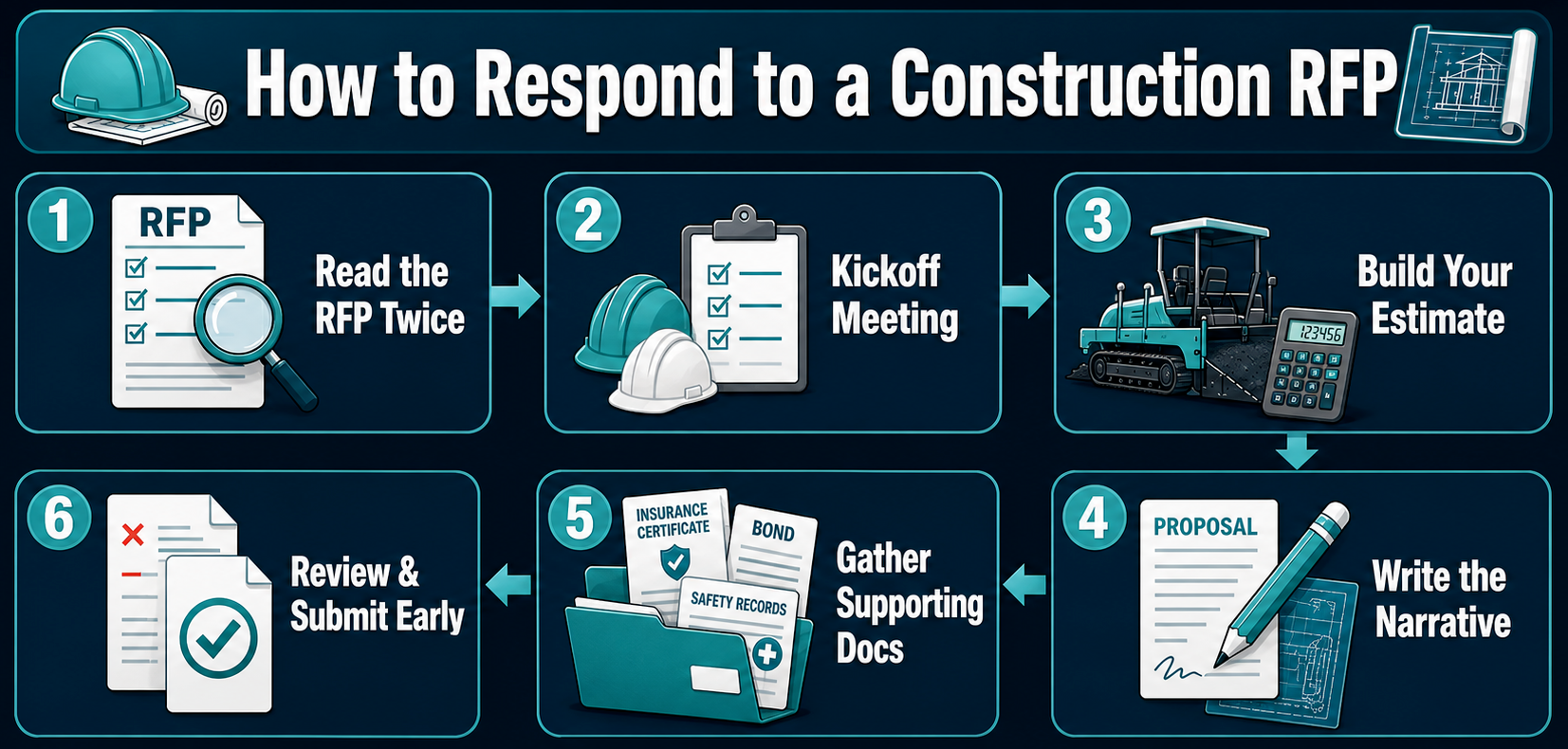
Once you've decided an RFP is worth pursuing, here's the process the best paving contractors follow.
Step 1: Read the RFP twice (yes, twice)
The first read is to get the lay of the land. The second is to mark every requirement, deadline, submission rule, and evaluation criterion. Owners reject proposals all the time for missing one specific document or skipping a required form. Do not skip this step.
Step 2: Hold a kickoff meeting
Pull in your estimator, project manager, safety lead, and whoever owns the customer relationship. Twenty minutes is enough. Goal: assign owners to each piece of the response so nothing falls through the cracks.
Step 3: Build your estimate
This is where most of your time goes. Whether you're estimating asphalt by the ton, square yard, or lane mile, your numbers have to be defensible.
If your math is shaky here, the rest of the proposal can't save you. Knowing how to calculate asphalt yield and asphalt thickness for your specific mix and project conditions is non-negotiable.
A quick note on pricing: build your number from your true cost plus a healthy margin. Don't try to back into a price by slapping on a markup. Margin-based pricing is more honest, easier to defend, and protects you when material or labor costs shift mid-project.
Step 4: Write the proposal narrative
This is where contractors lose. The narrative is there to show the owner you understand their specific project and have a credible plan to deliver it. Keep it specific. Reference their site, their constraints, and their timeline. Generic copy gets generic results.
Step 5: Pull together your supporting documents
Insurance certificates, bonding letters, references, safety records, equipment lists, key personnel resumes: all the stuff buyers ask for, and most contractors slap together at the last minute. Keep a digital folder with your latest versions, so you're not scrambling.
Step 6: Review, then submit early
Have someone who didn't write the proposal read it cold. They'll catch typos, missing pages, and weak claims faster than the writer will. Submit at least a few hours before deadline. Servers go down. Emails bounce. Don't risk it.
What Goes into a Winning Construction RFP Response?
Your RFP response must include a cover letter, your understanding of the project, the exact scope of work, schedule, team members’ details, your safety record, price (detailed quote), and references.
Your RFP templates should be built around these:
Cover letter
One page. State the project name, confirm you're submitting a full response, name your point of contact, and briefly say why you're a good fit. Don't ramble.
Project understanding
Show the owner you actually read the RFP. Summarize the project in your own words, call out the critical constraints (traffic control, weather window, environmental requirements), and explain how your approach addresses them.
Scope of work
Lay out exactly what you'll do, in the same order the owner asked for it. If they bullet-pointed scope items, mirror their structure. This makes side-by-side evaluation easy for the buyer, which works in your favor.
Schedule and phasing
A realistic timeline with milestones. If the project is phased (mill, base, binder, surface, striping), break each phase out with start and finish dates. Vague schedules are an instant credibility killer.
Team and qualifications
Who's running the job? Include resumes for your project manager and superintendent at minimum.
Add notes on certifications and ongoing training, like roller operator training and equipment-specific credentials. Buyers want to know experienced humans are in charge, not anonymous "crews."
Safety record and approach
Public sector and commercial buyers care about safety, both because of liability and because it correlates with quality work.
Include your EMR, recent OSHA history, and a short summary of your safety program. If you have specific asphalt safety protocols for hot-mix handling, traffic control, or compaction, call them out.
Pricing
Detailed, line-itemed, and tied to your scope. Lump-sum numbers without breakdowns make buyers nervous. Show your work.
References
Three to five recent, relevant projects. Same job type, similar size, ideally similar geography. Include the buyer's contact info.
6 Common Mistakes Contractors Make on Construction RFPs
A few patterns come up over and over:
- Treating every RFP the same: The proposal has to feel tailored to the project. Recycled language is obvious to evaluators.
- Missing required documents: A single missing certificate of insurance can disqualify your entire bid.
- Underestimating the schedule: Aggressive timelines win the bid and lose the project. Be realistic.
- Skipping the proposal narrative: Submitting a price with no explanation tells the owner you don't really care about their project.
- Bidding from markup instead of margin: Markup math hides your real profit and creates pricing that crumbles when costs shift.
- Waiting until the last minute: Rushed proposals look rushed. Owners notice.
Win More Bids with OneCrew
OneCrew is built for project-based paving contractors (asphalt and concrete) who want to respond to more RFPs without burning out their estimating team. It replaces the patchwork of spreadsheets and disconnected programs that slow you down.
Here's what you can do with OneCrew:
- Estimate from PDF plan takeoffs or satellite maps with built-in calculators and configurable cost automations: Set up your labor rates, costs, equipment charges, and sub-line items once, and the system applies them across every RFP response.
- Track leads and customer relationships from first RFP through repeat contracts: Every inquiry, quote, and project history lives in one system. When a property manager issues a new RFP for a lot you paved two years ago, you pull up the full record instantly.
- Build and send proposals through a customer portal where clients can review, approve, and sign: Turn your RFP-ready estimates into polished, branded proposals that include scope, phasing, timeline, and line-item pricing in one document.
- Schedule crews and assign roles to specific job phases once the bid is won: Your estimate feeds directly into scheduling, so the phase-by-phase timeline you proposed in the RFP becomes the actual crew plan without re-entering data.
- Keep field crews connected to job details, schedules, and real-time updates from the office: Field management tools put site information, material specs, and daily assignments on your crews' phones.
- Invoice and collect payment without double-entry or chasing paperwork: Generate invoices from completed work orders with line items pulled directly from your original estimate.
You only need one platform to manage your bidding process. Book a free demo and see how OneCrew helps you win more paving projects with faster, more accurate RFP responses.
FAQs
1. What is an RFP in construction?
An RFP in construction is a formal document that a buyer (owner, developer, or general contractor) issues to invite qualified contractors to submit a written proposal for a project. It includes the project scope, timeline, requirements, and evaluation criteria, and asks contractors to explain their approach and pricing.
2. What's the difference between an RFP and an RFQ?
The main difference between an RFP and an RFQ is depth. An RFP asks for a full proposal covering approach, team, schedule, and price, while an RFQ only asks for a price quote on a clearly defined scope. RFPs are typical for larger or more complex paving projects. RFQs work for smaller, well-defined jobs.
3. How long does it take to respond to a construction RFP?
A typical construction RFP response takes 25 to 60 hours of work spread across estimating, writing, and document gathering. Industry benchmarks put the average at around 25 hours, but complex public works projects often run much higher. Using prebuilt RFP templates and reusable estimating data is the fastest way to cut that time down.
4. Are RFP templates worth using for every construction bid?
Yes, RFP templates are worth using for almost every bid because they save time, reduce errors, and keep your responses consistent. The trick is to use them as a starting structure, not a copy-paste shortcut. Every proposal still needs project-specific scope, schedule, and pricing details to actually compete.
5. How can paving contractors improve their RFP win rate?
Paving contractors can improve their RFP win rate by being selective about which bids they pursue, building relationships with buyers before RFPs come out, using consistent RFP templates to speed up responses, and tailoring each proposal to the specific project. Tracking your win rate by project type and customer also reveals where to invest your estimating time.

.png)