Parking Lot Maintenance Schedule: 7 Tasks, Season by Season

A parking lot maintenance schedule decides whether a lot reaches its design life or needs reconstruction years early. Lots rarely fail all at once.
They fail quietly: a hairline crack in year three, a soft spot by the dumpster pad in year five, then a pothole that opens the same week a property manager walks a client through.
We built this plan around the intervals paving contractors work to and the temperature windows that control what you can put down and when. Here's the full year, season by season, plus the repairs that pile up when a season gets skipped.
Parking Lot Maintenance Schedule: TL;DR
- Seven recurring tasks, one table: the schedule below shows how often each job comes around and when in the year it fits best.
- Match each job to the weather: crack seal in spring and fall, sealcoat and stripe in summer, and finish hot mix before the plants close.
- Keep water out of the base: sealcoat guards against sun damage, while sealed cracks and clear drains stop the water that starts potholes.
- Budget line by line: price each task by unit cost and frequency, and build 2026's asphalt and diesel price swings into multi-year contracts.
- Know when to stop patching: widespread base failure means reclamation or reconstruction.
What a Parking Lot Maintenance Schedule Covers
A parking lot maintenance schedule sets the interval for every recurring task on a paved lot. Seven items carry most of the weight, and each one runs on its own clock:
Treat those numbers as your starting point. A grocery lot in Phoenix wears out differently from a medical office lot in Cleveland, so traffic counts, freeze-thaw exposure, and the original pavement section all shift the dates.
What matters is that the dates live somewhere other than your head, and a written checklist beats a memory every time.
Why Timing Drives the Whole Parking Lot Maintenance Schedule
Pavement holds up nicely for years, then drops off a cliff. Over the first 75 percent of its life, condition falls by about 40 percent, and the next 40 percent drop takes only another 12 percent of that life.
A dollar spent while the lot still rates fair can save five dollars compared with waiting until it rates very poor.
That curve explains how a lot can look acceptable and still be an emergency. The early tells are easy to spot once you know them: color fading from black to gray, fine aggregate loosening under your boot (raveling), hairline cracks starting to spall at the edges.
PennDOT's local roads program tells agencies to watch newly resurfaced pavement and plan on sealing within three to five years, while the first cracks are still forming. A five-year-old lot with no crack seal history has already lost ground, even when it still looks fine from the office window.
Spring: Inspect, Clean, and Fix What Winter Broke
Spring sets up the rest of the year. Whatever you miss in April gets priced into a bigger repair in September, and property managers remember which contractor caught it.
Walk the lot and score what you find
Start with a written inventory: crack widths, potholes, raveling, standing water after rain, faded markings, spalled concrete at curbs and pads. Photograph each distress with its location noted, because owners approve work faster when they can see the problem.
Portfolio clients rate every lot with a pavement condition index so the budget follows the worst pavement first. A repeatable paving project checklist also keeps two estimators from scoring the same lot two different ways.
Clear debris before you go looking for damage
Blowers, brooms, and wire brushes do the cleaning on asphalt. Pressure washing drives water into the pavement, which works against everything else on your list. Sweep the perimeter and islands where grit piles up over winter, then pull the grates and see what settled in the catch basins.
EPA lists parking lot sweeping as a stormwater practice that can cut the sediment, trash, and trace metals reaching storm drains, and it asks private lot owners to coordinate with municipal staff to limit what their lots discharge.
Prep like this belongs inside the job it serves, and smart contractors bill it that way.
Repair potholes and localized failures
Patching fills potholes and damaged areas with hot mix asphalt, cold patch material, or a specialized repair product.
Crews clean the hole, square up the broken edges, fill it, and compact it. Those square edges matter more than most owners expect, since a feathered edge fails again at the first freeze.
Infrared patching reheats and reworks the existing surface for a bonded repair without a saw cut, which suits shallow surface failures well. Material choice follows the calendar: hot mix gives you the strongest repair when plants are running, and cold patch holds the line once they close and a pothole becomes a liability.
Deeper failures need excavation down to a stable base, and no product on the market covers for skipping that step. Compaction decides the result, so size the roller to the patch and get your passes in before the mix cools. Under-compacted patches ravel at the edges within months, and the owner reads that as a failed repair.
Seal cracks while the weather stays cool
Crack sealing belongs in spring and fall. Minnesota's 2023 crack treatment guide times it there because of thermal movement, with the pavement at 40°F and rising. Cracks sit near the middle of their working range in those seasons, so the sealant doesn't have to stretch or squeeze as hard once July and January arrive.
NCAT's Pavement Preservation Group study found crack-sealed sections deteriorated more slowly than untreated sections that started in similar shape, and that the benefit depends on traffic, climate, and the pavement's existing condition. Hour for hour, it's the best money on the schedule.
Summer: Sealcoating, Striping, and Heavy Repairs
Summer is production season. Plants are running, sealer cures, paint dries, and the big-ticket items land between June and September.
Sealcoat in the right window, for the right reason
Sealcoating protects asphalt from UV degradation and oxidation, the process that turns a black lot gray and brittle. On its own, it does little against water, so seal the cracks first or moisture keeps reaching the base through them.
Selling it on that basis sets honest expectations: a sealcoat every two to four years buys surface protection and a sharp look, and crack sealing handles the water.
Pick a sealer your jurisdiction allows
Two families dominate: coal tar and asphalt emulsion. USGS research found polycyclic aromatic hydrocarbon (PAH) levels in urban streambed sediment significantly higher in regions where coal-tar sealcoat is commonly used.
Minnesota has banned the sale and use of coal tar-based sealants since 2014, after a state study traced 67% of the PAHs in 15 metro-area stormwater ponds back to them.
Washington state, New York, Maryland, Maine, Virginia, and the District of Columbia have their own restrictions, and so do a number of cities. Virginia's goes furthest: since July 1, 2025, no one can apply a pavement sealant above 1% PAH by weight, coal tar or not.
Check the state and the municipality before you bid, because a banned product on your spec sheet kills a job after award.
Restripe and re-run the ADA math
Restriping carries a compliance obligation with it. DOJ's guidance is direct: when a business restripes a lot, it has to provide accessible parking spaces that meet the 2010 ADA Standards. Counts run per facility, so each lot or garage on a site is calculated on its own.
One of every six accessible spaces, and always at least one, has to be van accessible.
Car spaces run 96 inches wide minimum with a 60-inch access aisle; van spaces need 132 inches with a 60-inch aisle or 96 inches with a 96-inch aisle, and signs mount with the bottom at least 60 inches above the ground. Contractors who quote paint alone tend to eat the difference later.
Handle the repairs that outgrew patching
Some areas stop responding to patching. Alligator cracking across a drive lane, ruts at a dumpster approach, or a soft spot that pumps water after rain all point to a failed base. Those need full-depth repair before anything goes on top of them, and once the failures spread across a section, the base itself has to be reclaimed or rebuilt.
Milling takes the distressed surface off at a controlled depth and protects your grades and drainage, and the milling machine you bring decides how much production you get in a day. Overlays placed over unaddressed base failures crack through within a season or two, and the owner blames the overlay.
Fall: Close the Season and Get Ahead of Freeze-Thaw
Fall gives you the second crack sealing window and your last shot at hot mix.
Ohio DOT's construction specifications set 40°F air temperature as the floor for surface courses (32°F with a chemical warm-mix additive) and 50°F for polymer-modified mixes, which aren't scheduled after November 1 without the project engineer's approval, a fair proxy for when your paving season closes.
Seal cracks and clean drains before the first freeze
Moisture that reaches the base freezes, expands, and lifts the pavement, and that's how a 1/4-inch crack becomes a pothole over one winter. Get the crack seal done, clean every catch basin and trench drain, and regrade the low spots that hold water after a storm.
Stack the fall schedule early
Every property manager wants their work finished before Thanksgiving, so October fills up fast. Sequence the lots so the hot mix work lands early, and the crack seal follows before winter sets in, then confirm plant closing dates before you promise anything.
Managing several projects at once in a compressed window is exactly where margin leaks, since a crew waiting on a mobilization costs the same as a crew paving.
Winter: Snow, Salt, and Selling Next Season
Winter work protects the lot you built and fills next year's calendar:
Plow without breaking your own work
Set blade heights and mark the obstacles before the first storm: catch basins, curbs, wheel stops, islands, and ADA signage.
Plow damage shows up as gouged asphalt, sheared curb faces, and torn markings, and it happens in the same handful of spots year after year. Walk those areas with the snow contractor in November, and you avoid an awkward conversation in March.
Watch what goes down as deicer
Chlorides speed up damage on both surfaces. New concrete is the strict case: the Michigan Concrete Association says to skip deicing chemicals for the first winter and use sand for traction, and never to use products with calcium or magnesium chloride after that.
On asphalt, brine works into open cracks and freeze-thaw cycling does the rest, which is one more argument for closing cracks in the fall.
Sell the plan while nobody is paving
Asphalt work stops when it gets cold, and that's when owners finally have time to talk.
Bring a written parking lot maintenance schedule for next season with dates, scopes, and a budget number, and you'll book the plan before competitors start cold calling in April. Consistency is what sells it when you're building 20 of these proposals in a month, and OneCrew shows which owners have opened theirs, so you know where to follow up first.
Adjusting the Parking Lot Maintenance Schedule by Lot Type
Retail, grocery, and restaurant lots
Constant turnover, tight turning movements, and heavy delivery traffic beat up entrances and drive aisles. Sweep weekly, inspect twice a year, and expect sealcoat cycles at the short end of the range. Drive lanes and loading zones wear out well before the parking stalls do, which makes zone-by-zone pricing an easy way to show an owner where the money should go.
Industrial, distribution, and truck lots
Loaded trucks concentrate stress at gates, dock approaches, and turning radii. Those areas often call for concrete, since asphalt ruts under standing loads. Inspect quarterly and budget for full-depth repairs, because a surface treatment can't fix a base problem under an 80,000-pound truck.
Office, medical, and low-traffic lots
Light traffic means sunlight and water do most of the damage here. UV oxidation drives the calendar, so sealcoating and crack sealing carry more weight than structural repair.
Appearance also matters more to these owners, which makes clean striping and sharp edges an easier sell here than anywhere else.
Concrete curbs, pads, and ADA ramps
Nearly every asphalt lot has concrete in it: curbs, gutters, sidewalks, dumpster pads, and accessible ramps. Inspect joints and joint sealant every year, look for spalling and scaling once winter ends, and check ramp slopes whenever you restripe.
Concrete runs on its own repair cycle, and pricing it as an afterthought on an asphalt bid is how contractors lose money on maintenance contracts.
How Much a Parking Lot Maintenance Schedule Costs
An owner's yearly budget comes down to a short list of line items: the quantity of each task times its unit price, spread across how often the task comes around. Caltrans' 2026 treatment-selection guide frames it as cost per year of life, the unit cost of a treatment divided by how long it lasts.
At $0.18 per square foot on a three-year cycle, sealcoating works out to about 6 cents per square foot per year, a number you can line up directly against an annual crack seal.
Every price comes from a public agency's own 2026 bid records: cities, counties, school districts, and a state agency buying parking lot work, plus two Massachusetts street contracts for infrared patching.
Public contracts buy in bulk, so use them as a reference point when you price a single commercial lot. Your own crew hours decide where you land inside those ranges, and our free asphalt labor calculator works them out from the job's size, crew, and production rate before you lock in a unit price.
Those prices are moving. Virginia DOT's asphalt index sits at $753.13 a ton for October 2026, up about a quarter from $598.75 a year earlier, and EIA put the national diesel average at $6.28 a gallon for the week of October 19, $2.66 more than a year before.
On a multi-year maintenance contract, write in a binder or fuel adjustment, or shorten how long each quote stays valid.
Owners who manage whole portfolios sometimes budget by a rule of thumb instead. APPA, an association of facilities professionals, cites a guideline of 2 to 4 percent of current replacement value a year for routine maintenance and capital renewal across a large inventory of buildings. For a single lot, the line-item budget gives you a number to defend task by task.
When Preservation Stops Paying
Preservation buys time on structurally sound pavement. Once the base fails across a section, sealing and patching become recurring costs with no return, and the owner starts questioning every invoice.
Chip seal comes up in these conversations too, and it's worth being clear that chip seal belongs mostly on highways and rural roads; commercial lots stay with crack seal, sealcoat, patching, and overlays.
The honest conversation covers three paths: keep preserving, mill and overlay, or reconstruct.
Put real numbers on all three across a five-year horizon so the owner can see the crossover point, and run the overlay through our free asphalt tonnage calculator to firm up the material line. Price the work on margin, since maintenance contracts run thin enough that a percent or two decides whether the work is worth taking.
Knowing the Schedule Is the Easy Part
OneCrew is a platform built specifically for commercial asphalt and concrete paving contractors who run repeat maintenance work alongside new construction, and it keeps every lot, every cycle, and every crew assignment connected from the first site visit to the final invoice.
Here's what OneCrew covers:
- Maintenance quotes in less time: OneCrew's estimating tools let you build estimates from site measurements or PDF plan takeoff with configurable calculators for labor, materials, equipment, and subs.
- Crew calendars that flag conflicts: OneCrew's scheduling feature assigns crews and roles to specific job phases so your office and field stay aligned when six lots have to close out before the plant shuts down in November.
- Progress from every lot: The field management tools push mobile work orders, job specs, and GPS directions to crew phones and pull time, daily actuals, and job-site photos back to the office as each lot closes out.
- Owner sign-off from any device: OneCrew's proposals feature generates professional, branded proposals directly from your estimate.
- Each property's history: OneCrew's CRM tracks every property manager, past treatment, and project record in one place.
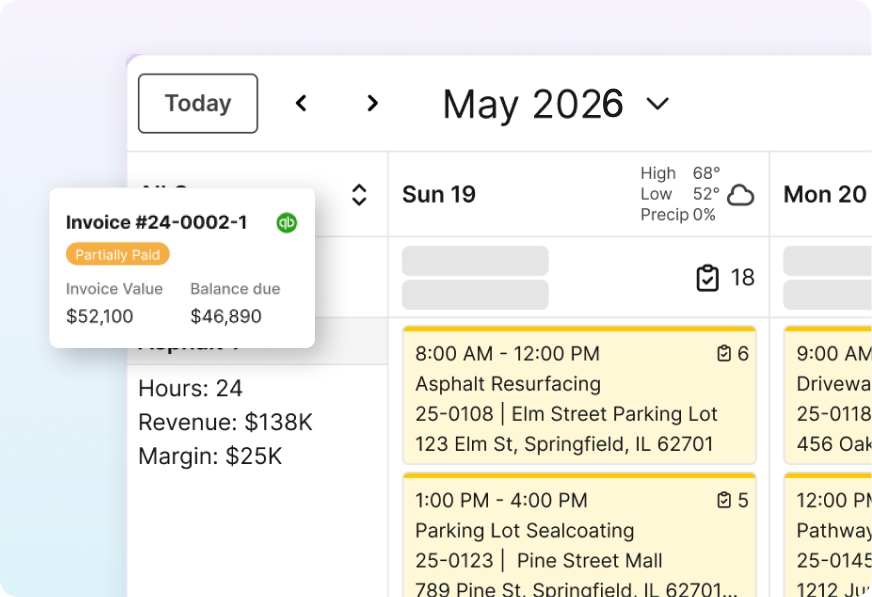
- Faster billing: OneCrew's invoicing tools generate invoices from the line items already in the platform and sync invoicing and payment data with QuickBooks Online.
Seat-based pricing keeps the platform sized to your team, and we walk through the numbers together. Book a Demo and see how OneCrew runs a full parking lot maintenance schedule, from takeoff to final invoice.
FAQs
1. How often should a parking lot be sealcoated?
Most commercial parking lots get sealcoated every two to four years. Traffic, sun exposure, and the condition of the last coat set the exact interval. Have the cracks sealed beforehand, since sealcoat shields the surface from UV oxidation and the crack sealant keeps water out of the base.
2. When is the best time of year to sealcoat and stripe a parking lot?
Sealcoat and stripe from late spring through early fall, when warm surfaces let the material cure properly. Crack sealing fits the cooler shoulder seasons, once the pavement is at least 40°F and rising. That's why spring and fall handle crack work, and summer handles sealer and paint.
3. How long does an asphalt parking lot last?
An asphalt parking lot typically lasts 15 to 20 years. Pavement loses about 40 percent of its condition over the first 75 percent of its life, then deteriorates quickly. The crack sealing and patching done in years three through eight decide whether the lot makes it to year 20.
4. How often should a parking lot be restriped?
Most parking lots need restriping every one to three years, sooner on high-traffic lots. Visibility is the practical trigger: once drivers can't read the stalls at night or in the rain, the lot needs paint. Restriping also brings ADA requirements into play, so recount the accessible spaces before the crew mobilizes.
5. How much does parking lot maintenance cost?
Routine work costs a dollar or less per foot in 2026 public bids. Sealcoating ran $0.14 to $0.22 per square foot, and crack sealing $0.40 to $1.00 per linear foot. A 2-inch mill and overlay ran $25 to $33 per square yard, and full reconstruction $40 to $68. Those are bulk prices, so check them against your crew costs.
6. How long should new asphalt cure before sealcoating?
Give new asphalt at least 30 days before its first sealcoat. Check the sealer's label, since Crafco calls for 90 days in hot weather. Before sealing, pour water on the surface: if it beads or leaves an oil ring, the surface oils haven't dissipated, and the lot needs more time.