Construction Management Checklist for Asphalt Paving Leads

Running an asphalt paving project without a construction management checklist is like paving without a grade stake: you might finish, but nothing will sit right. Between coordinating equipment, confirming mix temperatures, managing subcontractors, pulling permits, and keeping clients updated, a single missed step can trigger costly rework or payment disputes. A well-built construction project checklist does more than keep you organized; it becomes your crew’s shared source of truth from mobilization to final invoice. This guide breaks down the essential components, quality control requirements, closeout steps, and format choices that make the difference between a project that runs clean and one that bleeds time and money.
Key Takeaways
Key criteria for an effective construction management checklist
A checklist is only as good as its structure. For asphalt paving projects, vague to-do lists don’t cut it. You need a checklist that mirrors how your projects actually move.
A phase-based checklist covering planning, pre-construction, procurement, quality-control checkpoints, progress tracking, and closeout documentation ensures teams don’t miss critical deliverables at any stage. That’s the baseline. Here’s what separates a functional checklist from one that actually gets used in the field:
- Assign ownership for every item. Each task needs a name attached: superintendent, quality control manager, project engineer, or crew lead. Shared responsibility means no responsibility.
- Include milestone dates and percent-complete fields. A task marked “done” with no date tells you nothing. Adding target dates creates schedule visibility you can actually manage.
- Attach documentation requirements. For asphalt paving, that means compaction test reports, delivery tickets, inspection logs, and permit approvals tied directly to the checklist item.
- Separate proactive tasks from reactive punch list items. Your pre-pour or pre-pave checklist is proactive. Your punch list is corrective. Mixing the two creates confusion about what’s a standard step and what’s a deficiency to fix.
When you review asphalt paving contract essentials before mobilization, you’ll often find contract-specific requirements that need to live inside your checklist, not in a separate binder nobody reads.
Here’s a quick overview of the six core phases every asphalt paving checklist should cover:
- Planning and initiation: Scope confirmation, permit applications, stakeholder approvals, site surveys
- Pre-construction: Subgrade inspection, utility locates, equipment readiness, material submittals
- Procurement: Mix design approval, supplier qualifications, delivery scheduling
- Quality-control checkpoints: Temperature logging, compaction testing, thickness verification
- Progress tracking: Daily production reports, milestone confirmations, schedule updates
- Closeout documentation: Final inspection, as-built records, warranties, lien waivers, final payment
Must-have checklist items for asphalt paving quality control and compliance
Quality on an asphalt job isn’t subjective. There are hard numbers to hit, and your checklist needs to reflect them.
Practical QC/QA checklist items for asphalt paving consistently include subgrade compaction verification, mix temperature monitoring, density targets, and surface thickness and regularity checks. Missing any one of these isn’t just a quality problem; it’s a liability problem. Here are the non-negotiables:
- Subgrade strength and compaction: Verify bearing capacity and compaction before any base or surface material goes down. A weak subgrade creates premature failures regardless of how good your mix is.
- Mix temperature at delivery and laydown: Use infrared thermometers to track temperature throughout paving. The target range is 275 to 325°F. Material arriving below spec needs to be rejected on the spot, not documented after the fact.
- Compaction density: Target 92 to 96% of maximum density. Use nuclear density gauge readings at regular intervals and log every result. Familiarize your crew with asphalt compaction basics to reduce variance between operators.
- Layer thickness: Core samples or measurement during paving confirm you’re hitting spec. Thin lifts fail early, and no amount of documentation fixes a bad core result.
- Surface smoothness and regularity: Especially critical on roadways and parking lots with drainage grades. Check against your project’s tolerance spec.
- Field testing and lab certifications: Schedule certified lab tests and log them with dates and results in your checklist, not in a separate spreadsheet.
Understanding the full range of asphalt testing methods available helps you choose the right verification approach for each phase.
Real-time data logging apps that connect field measurements directly to your checklist catch defects within the paving window when they’re still fixable. Waiting until end-of-day reports is how rework costs build up.
Building an organized punch list and closeout checklist for smooth project completion
A large share of project overruns happen in the final stretch of the job. That’s where discipline matters most, and most teams are already mentally on to the next project.
Closeout is a structured process that spans punch list completion, inspections, and financial closeout and it cannot be treated as an afterthought. Here’s how to execute it:
- Start your punch list at 85 to 90% completion. Don’t wait for the final walkthrough. Identify surface defects, drainage issues, and incomplete striping while your crew is still on site.
- Verify every corrective item meets spec before signing off. Patched areas need to meet the same compaction and surface requirements as the original work.
- Schedule final inspections and obtain permit closeout. For contracts that require it, this often includes a formal certificate of substantial completion.
- Compile all project documentation. As-built drawings, mix design records, test reports, warranties, and any required O&M materials go into a single turnover package.
- Submit final payment applications with lien waivers. Financial closeout doesn’t happen until every subcontractor and supplier confirms payment received.
Review asphalt paving closeout tips to build a repeatable closeout workflow your team can execute consistently on every job.
Comparing checklist options: digital tools versus traditional templates for asphalt paving
Understanding checklist content is one side of the coin. Choosing the right format ensures your team actually follows through.
Role-specific checklists reduce variability by turning proven practices into repeatable actions for plant operators, paving crews, roller operators, and inspectors. That principle applies whether you’re using a spreadsheet or a field app.
Traditional paper or Excel templates still work well on smaller jobs or where cell coverage is unreliable. The real gap shows up on multi-crew projects where version drift, illegible handwriting, and lost forms create disputes over what was actually checked and when.
Situational recommendations: tailoring your construction management checklist for asphalt paving projects
No two paving jobs are identical, and neither should your checklist be.
Adapting your checklist to contract requirements and delivery methods, whether design-build, construction management, or design-bid-build, is a recognized best practice in project management. Here’s how to make that practical:
- Start with a base template covering all six phases, then layer in project-specific requirements such as local permit conditions, owner-specific reporting formats, or applicable agency standards…
- Design-build projects need extra checkpoints. Add design review approvals, owner sign-offs on mix designs, and value engineering confirmations as distinct checklist items. These often get treated as informal conversations that leave no paper trail.
- Higher-rigor contracts require elevated documentation. On jobs with stricter oversight, increase field testing frequency, add third-party inspection sign-off fields, and document everything in writing. Audit exposure on these projects is real and penalties are significant.
- Include post-construction maintenance planning. Your pavement condition assessment guide checklist shouldn’t start two years after handoff. Build the first condition check into your project closeout package.
- Update your base template after every major project. Lessons learned after closeout should feed directly back into the checklist. A static template is a checklist that’s slowly becoming obsolete.
Why traditional checklist thinking isn’t enough for asphalt paving success
Here’s the uncomfortable truth most project managers won’t say out loud: most checklists stop at project handoff, which is precisely when the pavement starts aging.
High performance after construction depends on shifting from reactive problem response to preventive and predictive operations practices. That means the data your field crew captures during construction, density readings, temperature logs, thickness records, should flow directly into the maintenance workflow. Not sit in a job file that nobody opens again.
When your crews log compaction results digitally during paving, that same data becomes the baseline for your first pavement condition assessment. It tells your client when to expect the first crack seal cycle. It protects you when a failure claim comes in three years later. A well-executed asphalt maintenance guide builds on construction-phase documentation, not instead of it.
The checklist isn’t a compliance form. It’s the foundation of a client relationship that extends well past final payment.
Streamline your construction management with OneCrew’s all-in-one platform
Now that you know what great checklists look like, here’s how OneCrew helps you put them into action on every project.
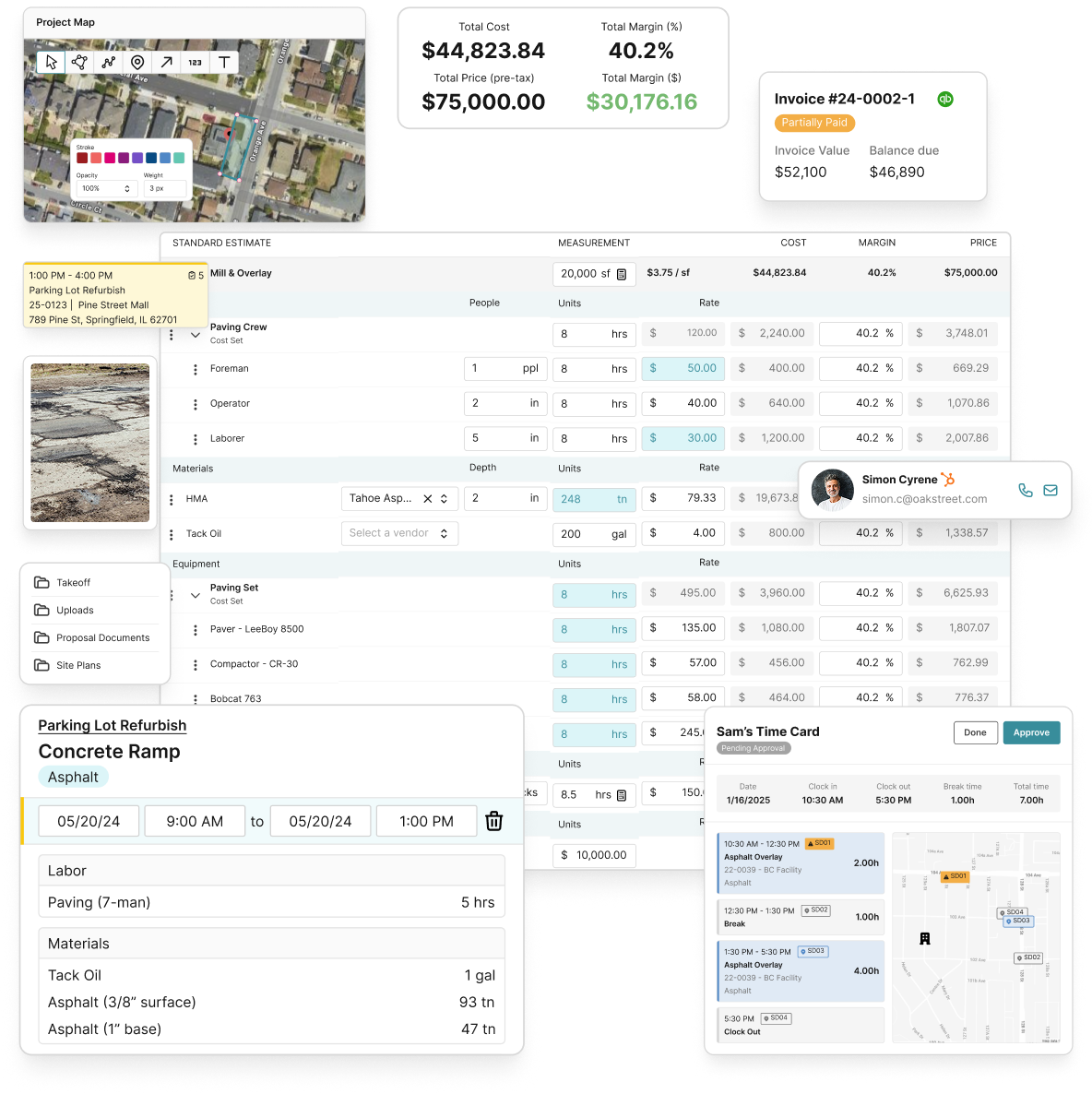
OneCrew is built specifically for asphalt paving and paving-related contractors in North America. The platform connects your paving estimating software with field management, scheduling, and invoicing in one place, so your checklist milestones line up directly with bids and progress payments. Your crews use the mobile field management app to log QC data, capture signatures, and close out tasks in real time, no paper trails, no transcription errors. From the first estimate to the final lien waiver, the OneCrew all-in-one platform turns your construction management checklist from a static document into a live project record your whole team works from. Book a demo to see it on your next project.
Frequently asked questions
What is the difference between a construction management checklist and a punch list?
A construction management checklist is a preventive tool that tracks required tasks across all project phases, while a punch list is corrective and focuses on identifying and resolving deficiencies before the owner accepts the completed work.
What documents are essential in the construction closeout package?
A complete closeout package includes punch list confirmation, certificate of substantial completion, final inspection reports, as-built drawings, O&M manuals, warranties, lien waivers, and the final application for payment.
Can digital checklists really improve asphalt paving project outcomes?
Yes. Digital checklists reduce variability by making best practices repeatable and role-specific, while real-time updates and mandatory field captures ensure QA/QC steps are consistently documented, resulting in fewer defects and less rework.