Asphalt Rollers: 6 Top Brands Compared for Paving Contractors

After testing and researching spec sheets, dealer networks, and real contractor feedback across six major brands, BOMAG and CAT came out on top.
BOMAG is great for its intelligent compaction technology, and CAT wins for its unmatched dealer network that keeps machines running when downtime isn't an option. Here's how all six brands stack up and how to pick the right asphalt rollers for your crew.
6 Best Asphalt Roller Brands: Quick Comparison
How I Researched These Asphalt Roller Brands
I spent time comparing manufacturer spec sheets, dealer network coverage, and machine performance data across these six brands to see how each one holds up on commercial and municipal jobs. So, I looked at:
- Model range: How well each brand covers the full spectrum of paving work, from driveways to highway projects
- Compaction technology: Whether the brand offers intelligent compaction features that reduce guesswork and improve consistency
- Dealer and service support: How quickly a contractor can get parts and technicians when a machine goes down mid-job
- Specialty features: Oscillation, split drums, and other technology that give certain brands an edge on specific job types
This research helped me see which brands actually deliver across different paving operations, not just which ones have the best marketing.
1. BOMAG: Best for Intelligent Compaction Across All Job Sizes

BOMAG is a German manufacturer with one of the deepest asphalt roller lineups in the industry. Its tandem vibratory models (BW Series) range from light 1.5-ton machines for small patch jobs up to 15+ ton units for highway work.
Best for: Contractors who want technology-assisted compaction that reduces operator guesswork, especially crews training newer rollers.
What stands out is BOMAG's Asphalt Manager system. It automatically adjusts vibration amplitude and frequency based on mat stiffness, which takes a lot of the guesswork out of compaction.
That's especially valuable for newer operators who are still learning how paving schedules and seasons affect material behavior.
Key features
- Asphalt Manager system: Auto-adjusts vibration settings based on real-time mat stiffness readings, so operators spend less time dialing in settings and more time compacting
- Wide model range (BW Series): The BW 120 AD-5 (approximately 5,950 lb or 2,700 kg) handles driveways and patches, the BW 174 AP-5 AM covers mid-range commercial work, and the BW 190 AD-5 AM takes on highway-scale projects
- Combination roller options: Models like the BW 174 AP-5 AM pair a vibratory drum with pneumatic tires, giving you breakdown and finish rolling capability in one machine
BOMAG pros
- Asphalt Manager removes compaction guesswork and shortens the learning curve for new operators
- One of the widest model lineups available, covering everything from 1.5-ton utility rollers to 15+ ton highway machines
- Solid parts and service support across most of North America
BOMAG cons
- Dealer availability in rural areas can mean longer wait times for specialized components
- Asphalt Manager-equipped models cost more upfront than comparable machines without intelligent compaction
Bottom line
BOMAG is the pick for contractors who want intelligent compaction technology across a wide range of job sizes.
If your crew handles everything from patchwork to highway projects and you're training newer operators, the Asphalt Manager system pays for itself in consistency and reduced rework. If dealer proximity matters more than technology, CAT might be a better fit.
2. Caterpillar (CAT): Best for Uptime and Service Network

CAT builds its tandem vibratory asphalt rollers (CB Series) with the same durability philosophy as its earthmoving machines. It pairs that with the strongest dealer and service infrastructure in the industry.
Best for: Contractors who can't afford scheduling delays and need the fastest possible parts and service response when a roller goes down mid-project.
If a roller breaks down on a job site, CAT can usually get parts and a technician to you faster than any other brand. For paving contractors running tight schedules during the busy season, that uptime advantage is worth the premium.
Key features
- Compaction Measurement Value (CMV): Gives operators real-time feedback on compaction progress, helping crews reduce over-compaction and optimize pass counts
- Broad CB Series lineup: The CB2.7 (5,936 lb or 2,698 kg) handles small to mid-size jobs, the CB10 (22,500 lb) covers commercial paving, and the CB13/CB15 take on highway-scale compaction
- Industry-leading dealer network: More service locations across North America than any competitor, which translates to faster turnaround on parts and repairs
CAT pros
- Fastest parts and service access in the industry, thanks to the largest dealer network
- CMV compaction data helps optimize pass counts and provides documentation for agency-required quality assurance
- Machines built for durability and long service life
CAT cons
- Higher purchase price compared to brands like Sakai or Wacker Neuson for similar-sized machines
- CMV is useful but not as automated as BOMAG's Asphalt Manager (operators still need to interpret the data and adjust settings)
Bottom line
CAT is the right choice if uptime and service response time are your top priorities. You'll pay more upfront, but the dealer network means less downtime when something breaks.
If you're more focused on compaction technology than service speed, BOMAG's Asphalt Manager offers more automated intelligence.
3. Sakai: Best for Oscillation Technology and Low Operating Costs
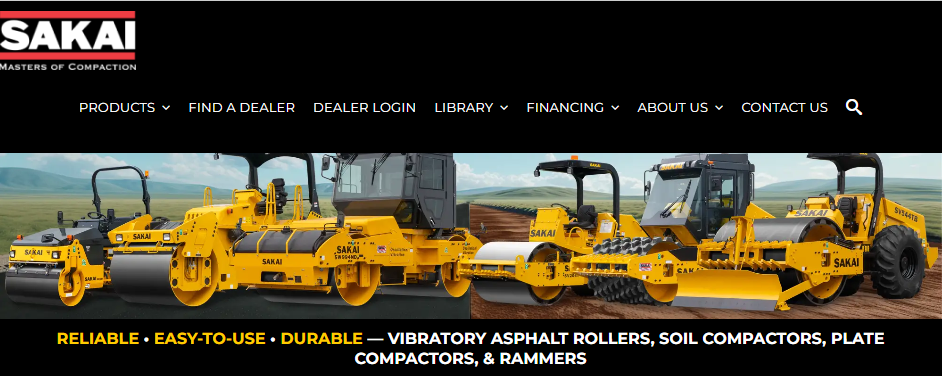
Sakai is a Japanese manufacturer that's earned a strong reputation among paving contractors who value precision engineering and long machine life. It isn't as flashy as CAT or BOMAG, but its asphalt rollers are well-built and hold up.
Best for: Contractors working near bridges, utilities, or sensitive structures where traditional vibration could cause damage, and crews that prioritize low fuel and maintenance costs.
Sakai's SW series rollers are known for excellent drum geometry and smooth compaction patterns. Its machines tend to run more fuel-efficiently and carry lower maintenance costs than similarly sized rollers from competing brands.
Key features
- Oscillation technology: Available on several models, oscillation compacts by rapidly rocking the drum forward and backward instead of bouncing it up and down. This creates compaction without the impact vibration, which is critical on bridge decks, over utilities, or near sensitive structures
- SW Series range: The SW354 handles utility work and tight spaces (47" drum, ~6,745 lb), the SW654 is a mid-range tandem with oscillation capability, and the SW884 (79" drum, 28,415 lb) covers highway-class projects
- Fuel-efficient operation: Lower fuel consumption and maintenance costs compared to similarly sized machines from other brands
Sakai pros
- Oscillation technology lets you compact near bridges, utilities, and sensitive structures without causing vibration damage
- Lower fuel consumption and maintenance costs than most competitors in the same weight class
- Excellent drum geometry produces smooth, consistent compaction patterns
Sakai cons
- Smaller brand presence in North America means fewer dealer locations and potentially longer waits for parts in some regions
- Less name recognition can affect resale value compared to CAT or BOMAG
Bottom line
Sakai is the smart pick if you regularly work near sensitive structures or want to minimize operating costs over the life of the machine.
Its oscillation technology is a genuine differentiator that no amount of vibration adjustment on a traditional roller can replicate. If dealer proximity and fast service matter more, CAT or BOMAG will serve you better.
4. Hamm (Wirtgen Group): Best for Highway Projects With Complex Geometries
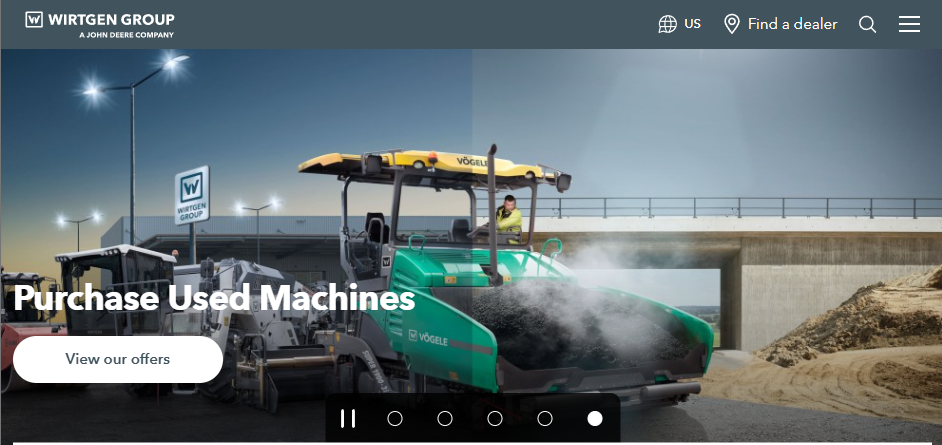
Hamm is part of the Wirtgen Group (which also includes Vogele pavers and Kleemann crushers). Its asphalt rollers, particularly the HD+ and DV+ series, are common on highway projects across North America.
Best for: Highway and large commercial paving, especially on projects with curves and irregular geometries where standard rollers struggle to maintain mat quality.
What sets Hamm apart is its split-drum option. On equipped models, the front drum divides into two halves that move independently. This helps maintain mat quality on curves and keeps crews aligned with OSHA surface standards without the edge damage that rigid drums can cause.
Key features
- Split-drum technology: Two independently moving drum halves maintain mat quality on curves and transitions where a single rigid drum would shove or crack the surface
- Smart Compact system: Provides real-time compaction data so operators know when target density is reached
- HD+ and DV+ Series range: The HD 14i VV covers small to mid-range commercial work, the HD 110i VV handles mid-range commercial projects, and the DV+ 90i VO is a highway-class oscillation roller
Hamm pros
- Split-drum option solves a real problem on curved paving that other brands don't address as effectively
- Smart Compact provides reliable real-time compaction feedback for quality assurance documentation
- Wirtgen Group ecosystem means good integration if you already run Vogele pavers
Hamm cons
- Dealer network is thinner in some regions compared to CAT, which can mean slower service response
- Split-drum models cost more than standard configurations
Bottom line
Hamm is the right choice for highway contractors who deal with curves, transitions, and complex paving geometries.
Its split-drum technology solves a problem that other brands address with workarounds rather than engineering. If your work is mostly straight runs on parking lots or residential streets, you're paying for capability you won't use.
5. Dynapac (Fayat Group): Best for Precise Compaction Documentation
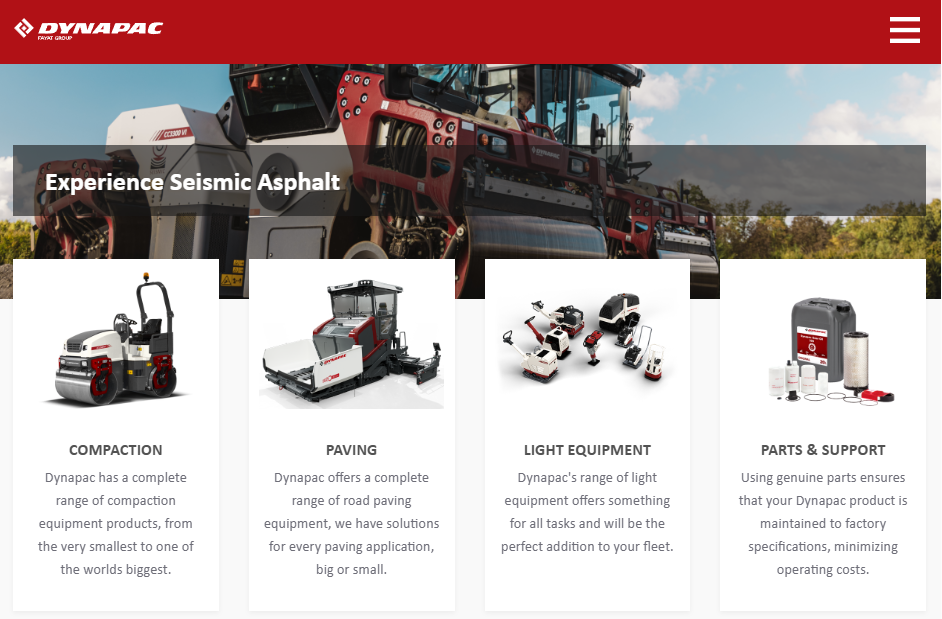
Dynapac is a Swedish brand (now owned by France's Fayat Group) with a long history in compaction equipment. Its CC series tandem rollers are widely used across Europe and have a growing presence in North America.
Best for: Contractors who need the most accurate compaction measurement available, particularly for projects where agencies require detailed quality assurance documentation.
Dynapac's Seismic technology measures compaction in real-time by sending a wave through the mat and analyzing the response. It provides a more accurate picture of what's happening beneath the surface compared to traditional accelerometer-based systems used by most competitors.
Key features
- Seismic compaction measurement: Sends waves through the mat to measure below-surface compaction, giving a more accurate density reading than accelerometer-based systems
- CC Series range: The CC1200 handles utility work, the CC3200 covers mid-range commercial projects, and the CC6200 is built for highway-class paving
- European engineering heritage: Decades of compaction R&D behind the design, with a growing North American support network
Dynapac pros
- Seismic technology provides the most accurate below-surface compaction data available, which is increasingly valuable as agencies tighten QA requirements
- Well-engineered machines with a strong track record in European markets
- Growing North American dealer presence, with good support in major metro areas
Dynapac cons
- North American dealer network is still smaller than CAT, BOMAG, or Hamm, which can mean longer lead times for parts and service outside major metros
- Less brand recognition in North America may affect resale value
Bottom line
Dynapac is worth considering if compaction documentation accuracy is a priority for your projects.
Its Seismic measurement system is genuinely more precise than what most competitors offer. But if you're in a smaller market, verify dealer and parts coverage in your area before committing.
6. Wacker Neuson: Best for Small Crews and Light Commercial Work
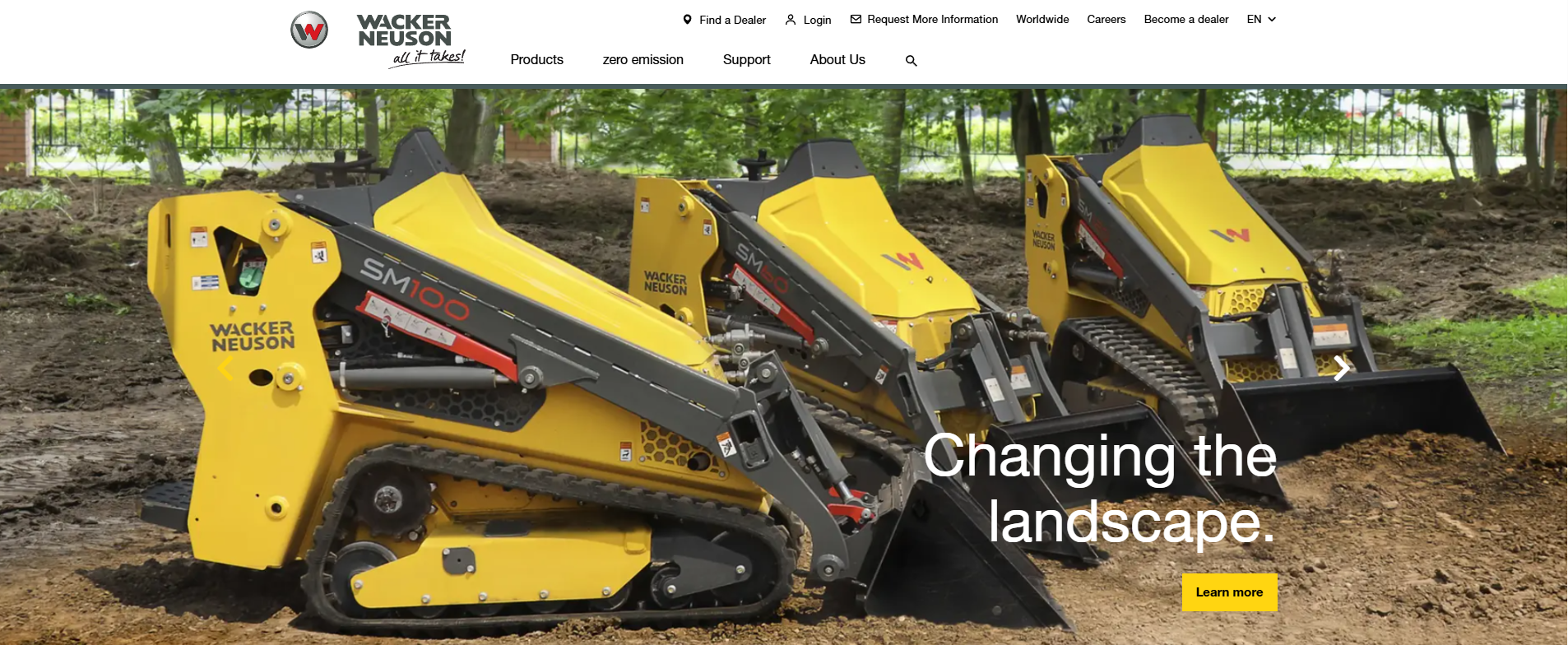
Wacker Neuson targets the smaller end of the asphalt roller market with compact machines designed for utility, patch, and small commercial work.
If your crew handles a lot of driveway work, small parking lots, or line striping prep and smaller overlay projects, Wacker Neuson is worth a look.
Best for: Smaller paving contractors who move between multiple residential or light commercial jobs in a single day and need machines that are easy to transport.
Many of its rollers fit on a standard trailer behind a pickup truck, which saves on mobilization costs. That's a real advantage when you're running lean and hopping between job sites.
Key features
- Compact, trailer-friendly design: Most models fit on a standard trailer behind a pickup, cutting mobilization costs significantly compared to hauling a full-size roller
- RD Series range: The RD 12 (1.2 tons) handles patches and driveways, the RD 24 (approximately 2.5 tons or 5,456 lb) hits the sweet spot for utility and light commercial work, and the RD 45 covers mid-range commercial projects
- Simple operation: Straightforward controls and lower maintenance requirements make these machines accessible for smaller crews
Wacker Neuson pros
- Lowest mobilization costs of any brand on this list, thanks to compact, trailer-friendly design
- Well-priced entry point for smaller contractors building their fleet
- Simple to operate and maintain, with lower parts costs than premium brands
Wacker Neuson cons
- No highway-class models available. If you're bidding on DOT projects or large-scale commercial paving, you'll need BOMAG, CAT, Sakai, or Hamm for those heavier machines
- Less compaction force than full-size rollers, which means more passes on thicker lifts
Bottom line
Wacker Neuson is the right fit for small paving operations focused on residential and light commercial work.
Its portability and low cost of entry make it a practical first roller purchase. But if your business is growing toward commercial and municipal work, you'll outgrow its lineup and need to look at the other brands on this list.
How to Choose the Right Asphalt Rollers for Your Jobs
The right choice depends on a combination of job types, crew structure, and how you plan to grow your business. Here's how to think through it:
Match the roller to your typical job scope
Start with the work you do most often. If 80% of your jobs are parking lots and commercial overlays, a tandem vibratory roller in the 8 to 12 ton range covers most of what you need.
If you're running a mix of commercial and residential, a combination roller gives you more flexibility without needing a separate pneumatic roller for finish work.
Contractors who regularly bid on paving contracts for DOT or highway work will typically need heavier tandem vibratory rollers (12+ tons) and possibly a dedicated pneumatic tire roller for finish rolling to meet agency specifications.
Consider drum width and operating weight
Drum width determines how much area you cover per pass. Wider drums (66 to 84 inches) speed up production on large, open paving jobs. Narrower drums (47 to 54 inches) give you better maneuverability in tight spaces, around obstacles, and on irregular lot layouts.
Operating weight matters because heavier asphalt rollers deliver more static linear force per inch of drum width. That translates to better compaction on thick lifts with fewer passes. But a machine that's too heavy for your typical lift thickness can crush aggregate or shove the mat.
General sizing guide
Think about compaction technology
Modern asphalt rollers come with intelligent compaction features that measure density and mat stiffness in real-time. BOMAG's Asphalt Manager, CAT's CMV, Hamm's Smart Compact, and Dynapac's Seismic technology all aim to reduce guesswork and improve consistency.
These systems cost more upfront, but they can pay for themselves by reducing over-compaction (which damages the mat), cutting pass counts (which saves fuel and time), and providing documentation that some agencies now require for quality assurance.
If your crew is training newer operators, intelligent compaction technology is especially valuable. It shortens the learning curve and helps less experienced rollers achieve consistent results.
7 Key Specs to Compare Before You Buy
When you're comparing asphalt rollers side by side, these are the numbers that actually matter:
- Centrifugal force: Measured in pounds or kilonewtons, this tells you how much compactive effort the drums deliver. Higher centrifugal force means better compaction on thick lifts, but too much force on thin lifts can damage the mat.
- Vibration frequency: Measured in vibrations per minute (VPM). Most asphalt rollers operate between 2,800 and 4,000 VPM. Higher frequencies produce a smoother finish, which is ideal for finish rolling.
- Drum width: Affects production rate and maneuverability. Match this to your typical job size.
- Operating weight: Heavier machines compact more effectively per pass but cost more to transport and can be overkill for lighter work.
- Water system capacity: Asphalt rollers use water spray to prevent hot mix from sticking to the drums. Larger water tanks mean longer run times between refills. For long paving runs, a tank under 60 gallons means frequent stops.
- Turning radius: Critical for parking lot work and residential streets where you're making tight turns at the end of each pass. A wider turning radius means more maneuvering, more time, and potential mat damage at lane edges.
- Engine power and fuel consumption: More horsepower typically means better performance on grades and more consistent drum speed under load. Balance this against fuel costs, especially if you're running multiple rollers across several crews.
Buy vs. Rent: Figure Out Your Break-Even Point
Buying asphalt rollers makes sense if you're running them consistently throughout paving season. The rule of thumb? If you'd rent a roller for more than 60% to 70% of the season, you're probably better off buying.
Buying pros:
- Lower long-term cost if utilization is high
- Available whenever you need it (no scheduling around rental availability)
- Builds equity in your fleet
- You control maintenance and machine condition
Renting pros:
- No capital outlay or financing costs
- Access to newer machines with the latest technology
- Easier to scale up for a big project and scale back down
- Maintenance and major repairs are the rental company's problem
Many contractors use a hybrid approach: own their primary asphalt rollers and rent specialty machines (like heavy pneumatic rollers or oscillation units) for specific projects that require them.
New vs. Used Asphalt Rollers
New asphalt rollers give you warranty coverage, the latest compaction technology, better fuel efficiency, and the peace of mind that comes with knowing the machine's full history.
A new mid-range tandem vibratory roller from a major brand typically runs between $80,000 and $200,000+, depending on size and features.
Used rollers can save you money, but they come with risk. Drum condition is the biggest concern. Worn drums, damaged bearings, or cracked vibration isolators are expensive to repair and hard to spot without a thorough inspection.
If you're shopping for used asphalt rollers, check these things carefully:
- Drum surface condition: Look for gouges, flat spots, or uneven wear patterns
- Vibration system: Run the machine and listen for unusual noises or inconsistent vibration
- Hydraulic system: Check for leaks at fittings, cylinders, and the drum drive motors
- Water spray system: Test every nozzle. Clogged or broken spray bars cause asphalt to stick, which damages the mat and the drum
- Hour meter: Most asphalt rollers have a useful life of 5,000 to 10,000+ hours, depending on maintenance. Anything over 6,000 hours deserves extra scrutiny
- Maintenance records: A machine with documented service history is worth significantly more than one without it
Reputable dealers like GoMidSouth and brand-certified used equipment programs offer inspected machines with limited warranties, which splits the difference between new and private-sale pricing.
Which Asphalt Roller Brand Should You Choose?
Choose BOMAG if you …
- Want the most automated compaction technology available
- Run a range of job sizes and need a deep model lineup
- Are training newer operators who need help achieving consistent results
Choose CAT if you …
- Prioritize uptime and need the fastest service response when a machine goes down
- Want strong resale value and a brand with the widest dealer reach
- Run tight schedules during the busy season, where a day of downtime costs thousands
Choose Sakai if you …
- Regularly compact near bridges, utilities, or other vibration-sensitive areas
- Want to minimize long-term operating costs (fuel and maintenance)
- Value precision drum geometry and quiet, consistent compaction
Manage Your Asphalt Roller Crews, Quotes, and Jobs in One Place
OneCrew is a platform built specifically for project-based asphalt and concrete contractors. It replaces the patchwork of disconnected tools that slow your team down and create gaps where jobs and revenue slip through the cracks.
Here's what you can do with OneCrew:
- Estimate from PDFs or satellite maps with built-in calculators and configurable cost automations: Bake your asphalt roller costs, operator hours, fuel consumption, and mobilization fees into every bid.
- Schedule crews and assign roles to specific job phases with clear accountability: Assign your breakdown roller crew to the morning pour and your finish rolling team to the afternoon, all from one schedule.
- Track leads and customer relationships from first call through repeat business: Every inquiry, conversation, quote, and project history lives in one system.
- Build and send proposals through a customer portal where clients can review, approve, and sign: Turn your finished estimates into polished, branded proposals that include project scope, equipment allocation, and pricing in one document.
- Keep field crews connected to job details, schedules, and real-time updates from the office: Field management tools put site information, material specs, and daily assignments on your crews' phones.
- Invoice and collect payment without double-entry or chasing paperwork: Generate invoices from completed work orders with line items pulled directly from your original estimate, including equipment charges.
You don't need five different apps to manage your paving business. Book a free demo and see how OneCrew helps you take control of every project from start to finish.
FAQs
1. What size asphalt roller do I need for parking lot paving?
Most parking lot paving jobs require a tandem vibratory roller in the 15,000 to 24,000 lb range with a 60 to 67 inch drum width. This size provides enough compaction force for standard 2 to 3 inch lifts and covers ground efficiently on open lots. Smaller patches or tight areas may require a lighter utility roller as a second machine.
2. What's the difference between vibratory and static asphalt rollers?
Vibratory asphalt rollers use rapidly spinning eccentric weights inside the drums to create high-frequency vibrations that compact asphalt more aggressively. Static rollers rely only on the machine's dead weight. Vibratory rollers achieve target density in fewer passes, which makes them the standard for most paving work today. Static rollers are mainly used for finish rolling or on thin lifts where vibration could damage the mat.
3. How many passes does an asphalt roller need to reach target density?
Most asphalt rollers reach target density (typically 92% to 96% of theoretical maximum) in 4 to 8 passes on a standard 2 to 3 inch lift. The exact number depends on mix temperature, lift thickness, roller weight, and vibration settings. Intelligent compaction systems from BOMAG, CAT, and Hamm measure density in real-time, which helps operators avoid under-compaction or over-compaction.
4. Should I buy or rent asphalt rollers?
Buy if you'll use the roller for more than 60% to 70% of paving season. Rent if you need a specialty machine for a specific project or if you're testing a new brand before committing. Many paving contractors own their primary tandem vibratory roller and rent pneumatic or oscillation rollers when specific jobs require them.
5. How much do new asphalt rollers cost?
New asphalt roller prices vary widely by size and features. Compact utility rollers (under 3 tons) start around $30,000 to $50,000. Mid-range commercial tandem vibratory rollers (8 to 12 tons) typically range from $80,000 to $150,000. Highway-class machines (12+ tons) with intelligent compaction technology can exceed $200,000. Contact manufacturers or authorized dealers directly for current pricing, as costs fluctuate with market conditions.