6 Best Construction Materials Pricing Software for Asphalt Paving Companies in 2026

The best construction materials pricing software for asphalt paving companies helps contractors calculate material quantities, track fluctuating costs, and build profitable estimates without spreadsheet headaches.
OneCrew leads on its configurable estimating engine with built-in material calculators, and Pittbos stands out for its supplier-contractor portal for real-time pricing updates.
6 Best Construction Materials Pricing Software for Asphalt Paving Companies
1. OneCrew: Best Construction Materials Pricing Software Overall
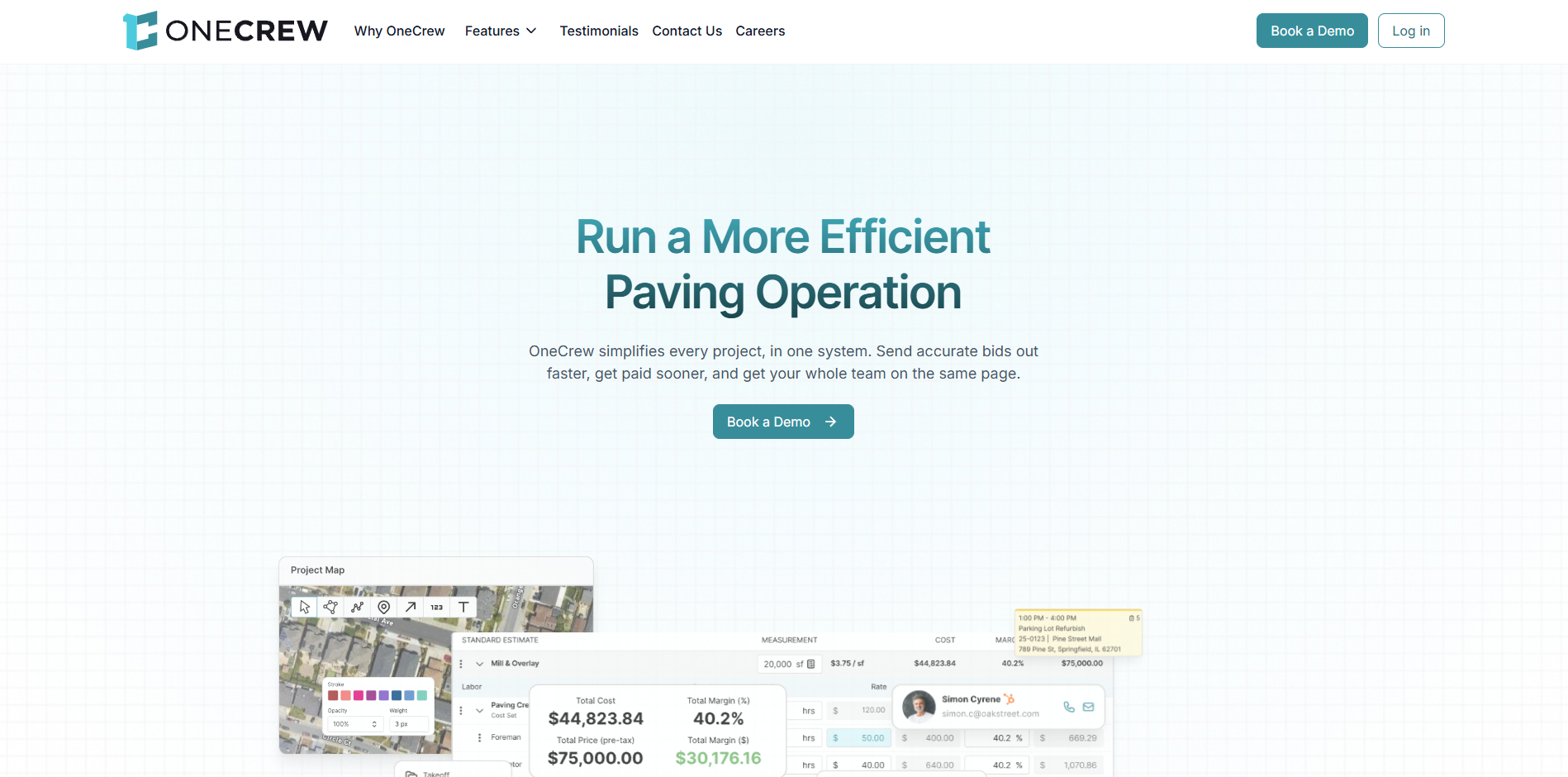
OneCrew gives paving contractors a configurable estimating engine that handles material quantities, labor rates, equipment costs, and subcontractor pricing in one unified platform.
Who it's for: Asphalt and concrete contractors of any size who manage project-based work and want accurate material pricing tied to complete job workflows.
Here's what makes OneCrew different from generic construction tools: it thinks like a paving contractor thinks. Most construction materials pricing software for asphalt paving companies forces you into rigid templates designed for other trades. OneCrew lets you build estimates the way your business actually operates.
The platform's material calculators connect directly to your takeoff measurements. Measure a parking lot from aerial imagery or a PDF plan, and the system pulls those quantities into your estimate. You set your material costs, production rates, and waste factors once, then the platform handles the math for every future job.
Key features
- PDF takeoff and map measurement: Two separate tools give you flexibility. Upload blueprints for PDF takeoff or measure properties from satellite imagery. Both methods feed quantities directly into your estimates.
- Configurable cost calculators: Build estimates using labor, material, equipment, and sub-line items. Set your own production rates, material prices, and margin targets. The system calculates costs based on your specific business metrics.
- Material and labor templates: Create reusable assemblies for common paving specs. Apply them across projects to maintain consistent pricing and reduce estimate creation time by up to 75%.
- Customer portal for approvals: Share proposals with clients through a dedicated portal where they can view and sign estimates, pay invoices, share photos, and message your team directly. Many contractors also attach an asphalt paving contract to the same approval flow.
- QuickBooks Online integration: Sync invoicing and payment information to keep financials organized without double-entry headaches.
- Safety planning: Estimating workflows account for required PPE and align with OSHA requirements on asphalt jobs.
OneCrew pros
- Built specifically for paving: OneCrew understands project-based workflows for asphalt and concrete contractors, unlike generic field service tools designed for quick service calls.
- Independent ownership: Your data stays yours. OneCrew isn't owned by private equity roll-ups that acquire paving companies, so you don't have to worry about competitors accessing your information.
- Replaces patchwork tools: Material pricing, scheduling, customer management, and invoicing live on one platform instead of being scattered across multiple apps and spreadsheets.
OneCrew cons
- Requires demo for pricing: You'll need to schedule a conversation to get specific costs based on your team size and feature requirements.
- More than solo operators need: The platform targets growing businesses, so individual contractors working alone might find simpler tools sufficient.
Pricing
OneCrew uses seat-based pricing determined during a demo. The platform serves paving contractors from small operations to large enterprise companies.
Bottom line
OneCrew delivers the most complete construction materials pricing software for asphalt paving companies that manage real projects from estimate to final invoice. The configurable material calculators and project-based workflow design set it apart from generic construction tools. Book a demo if you want to see how the estimating engine handles your specific pricing structures.
2. Pittbos: Best for Supplier-Contractor Material Pricing
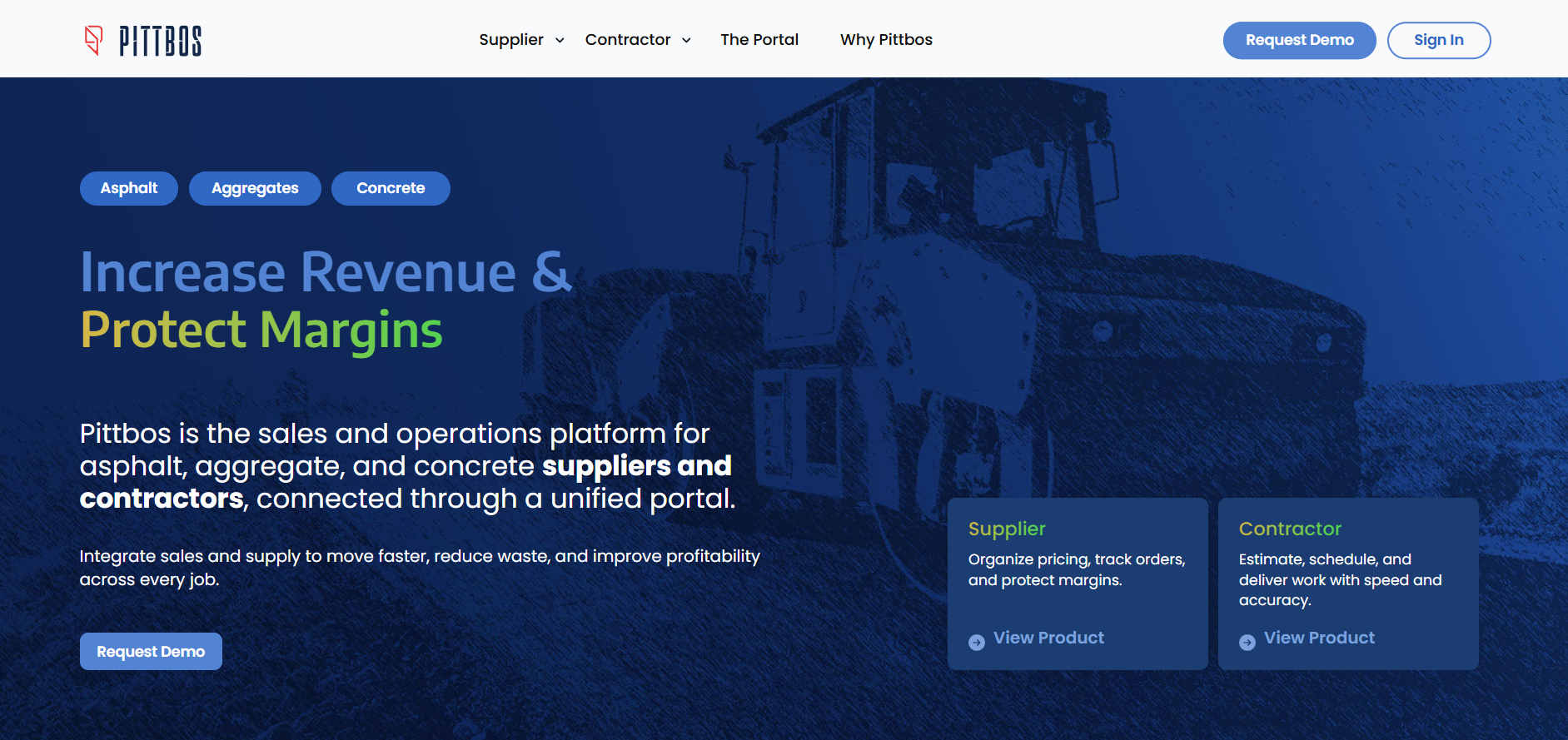
Pittbos connects asphalt suppliers and contractors through a unified portal where material pricing, mix designs, and order scheduling flow between both parties in real time.
Who it's for: Paving contractors who work closely with asphalt plants and want current material pricing without constant phone calls and email chains.
Pittbos approaches construction materials pricing software for asphalt paving companies from a unique angle. Instead of treating material costs as static numbers you update manually, the platform creates a live connection between suppliers and contractors.
When your asphalt supplier updates AC pricing, RAP blend costs, or haul rates, those changes flow directly into your estimating system. No more discovering yesterday's quote is already outdated. The Pittbos Portal gives both sides visibility into scheduling, pricing, and backlog status.
The platform was built by people with decades in the asphalt industry. That experience shows in how it handles real-world details like plant costs, additives, aggregate variables, and trucking logistics that generic construction tools overlook entirely.
Key features
- Supplier-contractor portal: Connect directly with your asphalt suppliers for real-time pricing updates, scheduling coordination, and order management.
- Mix design pricing: Material costs tie directly to specific mix designs, so estimates reflect actual product specifications rather than generic asphalt tonnage.
- Accurate estimating tools: Build estimates with current pricing data from your suppliers, including trucking costs, plant variables, and material specifications.
- Professional proposals: Generate quotes that include accurate material costs and win more bids with a professional presentation.
- Backlog visibility: Track scheduled work and coordinate with suppliers on material availability and delivery timing.
Pittbos pros
- Real-time supplier pricing: Material costs update automatically when suppliers change pricing, keeping your estimates accurate without manual updates.
- Industry-specific design: Pittbos understands asphalt, aggregates, and concrete supply chain dynamics that general construction platforms miss.
- Connects both sides of the transaction: The portal model improves communication and reduces errors between paving contractors and material suppliers.
Pittbos cons
- Requires supplier adoption: Maximum value comes when your suppliers also use Pittbos. Contractors working with suppliers on other systems won't see all the benefits.
- Newer platform: Pittbos is growing but doesn't have the established user base of older construction platforms.
Pricing
Pittbos provides custom pricing through demo consultations. The platform serves both asphalt suppliers and paving contractors.
Bottom line
Pittbos delivers a unique approach to construction materials pricing software for asphalt paving companies by directly connecting the supply chain. If your business relies on tight coordination with asphalt plants and material suppliers, this platform eliminates the pricing communication gaps that cause estimate errors.
3. Bitumio: Best for Small Residential Asphalt Maintenance Calculations

Bitumio automates material quantity calculations for sealcoating, crack filling, and patching work that general platforms struggle to handle accurately.
Who it's for: Small residential asphalt maintenance contractors who focus on sealcoating, striping, and repair work rather than new construction projects.
Bitumio's pre-configured calculations are its strongest feature. The platform automatically factors in crack sizes, application methods (spray versus squeegee), material coverage rates, and waste percentages. Enter your job specifications, and the system tells you exactly how much sealcoat, crack filler, or hot mix you need.
This construction materials pricing software for asphalt paving companies also handles trucking logistics. The system calculates transfer truck requirements, travel times, and delivery costs based on job location and material quantities. Most generic platforms force you to figure out these details manually.
Key features
- Automated material calculations: Enter crack dimensions or surface area, and the platform calculates material needs based on product type and application method. No more manual spreadsheet formulas.
- Trucking cost automation: The system factors in crew travel times, transfer truck requirements, and logistics costs based on job location and material quantities.
- Map measurements: Measure properties directly within the platform and attach images to proposals. Quantities feed into material calculations automatically.
- Job costing with material tracking: Input actual material usage after jobs are complete to compare against estimates and refine future pricing.
Bitumio pros
- Specialized for asphalt maintenance: Few platforms handle sealcoating and crack fill calculations with this level of automation.
- Cuts estimation time significantly: Pre-configured calculations eliminate manual math and reduce proposal creation time by roughly 40%.
- Free trial available: Test the platform before committing to paid plans.
Bitumio cons
- Limited for new construction: The specialization that makes Bitumio great for maintenance work means it lacks features for large paving projects.
- Not designed for concrete work: Contractors handling both asphalt and concrete may need additional tools.
Pricing
Bitumio offers a free trial, with paid plans starting at $149 per user per month.
Bottom line
Bitumio wins for small residential asphalt maintenance contractors who want automated material calculations for sealcoating, crack sealing, and repair work. If your business focuses on these services, the platform eliminates guesswork from material pricing. Contractors handling diverse paving projects should evaluate other options.
4. RSMeans Data Online: Best for Material Cost Validation
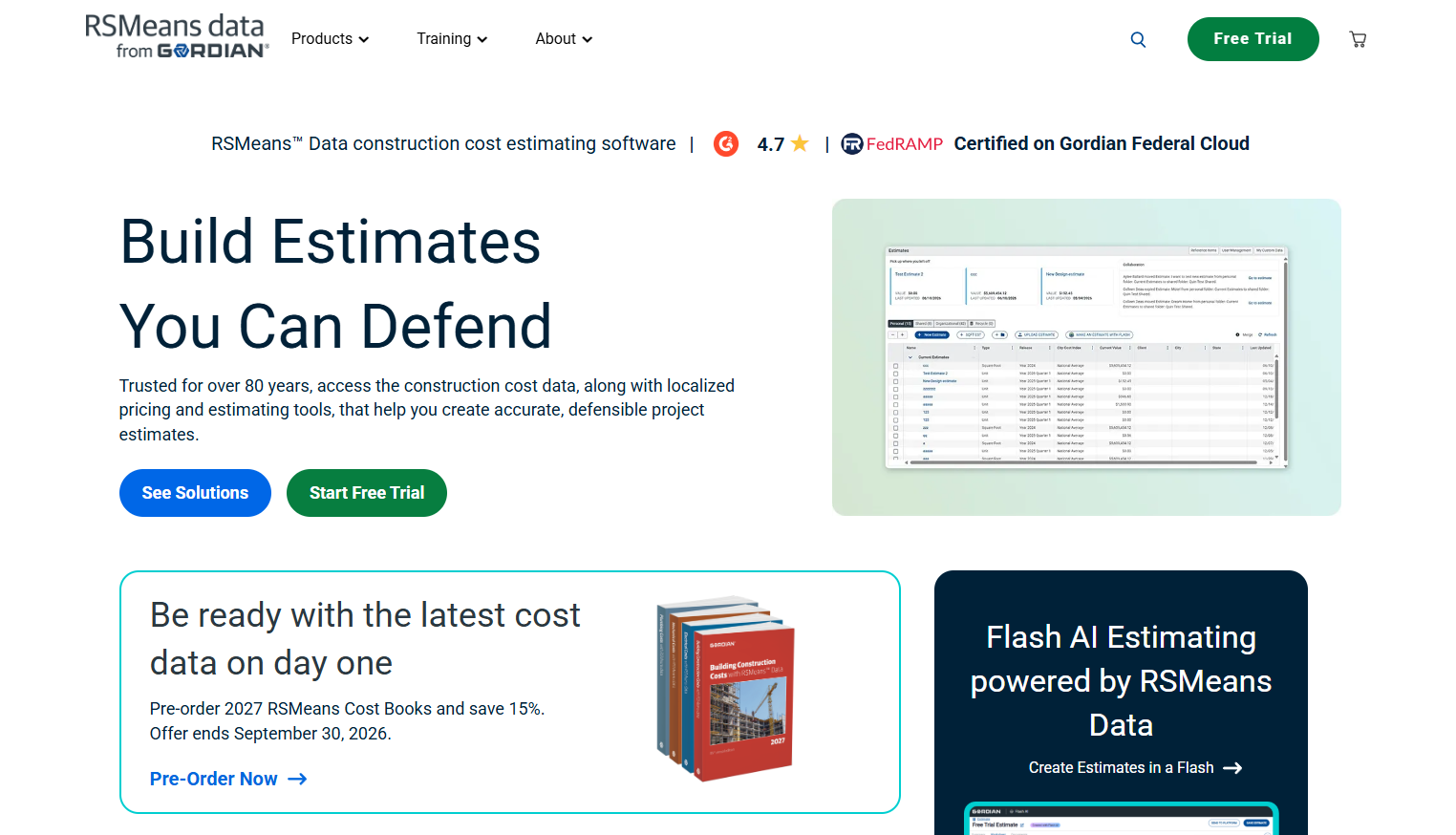
RSMeans Data Online provides industry-standard construction cost databases that help paving contractors validate material pricing, benchmark estimates, and justify costs to clients.
Who it's for: Contractors, estimators, and project managers who need authoritative cost data to validate estimates or fill gaps in unfamiliar scopes of work.
RSMeans takes a different approach than other construction materials pricing software for asphalt paving companies. Rather than managing your projects end-to-end, it serves as a cost reference library with over 92,000 unit line items covering everything from earthwork to paving to site utilities.
The platform shines when you need to validate unfamiliar costs, benchmark your pricing against industry standards, or justify estimates to skeptical clients. The location adjustment feature automatically modifies costs for your specific city, so you're not working with national averages that don't reflect local market conditions.
For heavy construction and large site development projects, the Heavy Construction dataset includes specific costs for paving, curbs, gutters, sidewalks, and driveways. Quarterly updates keep the data current as material prices shift.
Key features
- Comprehensive cost database: Access over 92,000 unit line items plus building assemblies and heavy construction costs covering earthwork, paving, and site utilities.
- Location cost adjustment: Automatically adjust costs for over 970 locations across the U.S. and Canada to reflect local material and labor markets.
- Quarterly updates: Cost data updates quarterly to reflect current market conditions and material price changes.
- Predictive pricing (Complete Plus tier): Machine learning models forecast material price changes up to three years into the future for long-term project planning.
- Square foot estimating: Generate quick conceptual estimates using pre-built models for commercial and residential projects.
RSMeans Data Online pros
- Industry-standard authority: RSMeans costs are accepted as an impartial benchmark for construction pricing, useful for dispute resolution and client justification.
- Comprehensive coverage: The database covers virtually every construction cost imaginable, from heavy highway work to facilities maintenance.
- Location-specific pricing: Automatic adjustments for local markets mean you're not guessing how national averages apply to your area.
RSMeans Data Online cons
- Reference tool, not project management: RSMeans provides cost data but doesn't manage estimates, scheduling, or invoicing like full platforms.
- Requires subscription: Annual pricing starts at $387.60 for basic access, with more advanced features costing significantly more.
- Learning curve for data navigation: The comprehensive database requires some time to learn how to find and apply relevant costs efficiently.
Pricing
RSMeans Data Online offers three tiers: Core ($387.60/year) for basic cost access, Complete ($996.55/year) for historical analysis, and Complete Plus ($5,674.35/year) for predictive pricing features.
Bottom line
RSMeans Data Online works best as a companion tool for construction materials pricing software for asphalt paving companies rather than a standalone solution. Use it to validate estimates, benchmark your pricing, and fill knowledge gaps on unfamiliar work scopes. Pair it with project management platforms like OneCrew for complete workflow coverage.
5. B2W Estimate: Best for Heavy Civil Material Tracking

B2W Estimate provides enterprise-grade estimating tools for heavy civil contractors with centralized cost databases, historical tracking, and ERP integration.
Who it's for: Large paving contractors bidding DOT work, highway projects, and infrastructure jobs where detailed cost tracking and enterprise integration matter.
B2W (now part of Trimble) approaches construction materials pricing software for asphalt paving companies with an enterprise mindset. The platform centralizes cost databases across your organization, so every estimator works from the same material pricing, production rates, and historical data.
The real power emerges when B2W Estimate connects with B2W Track for field performance monitoring. Actual material usage from completed jobs flows back into your cost database, improving estimate accuracy over time. For DOT bidding, the platform includes state-specific item databases that auto-populate common bid items.
This level of sophistication requires investment. B2W works best for contractors with dedicated estimating staff, IT support, and the patience for proper implementation. Smaller operations will find the platform overwhelming.
Key features
- Centralized cost database: Maintain a single source of truth for material costs, crew production rates, equipment pricing, and historical job data across your organization.
- DOT bid automation: State-specific databases pre-populate common bid items, reducing manual entry and improving accuracy on public works projects.
- Historical cost analysis: Track actual versus estimated material usage across completed projects to refine future pricing and improve margins.
- ERP integration: Connect with accounting systems like Viewpoint Vista, Oracle, and Foundation for seamless data flow between estimating and financials.
- Work breakdown structure: Organize complex projects with detailed WBS templates that break costs into manageable, trackable components.
B2W Estimate pros
- Enterprise-grade accuracy: Centralized databases and historical tracking create the most accurate estimates possible for complex civil projects.
- Continuous improvement loop: Field data feeds back into estimates, so your pricing accuracy improves with every completed project.
- Scalable across large organizations: Multi-division contractors can maintain consistent pricing standards across all locations and teams.
B2W Estimate cons
- Significant implementation effort: Expect substantial time investment in configuration, training, and process changes before seeing full benefits.
- Overkill for smaller contractors: The platform's enterprise features create overhead that small paving companies won't need or use.
- Premium pricing: Enterprise licensing costs reflect the platform's positioning for large civil contractors.
Pricing
B2W uses enterprise pricing based on modules, users, and implementation scope. Contact Trimble for specific quotes.
Bottom line
B2W Estimate fits large contractors bidding complex civil projects where historical material cost tracking drives competitive advantage. For commercial parking lots and residential paving, simpler construction materials pricing software for asphalt paving companies like OneCrew delivers better value with less complexity.
6. Projul: Best for General Paving Contractors

Projul provides construction management tools with assembly calculators, QuickBooks integration, and customer portals for paving contractors who want organized operations without enterprise complexity.
Who it's for: Small to mid-sized paving contractors who need professional estimating and project management without the learning curve of heavy-duty platforms.
Projul positions itself as construction materials pricing software for asphalt paving companies that stays simple while covering essential workflows. The assemblies calculator lets you build reusable material and labor combinations for common paving specs, then apply them across estimates with a few clicks.
The platform earned strong reviews on G2 for ease of implementation and customer support. Users praise the intuitive interface and how quickly teams become productive compared to more complex alternatives. If you've tried enterprise tools and found them overwhelming, Projul offers a refreshing alternative.
The customer portal impresses clients with professional communication while reducing your phone time. Customers can view estimates, approve proposals, and track project progress without constant check-in calls.
Key features
- Assemblies calculator (Pro tier): Build reusable material and labor combinations for common paving work. Apply assemblies to estimates for consistent, accurate pricing.
- QuickBooks integration: Sync customer data, invoices, and payments with QuickBooks Online (Core+) or Desktop (Pro) to eliminate double entry.
- Customer portal (Core+ and above): Share estimates, collect approvals, and communicate project updates through a dedicated client-facing portal.
- Gantt chart scheduling (Core+ and above): Visualize project timelines and resource allocation with interactive scheduling tools.
- Geo-fenced time tracking (Pro tier): Track crew hours automatically based on job site location for accurate labor costing.
Projul pros
- Fast implementation: Teams typically become productive within days rather than weeks or months.
- Strong customer support: Users consistently praise Projul's responsive support team and willingness to help customize solutions.
- Honest pricing: Published pricing without hidden fees or surprise charges.
Projul cons
- General construction focus: Projul serves many trades, so paving-specific material calculations aren't as automated as specialized platforms.
- Limited for complex bids: Large DOT projects or multi-phase commercial work may require more sophisticated estimating tools.
Pricing
Projul starts at $4,788/year for Core. Core+ ($7,188/year) adds the client portal, Gantt charts, job costing, and QuickBooks Online, and Pro ($14,388/year) adds unlimited users, the assemblies calculator, geofencing, and QuickBooks Desktop. Billing is annual only.
Bottom line
Projul delivers solid construction materials pricing software for asphalt paving companies that want professional tools without enterprise complexity. The platform balances capability with usability effectively, though contractors needing asphalt-specific automations may prefer specialized options like OneCrew or Bitumio.
How to Evaluate Construction Materials Pricing Platforms
Here's what to examine:
- Material calculation accuracy: How well does the platform handle asphalt tonnage, aggregate quantities, sealcoat coverage, and other paving-specific material calculations?
- Pricing flexibility: Can you easily update material costs when suppliers change prices? Does the system support multiple pricing tiers for different job types?
- Integration with estimates: How smoothly do material quantities flow from measurements into cost estimates without manual data entry?
- Cost tracking capabilities: Does the platform track actual material usage against estimates to improve future pricing accuracy?
- Ease of use: Can your team start using the material pricing features productively within days rather than weeks?
Our process: we built sample estimates for a commercial parking lot project on each platform, looking at how the tools handled material quantity calculations, pricing updates, and cost tracking, then cross-checked user feedback from G2, Capterra, and industry forums against real contractor experiences.
Extra factors to consider:
- QuickBooks integration: Most paving contractors use QuickBooks for accounting, so material cost syncing matters for financial accuracy.
- Mobile access: Estimators need material pricing information on job sites, not just in the office.
- Industry specialization: Platforms built for paving understand material requirements that generic construction tools miss.
- Equipment cost accuracy: the strongest tools support equipment rates built around depreciation life.
Which Construction Materials Pricing Platform Should You Choose?
The right choice depends on your project types, team size, and current material tracking processes. Here's how to narrow your decision:
Choose OneCrew if you …
- Run an asphalt or concrete contracting business of any size
- Handle project-based work from estimate through final invoice
- Want configurable material calculators that match your specific pricing structures
- Need to replace multiple disconnected tools with one unified platform
- Value a platform built specifically for paving workflows
Choose Pittbos if you …
- Work closely with asphalt suppliers and want real-time pricing updates
- Need tight coordination between material ordering and project scheduling
- Want to eliminate phone tag and email chains with your suppliers
- Operate in the asphalt, aggregate, or concrete supply chain
Choose Bitumio if you …
- Run a small residential asphalt maintenance operation
- Need automated sealcoating, crack fill, and patching calculations
- Want trucking and travel costs folded into the material math
Choose RSMeans Data Online if you …
- Need an impartial benchmark to validate or defend your pricing
- Bid unfamiliar scopes where you have no historical cost data
- Already have a project platform and want a cost reference alongside it
Choose B2W Estimate if you …
- Bid DOT and heavy civil work where historical cost data wins jobs
- Have dedicated estimating staff and IT support for implementation
- Need estimating to feed an ERP like Viewpoint Vista or Oracle
Choose Projul if you …
- Want flat-rate pricing with no per-user fees
- Run general construction alongside paving work
- Can budget for the Core+ or Pro tier, where most features live
Final Verdict
Across these platforms, OneCrew stands out as the best construction materials pricing software for asphalt paving companies handling project-based work.
The configurable estimating engine lets you set up material calculations that match your specific pricing structures, and everything connects to scheduling, customer management, and invoicing in one system.
That said, specialized needs call for specialized tools. Pittbos delivers unique value for contractors who want real-time pricing coordination with their asphalt suppliers.
B2W Estimate remains unmatched for DOT bidding, where historical material cost data drives competitive advantage.
For most commercial paving contractors juggling material prices, crew schedules, and project management, OneCrew delivers the complete package.
Manage Materials, Crews, and Projects in One Place
When comparing construction materials pricing software for asphalt paving companies, the key question is which platform fits your actual workflow. Generic tools handle basic estimates but miss paving-specific material calculations.
If you estimate from plans, calculate quantities, assign crews, and manage real projects, you need purpose-built software.
OneCrew was designed specifically for asphalt and concrete contractors. It replaces spreadsheets and disconnected apps with one integrated platform.
Here's what you can do with OneCrew:
- Build estimates with accurate material calculations: The estimating features let you measure from PDFs or aerial maps and apply labor, material, equipment, and sub-line items with built-in calculators.
- Track every lead and customer interaction: The CRM captures inquiries and tracks communications from first contact through project completion.
- Send professional proposals that close faster: Create polished proposals clients can review, approve, and sign through a customer portal.
- Schedule crews across multiple projects: The scheduling features assign crews and roles to specific job phases. When your material estimates turn into won work, scheduling flows naturally without re-entering quantities or specifications.
- Keep field crews connected to job details: Field management tools put site information, material specs, and schedule updates in your crews' hands.
- Get paid without the back-office chaos: The invoicing features sync with QuickBooks to keep financials organized without double-entry. When your material pricing is accurate, invoicing reflects the real value you delivered.
You don't need five different apps to track material costs and manage your paving business. If you’re pricing work ahead of paving season, tighter material costing matters even more.
Book a free demo and see how OneCrew helps you take control of material pricing and project management from start to finish.
FAQs
What is the best construction materials pricing software for asphalt paving companies?
The best construction materials pricing software for asphalt paving companies is OneCrew because it provides configurable material calculators connected to complete project workflows. The platform handles PDF takeoffs, map measurements, material quantity calculations, crew scheduling, customer approvals, and QuickBooks integration in one unified system built specifically for asphalt and concrete contractors.
How does construction materials pricing software calculate asphalt quantities?
Construction materials pricing software calculates asphalt quantities using area measurements from blueprints or aerial imagery. You input surface dimensions, and the platform applies your material specifications (thickness, density, waste factors) to generate tonnage requirements. Advanced platforms like Bitumio include pre-configured calculations for common products like sealcoat and crack filler.
Can materials pricing platforms integrate with QuickBooks?
Yes, materials pricing platforms can integrate with QuickBooks Online. OneCrew syncs invoicing and payment data with QuickBooks Online, and Projul does the same from its Core+ tier up. Integration eliminates double-entry and keeps material cost records accurate for accounting purposes.
What features should I look for in paving materials pricing tools?
The features you should look for in paving materials pricing tools include material quantity calculators, customizable pricing templates, takeoff measurement tools, job costing for tracking actual versus estimated material usage, and QuickBooks integration. The best construction materials pricing software for asphalt paving companies also includes crew scheduling and customer portals to manage complete project workflows beyond just material pricing.
How much does materials pricing software cost for paving contractors?
Materials pricing software costs for paving contractors vary widely. Bitumio provides a free trial with paid plans at $149/month per user. RSMeans Data Online begins at $387.60/year for cost database access. OneCrew uses seat-based pricing determined during a demo. Enterprise platforms like B2W require custom quotes based on your organization's size and needs.
Is OneCrew good for small paving contractors tracking material costs?
Yes, OneCrew is good for small paving contractors tracking material costs and operations of any size. The platform scales from small operations to enterprise paving companies. Smaller contractors benefit from replacing scattered spreadsheets with one organized system for material pricing, scheduling, and customer management. The configurable calculators adapt to your specific material costs and pricing structures.