Construction Cost Estimate: How to Calculate It in 7 Steps

A construction cost estimate is your best prediction of what a job costs to build. Price it right, and you protect your margin. Price it wrong, and you fund somebody else's parking lot.
We pulled federal wage data, published asphalt spread rates, and the AACE estimate classes to build the seven-step calculation below on a 40,000-square-foot lot. The same method works on any construction job, and paving is the worked example.
TL;DR
Here's the whole calculation in order:
- Lock the scope and the drawing set
- Run the quantity takeoff
- Price materials from live quotes
- Build a burdened labor rate and production rate
- Add equipment, hauling, and mobilization
- Layer in general conditions, contingency, and overhead
- Set margin and sanity-check the unit price
What Is a Construction Cost Estimate?
A construction cost estimate is a documented prediction of the total cost to complete a project, built from measured quantities, current unit prices, and the share of running your company that this job has to carry.
The word "estimate" does a lot of hiding, though. A number scribbled on the back of a business card after a windshield survey is an estimate.
So is a 40-page bid package with a line item for every ton of mix. They belong to the same family and behave nothing alike, so decide how precise the number needs to be before anyone touches a calculator, then follow the estimating process.
Estimates miss more often than most contractors admit. A 2020 review of highway cost research in Applied Sciences points to an Indiana DOT study of 2,668 road projects, 55% of which ran over budget.
Those projects date from 1996 to 2001, but the mechanism is identical on a $200,000 repave. The quantity ran light, the scope grew, or the unit price came from last season.
How an estimate differs from a bid
An estimate is your internal cost picture plus the margin you need. A bid is the price you hand the customer once you decide how badly you want the work. Mixing the two is how contractors end up "winning" jobs that cost more to build than they collect.
The third number in that family is your actual cost, which only shows up through job costing once crews are on site.
Estimating and job costing are the same conversation held twelve weeks apart. Contractors who never close that loop keep repeating the same mistake every spring.
The 5 Types of Construction Cost Estimates
Construction cost estimates fall into five classes based on how much design information you have. AACE International publishes a widely used classification for building and site work, and it maps neatly onto how paving crews price commercial lots.
Road and highway jobs have their own version, AACE 98R-18.
The class reflects the quality of your inputs. Hand a property manager a Class 5 screening number as a bid, and you're contractually stuck with a number that could run 50% over.
Most commercial paving bids live in Class 2 territory, because you're working from a real plan set or a measured site and a quantity takeoff you can defend line by line. Screening numbers still earn their keep for qualifying leads, so long as everyone knows what they're looking at.
What Goes Into a Construction Cost Estimate
Every construction cost estimate pulls from five buckets: direct costs, indirect costs, overhead, contingency, and margin. Skip any one of them and the number looks great right up until payday.
Direct costs you can point to on site
Direct costs attach to the physical work. On a paving job that means mix, aggregate base, tack, striping paint, crew hours, paver and roller time, trucking, and any subcontracted scope like milling or concrete flatwork.
Materials usually carry the most dollars and the most risk. A material takeoff converts your measured areas into orderable quantities, and it needs a waste factor baked in. Most estimators add five to ten percent for normal loss on a rectangular lot, and irregular sites with lots of hand work run higher.
Indirect costs and general conditions
Indirect costs support the job without becoming part of it. Traffic control, permits, superintendent time, density testing, portable toilets, and temporary striping all belong here.
Contractors underestimate general conditions more often than mix. A night-work window on an occupied retail lot can add shift differential, extra lighting, and a flagging crew that never appears in the takeoff.
Pulling those items from one shared record of past jobs beats rebuilding them from memory on every bid.
Overhead, contingency, and margin
Overhead is the cost of being in business at all: your office, your estimator, your insurance, your shop.
Most contractors recover it as a percentage applied across direct costs, indirect costs, and contingency. Pull that percentage from last year's financials.
Contingency covers known unknowns. On a straightforward overlay, many bids start around five percent, and it climbs fast when you're paving over subgrade nobody has cored.
Then there's margin, which is where a lot of money quietly disappears. Margin and a straight percentage added to cost run on different math, and Step 7 shows what that gap costs on a sample job. Price off margin every time, and the arithmetic stops working against you.
What You'll Need Before You Start
Estimating goes faster when the inputs are already sitting in front of you. This is also the point where good paving project management habits pay for themselves, because half of these items are last quarter's records kept somewhere findable.
Gather these before you start pricing:
- A locked scope of work and a dated plan set or measured site
- Current delivered quotes from your asphalt plant and aggregate supplier
- Your burdened labor rates by crew position
- Production rates from your own completed jobs, in tons per day or square yards per hour
- Hourly ownership and operating costs for your paver, rollers, and trucks
- Sub quotes for milling, concrete, and striping
- A note on any additional scope like sealcoating or crack sealing the customer mentioned, but the plans don't show
Time required: roughly half a day for a clean parking lot with good drawings, and two to three days for a phased commercial site with multiple mixes and a night-work restriction.
How to Calculate a Construction Cost Estimate Step-by-Step
Each step below fills in one piece of the formula:
- Total cost = direct + indirect + contingency + overhead
- Price = total cost ÷ (1 − target margin)
Step 1. Lock the scope and the drawing set
Write down exactly what you're pricing and what you're not, then date it. Note the plan revision number, the mix designs called for, the compaction spec, and the working hours you assumed.
This step feels like paperwork until the first change order. A dated scope turns "that's not what we agreed" into a signed extra.
Pro tip: list your exclusions explicitly. Unsuitable subgrade, utility adjustments, and permit fees cause more arguments than anything else on a paving job.
Step 2. Run the quantity takeoff
Measure your areas and depths, then convert them to the units your suppliers and crews use every day. Square feet become square yards for paving, tons for mix, cubic yards for base, and gallons for tack.
Break the site into sub-areas that get different treatment. Drive lanes at three inches, parking stalls at two, and the dumpster pad in concrete are three separate quantities, and averaging them together is how you end up short 40 tons on a Thursday afternoon.
Pro tip: measure twice using two methods. Site measurement from imagery and PDF plan takeoff are separate tools for a reason, and some paving estimating platforms, OneCrew included, handle both inside the same job. When the two land more than a couple percent apart, one of them is wrong.
Step 3. Price materials from live quotes
Call the plant. Asphalt pricing moves with liquid binder and diesel, and preliminary federal producer price data shows paving mixtures and blocks ran about 7% higher in September 2026 than a year earlier. A quote from last October is a guess with a letterhead.
To convert quantities into tons, Asphalt Institute engineers use a rule of thumb of 110 pounds of hot mix per square yard per inch of compacted thickness, or let our free asphalt tonnage calculator do the conversion.
For volume-based items, the FHWA estimating table assumes:
- Hot mix: 145.2 pounds per cubic foot
- Aggregate base: 139 pounds per cubic foot
- Emulsion tack: 0.10 gallons per square yard
Pro tip: ask for a price validity window in writing, and store the quote date next to the unit price so nobody bids off a six-week-old number.
Step 4. Build a burdened labor rate and production rate
Your labor cost starts with the wage rate. Paving, surfacing, and tamping equipment operators earned a mean of $28.37 an hour nationally in May 2025, and construction laborers averaged $25.02. Then add burden.
As of June 2026, federal compensation data puts benefits at 30.5% of total employer cost in private construction, which pushes that $28.37 operator past $40 an hour before a single ton hits the ground:
- Wage share: 100% − 30.5% = 69.5% of total cost
- Burdened rate: $28.37 ÷ 0.695 = $40.82 an hour
That burden covers payroll taxes, comp insurance, and paid time off, and estimates built on raw wages come in roughly 30% light on every crew hour.
Then apply production rates from your own history, and turn them into crew hours with the asphalt labor calculator. A crew that lays 350 tons a day on open highway and 170 on a cut-up parking lot tells you more than any published table.
Pro tip: track production by mix type and lot geometry, so your next bid pulls from jobs shaped like this one.
Step 5. Add equipment, hauling, and mobilization
Price equipment at an hourly rate that includes ownership, fuel, wear parts, and repair, then multiply by planned hours plus a factor for standby. Owned iron still costs money long after the loan closes.
Hauling deserves its own line. Round-trip haul time from plant to site sets how many trucks you need, and the asphalt trucking calculator works out that count from your haul times and paving rate. An extra 20 minutes each way can add a full truck to the fleet. Mobilization and demobilization go here too, including lowboy moves and any traffic control setup.
Step 6. Layer in general conditions, contingency, and overhead
Put a dollar figure on every indirect item, down to the portable toilets, instead of a vague across-the-board percentage.
Apply contingency to the subtotal, then recover overhead on the full amount, contingency included. At 8% on the example below, that order is worth $328:
- With contingency: $86,122 × 8% = $6,890
- Before contingency: $82,021 × 8% = $6,562
Pro tip: if your overhead percentage hasn't changed in three years, it's wrong. It moves with headcount, insurance renewals, and volume.
Step 7. Set margin and sanity-check the unit price
Divide your total cost by one minus your target margin. For 15% margin on $93,012 of cost:
- Margin pricing: $93,012 ÷ 0.85 = $109,426
- 15% on top of cost: $93,012 × 1.15 = $106,964, a real margin of 13%
- The gap: $109,426 − $106,964 = $2,462 you never collect
Then step back and check the unit price against your own history. If your last six mill-and-overlay jobs came in between $22 and $26 a square yard and this one prices at $14, something got missed. The unit-price gut check catches errors no formula will.
A Construction Cost Estimate Example on a 40,000 SF Parking Lot
Here's a two-inch mill and overlay on a 40,000-square-foot commercial lot, which works out to 4,444 square yards. Figure a seven-person crew for three ten-hour days. Unit prices below are illustrative, so swap in your own plant quotes and equipment rates.
Asphalt quantity comes first:
- Base tonnage: 4,444 square yards × 2 inches × 110 pounds = 977,680 pounds, or 489 tons
- With 5% waste: 489 × 1.05 = 513 tons to order
That final number works out to $24.62 per square yard, or $2.74 per square foot. Notice how little of the total is crew labor. At $8,610, labor is under 10% of the price, and mix alone is nearly half.
On overlay work, a 5% error in tonnage hurts more than a 20% error in labor hours, which tells you exactly where to spend your review time.
4 Common Mistakes to Avoid
Check each bid for these four:
- Pricing one mobilization on a phased job: a lot paved in halves to keep tenants parking somewhere pulls the crew back a second time, and that move costs what the first one did.
- Ignoring plant minimum load fees: many plants add a short-load or minimum-order charge on small tonnage, so a patch order can cost far more per ton than the quote. Ask your plant for its minimum before you price small repair scope.
- Estimating off stale satellite imagery: the dumpster enclosure and two new islands that went in last year don't show up, and neither does the price of hand work around them.
- Taking the sub's number without the sub's exclusions: a milling or striping quote that leaves out traffic control or haul-off puts those costs back on your side of the line, so read the exclusions before you carry the number.
Advanced Tips for Tightening Your Numbers
Once the steps feel routine, add these habits:
- Build a unit-price library: Fill it from your own completed jobs and update it quarterly. Published cost data gets you in the neighborhood, but your crews, your haul distances, and your plant relationships set your real numbers.
- Track your bid-hit ratio by job type: If you win 60% of small overlays and 5% of municipal work, your municipal numbers are probably running high. Compare your traffic control and documentation line items against the bids that won.
- Hedge against cost swings: Put an expiry date on every bid's pricing, and add an escalation clause on anything with a long lead time. A price good for 30 days protects you when a customer awards a spring bid in August.
- Run a two-person review: On any bid over your comfort threshold, the estimator reads the scope aloud, and a second person checks quantities against the plan. It takes 20 minutes and catches the transposed dimension that would have cost you a season's profit.
Cut Estimating Time by 75% With OneCrew
OneCrew helps contractors reduce estimating time by 75%. Built specifically for commercial, project-based asphalt and concrete paving contractors, it keeps your construction cost estimate connected to every step that follows, so a carefully built bid doesn't fall apart between the estimate file and the invoice.
Here's what OneCrew covers:
- Estimate from your own costs: OneCrew's estimating tools let you measure jobs with site and plan mapping, auto-calculate tonnage and materials, and price jobs from your own cost templates, vendor rates, and default margins. With Instant Takeoffs, powered by TruTec, you highlight an area, choose what to detect, and map the results to your services.
- Schedule to the estimate: OneCrew's scheduling feature assigns specific crew members and equipment to each service. It splits multi-phase projects across weeks or crews, so the labor assumptions you built into the estimate match how the work actually sequences in the field.
- Track actuals while the job runs: The field management tools push job details from the work order to crew phones, and foremen send photos, daily actuals, and updates back to the office, where job costing compares them to the estimate.
- Send proposals for e-signature: OneCrew's proposals feature generates professional proposals directly from your estimate so scope differences surface before the saw cutter loads out rather than during a dispute at closeout.
- Keep every lead in one place: OneCrew's CRM tracks each follow-up and customer relationship, and keeps every location's work history with it.
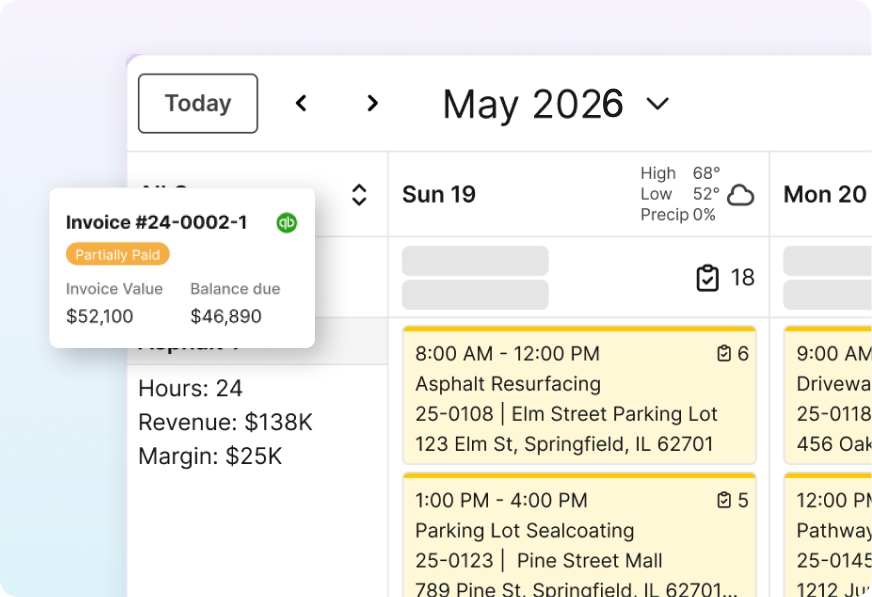
- Invoice from the same line items: OneCrew's invoicing tools generate invoices from the line items already in the platform and sync invoices and payments with QuickBooks in both directions.
Book a demo and see how OneCrew carries one set of numbers from construction cost estimate to final invoice.
FAQs
1. What is included in a construction cost estimate?
A construction cost estimate includes direct costs, indirect costs, overhead, contingency, and margin. Direct costs cover materials, labor, equipment, and subcontractors. Indirect costs cover items like traffic control, permits, testing, and supervision that support the job without becoming part of the finished work.
2. How accurate should a construction cost estimate be?
How accurate a construction cost estimate should be depends on the design information behind it. A screening estimate built from 0% to 2% design can miss by up to 30% under or 50% over, and a bid-level (Class 2) estimate built from 30% to 75% design and a detailed takeoff should land within about 10% under or 15% over.
3. What is the difference between a construction cost estimate and a bid?
The main difference between a construction cost estimate and a bid is who sees it. The estimate stays in your office and holds your true cost and target margin, and the bid goes out the door with a read on how badly you want the job.
4. How do you calculate cost per square yard for paving work?
You calculate cost per square yard by dividing your total bid price by the total square yards of pavement. On the 4,444-square-yard example above, a $109,426 price comes to $24.62 per square yard. Compare that figure against your own completed jobs, because unit prices vary widely by region, lot geometry, and mix type.
5. Who prepares a construction cost estimate?
A dedicated estimator prepares construction cost estimates at most mid-size and larger contractors, and owners or project managers handle it at smaller companies. Whoever owns the number should also review actual job costs afterward, since that comparison is what makes the next estimate sharper.