
Why Choose Cloud-Based Estimating for Paving Contractors

You’ve got a bid due Friday. Your estimator updated the spreadsheet on his laptop Thursday night, your project manager saved a different version to the shared drive Wednesday, and now nobody’s sure which one has the right material costs. Sound familiar? For commercial paving contractors, that kind of version chaos doesn’t just cause headaches. It kills margins and costs you jobs. Understanding why choose cloud-based estimating comes down to one thing: the way you estimate directly shapes whether you win profitable work or just stay busy.
Key takeaways
| Point | Details |
|---|---|
| Speed wins more bids | Cloud estimating delivers faster bid turnaround compared to traditional desktop tools. |
| Collaboration kills version conflicts | Real-time multi-user access creates one source of truth and removes the risk of costly duplicate files. |
| Integration drives profitability | Live accounting sync is the primary driver of accuracy and profit tracking in commercial paving. |
| Cost savings are real | Mid-size paving teams can save meaningfully by consolidating from fragmented tools into one platform. |
| Data is a long-term asset | Cloud platforms build searchable cost libraries that get more valuable with every project you complete. |
Why choose cloud-based estimating to speed up your bids
Speed is the most visible benefit. Cloud platforms typically deliver faster bid turnaround than traditional desktop tools. For commercial paving contractors chasing multiple private bids each month, that gap can be the difference between submitting more bids a week or fewer.
Here’s what actually drives that speed:
- Real-time collaboration: Multiple estimators can work on the same bid simultaneously without creating version conflicts. Cloud platforms create a single source of truth by enabling real-time multi-user editing, which removes the costly back-and-forth of reconciling separate files.
- Reusable templates: Build a parking lot resurfacing template once, with your standard crew sizes, equipment rates, and material specs. Pull it up on the next bid and adjust. You’re not starting from scratch every time.
- Live pricing updates: Cloud-based systems can pull current material costs directly into your estimate, so you’re not manually checking asphalt price sheets and risking a number that’s three weeks out of date.
- Automated quantity calculations: Interactive mapping tools tied to your estimate do the takeoff math for you, cutting the manual calculation time that piles up on large commercial lots.
One thing worth clarifying: accuracy between cloud and desktop is very close. The real edge cloud gives you isn’t magic math. It’s the combination of speed and collaboration that lets you produce more accurate bids, faster.
Pro Tip: Set up a pre-bid checklist template in your cloud platform that includes a mandatory pricing-refresh step. It takes seconds to run and catches outdated material costs before they get locked into a proposal.
Cost efficiency: what consolidating tools actually saves you
Most commercial paving contractors are paying for more software than they realize. You’ve got a desktop estimating tool, a separate spreadsheet for bid tracking, another tool for invoicing, and maybe a project management app your field super insists on. Each one costs money. Each one requires someone to re-enter data from the last one.
Integrated cloud platforms typically cost a fraction of what fragmented tool stacks run. Mid-size paving teams switching to a single platform can see meaningful monthly savings when you account for software licenses, time spent on manual data entry, and errors that required rework.
The savings aren’t just in software fees. They’re in the hours your estimator spends reformatting data to paste into the invoicing system, or the time your PM burns reconciling two versions of the same bid. A good look at your current estimating software costs often reveals how much you’re overpaying for disconnected pieces.
Pro Tip: Before you evaluate any cloud platform, document every tool your team uses today and how many hours per week get spent transferring data between them. That number will tell you your real cost baseline faster than any pricing sheet.
Integration with accounting and bidding workflows
Here’s where cloud estimating for contractors moves from convenient to genuinely profitable. The benefits of cloud estimating compound when your estimating platform talks directly to your accounting system, your procurement process, and your sub-bid management.
Live accounting integration is the primary driver of improved profitability and accuracy in commercial paving estimating. When your estimate connects directly to your job costing in real time, you catch budget overruns while there’s still time to adjust. Without that connection, you’re looking at last week’s numbers and making decisions on incomplete information.
The pitfalls of weak integration are predictable and expensive:
- Double-entry errors: When estimating data doesn’t sync to accounting automatically, someone types it in twice. Two chances to get it wrong, and the error typically doesn’t surface until job close-out.
- Sub-bid mismatches: On commercial paving jobs with subcontracted striping, signage, or drainage work, manually tracking sub-bids alongside your own estimate creates gaps. Integrated platforms connect sub-bid data directly to the master estimate.
- Lost bid intelligence: Without a connected system, your historical bid data lives in email threads and folder structures. When your top estimator leaves, so does the institutional knowledge. A connected construction estimating process captures that data at the platform level.
- Approval bottlenecks: Disconnected tools mean a change order requires updating three different systems. Connected platforms push the change through automatically.
The contractors who get the most out of cloud estimating are the ones who prioritize integration depth over feature lists. A polished interface with weak accounting sync will cost you more than a simpler platform that keeps your numbers aligned.
Security, data retention, and building a cost library
Three things commercial paving contractors rarely think about until something goes wrong: backups, data access, and long-term knowledge retention.
- Understand shared responsibility. Cloud vendors secure the infrastructure, but contractors must maintain independent backup plans for their own data. Your vendor’s uptime guarantee doesn’t cover you if you need to export and restore your estimates in a different system.
- Check your export options. Before committing to any platform, verify you can export your historical bids in a readable format. Locked-in data is a liability, not a feature.
- Treat your estimating data as a business asset. Every job you complete adds to a searchable cost library. Two years into a cloud platform, you have real unit cost data for parking lot overlays, ADA ramp work, and crack sealing across dozens of projects.
- Use that library competitively. Contractors who leverage historical data bid more accurately on similar scopes, which means fewer surprises at job close-out and stronger margins over time.
See what OneCrew can do for your paving bids
If you’re a commercial paving contractor ready to stop managing disconnected tools and start bidding with confidence, OneCrew is built specifically for this work.
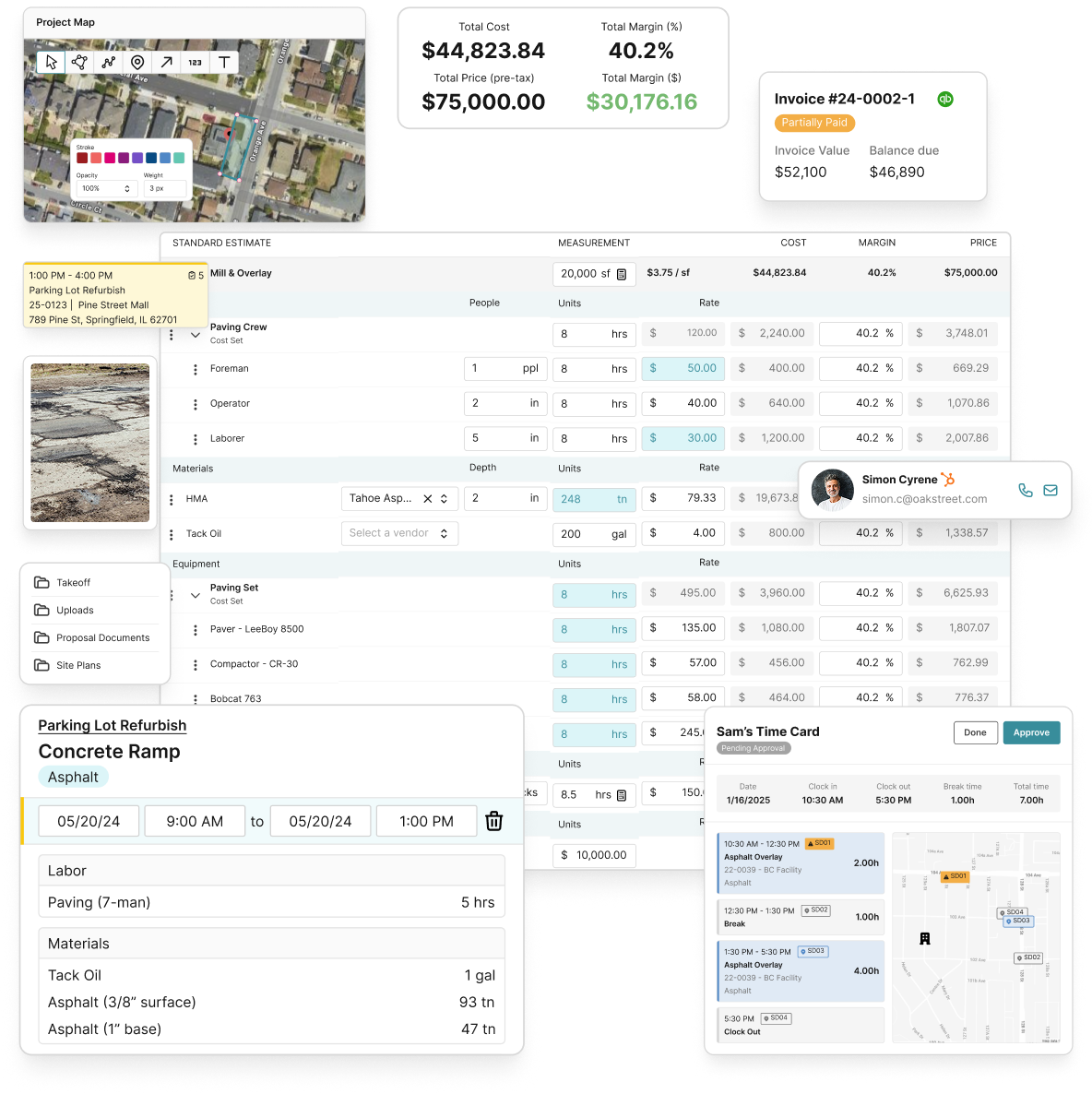
OneCrew’s paving estimating software gives your team real-time collaboration, automated quantity calculations, and direct accounting integration in one platform. You can generate accurate bids faster, track job costs as projects run, and build the historical cost library that makes every future estimate sharper. If you want a quick way to check your labor numbers right now, try the free asphalt labor calculator to estimate crew hours and costs before you even open a full estimate. When you’re ready to see the full platform, schedule a demo and see how OneCrew fits your operation.
FAQ
Why choose cloud-based estimating over desktop software?
Cloud-based estimating delivers faster bid turnaround, real-time collaboration between team members, and direct integration with accounting and procurement systems. Desktop tools can’t match the coordination speed or the cost savings that come from consolidating into one connected platform.
How much can cloud estimating save a mid-size paving company?
Mid-size paving teams can save meaningfully by switching from fragmented standalone tools to an integrated cloud platform, factoring in software fees, manual data entry time, and error-related rework.
Is cloud estimating accurate enough for commercial paving bids?
Yes. Cloud accuracy is on par with desktop tools. Accuracy depends on the quality of your cost database, not whether the software runs in a browser or on a local machine.
How long does it take to switch to cloud estimating?
Most mid-size commercial paving teams complete the technical setup in one to two weeks. The more important window is the first 90 days of daily use, where consistent adoption determines whether the platform fully delivers on its efficiency gains.
What integration should I prioritize in a cloud estimating platform?
Live accounting sync is the most important integration for commercial paving contractors. It keeps your job costing current in real time and is the single biggest driver of bid accuracy and profit tracking across active projects.

.png)