Types of Asphalt Paving Services: A Commercial Guide

Picking the wrong asphalt paving service for a commercial property is not just inconvenient — it is expensive. A parking lot laid with the wrong mix for your traffic load can fail in three years instead of fifteen. Yet many commercial property managers face real confusion over asphalt paving options, unsure whether they need hot mix, cold mix, an overlay, or something more specialized. This guide cuts through that confusion by walking you through the main types of asphalt paving services, the factors that determine which one fits your property, and how to compare them side-by-side before signing any contract.
Key Takeaways
How to choose asphalt paving services for commercial properties
Before you evaluate any specific service, you need a clear picture of what your property actually demands. Mix selection depends on traffic volume including truck percentage, speed, climate, existing pavement condition, and budget. Get these five factors wrong at the start, and no contractor’s skill will save you from premature pavement failure.
Here is what each factor means in practice for commercial properties:
- Traffic volume and truck percentage. A retail strip mall with light car traffic behaves very differently from a distribution center with daily 18-wheelers. Heavier loads require a stiffer, more durable mix to resist rutting.
- Traffic speed. Slow-moving traffic, like in parking lots, creates more vertical stress. High-speed surfaces, like access roads, face different shear forces. The mix grade needs to reflect that.
- Climate. Asphalt in Phoenix, Arizona performs very differently than the same mix in Edmonton, Alberta. Freeze-thaw cycles in northern regions demand mixes with better flexibility.
- Existing pavement condition. Cracked but structurally sound pavement may support an overlay. Pavement with base failure needs full removal and replacement first. Skipping this assessment leads to overlay failure within a few years.
- Budget across the full lifecycle. A cheaper surface that fails in five years costs more than a durable surface lasting fifteen. Thinking about choosing asphalt grades relative to lifecycle cost is always worth the extra planning time.
With a clear idea of what factors matter, let’s explore the specific types of asphalt paving services available.
Permanent asphalt paving services: hot mix and warm mix asphalt
These are the two workhorses of commercial asphalt paving. If you’re installing a new parking lot, repaving a loading dock, or resurfacing a high-traffic access road, you are almost certainly looking at one of these.
Hot Mix Asphalt (HMA) is heated for strong compaction and used for long-term permanent paving. It is the industry standard for a reason: produced at temperatures between 300°F and 350°F, it achieves excellent density and binds tightly with the aggregate, creating a surface that handles heavy loads and high traffic volumes year after year. For most commercial asphalt services, HMA is the default choice.
Warm Mix Asphalt (WMA) is produced at lower temperatures, providing flexibility in scheduling while maintaining durability. It is produced at roughly 200°F to 250°F, which means it stays workable longer during transport and can be placed in cooler weather conditions that would render hot mix unusable. For commercial projects in northern states or Canadian provinces where the paving window is short, warm mix can make the difference between finishing a project in October or pushing it to spring.
Key differences to keep in mind when evaluating these asphalt paving techniques:
- Hot mix compaction is well-understood and widely tested, making quality control straightforward.
- Warm mix requires additional quality checks to confirm proper compaction at reduced temperatures.
- Warm mix has a lower carbon footprint due to reduced fuel consumption in production.
- Both types support asphalt mix types and uses across most commercial paving applications.
Pro Tip: If your project is time-sensitive and temperatures are dropping, ask your contractor specifically whether warm mix is in their capability. Not all paving crews have the equipment or experience to handle it properly.
Beyond permanent paving, there are other asphalt paving service types tailored for specific needs like repairs and drainage.
Temporary and specialized asphalt services: cold mix and porous asphalt
Not every paving need calls for a full installation. Two asphalt surface types serve narrower but important roles: cold mix for emergency repairs and porous asphalt for drainage-critical sites.
Cold mix asphalt is used for temporary repairs and emergency pothole patches but is less durable than hot or warm mix. It is pre-mixed with a cutback or emulsified binder that stays workable at ambient temperatures, meaning you can store it in a bag and use it immediately without specialized equipment. That convenience comes with a ceiling: cold mix will not hold up under sustained heavy traffic. Treat it as a placeholder, not a fix.
Porous asphalt allows water to pass through the surface to improve drainage, making it ideal for stormwater-sensitive parking lots. Instead of shedding water to drains, it lets water filter down through an open-graded mix into a stone reservoir bed beneath. This dramatically reduces surface pooling and can help properties comply with local stormwater regulations without building traditional retention infrastructure.
Critical considerations for these specialized asphalt repair services:
- Cold mix is most useful during winter when hot mix plants are shut down or when you need to keep a pothole patched until proper conditions allow permanent repair.
- Porous asphalt requires a specifically engineered sub-base. Installing it over a standard dense base defeats the purpose entirely.
- Properties in areas with heavy silt or oil contamination may see porous asphalt clog over time. Vacuum sweeping maintenance is required.
- See asphalt maintenance essentials for guidance on keeping both standard and porous surfaces performing long-term.
Pro Tip: If you use cold mix to patch a pothole in November, schedule the permanent hot mix replacement the following spring before it breaks down further. Cold mix patches left too long often expand the damage instead of containing it.
Understanding these service types helps, but how do they stack up side-by-side? Let’s compare their key features next.
Comparing asphalt paving service types side-by-side
Here is a direct comparison of the four main asphalt surface types commercial property managers should evaluate:
A few additional points worth knowing when budgeting commercial asphalt services:
- An overlay extends pavement life meaningfully at a fraction of the cost of full replacement. If your base is structurally sound, resurfacing can be one of the best returns on a pavement investment.
- Different asphalt types comparison guides can help you and your contractor align on the right specification before bidding begins.
- For ongoing care, following proven asphalt maintenance tips extends the life of any surface type significantly.
With this comparison clear, we’ll wrap up with expert recommendations on making the best service choice for your commercial property.
Why matching asphalt service to your property’s lifecycle needs matters most
Here is the perspective most articles skip: choosing between hot mix and warm mix is almost never the most consequential decision a commercial property manager makes. The real mistakes happen before and after the paving crew shows up.
Service bundles often correspond to the pavement lifecycle: mix selection, base preparation, and targeted preventive maintenance. A perfectly specified hot mix asphalt surface laid over a poorly graded base will still fail early. Drainage that pushes water toward the pavement edge instead of away from it will undermine even the best porous asphalt installation.
The property managers who consistently get the most from their asphalt investment treat paving as a system, not a one-time purchase. They schedule sealcoating every two to three years. They catch crack sealing before water infiltration reaches the base. They plan cold mix patches as temporary fixes requiring staged permanent solutions rather than letting them degrade.
The right contractor will bring this lifecycle lens to your project automatically. Ask any contractor you’re evaluating how they approach base inspection before overlay work. If they don’t have a clear process, that’s a signal worth heeding. Pavement lifecycle management should be built into your property maintenance plan, not treated as an emergency response.
Streamline your asphalt projects with OneCrew’s all-in-one software platform
Understanding asphalt paving services is only half the work. The other half is managing projects accurately, from first estimate to final invoice.
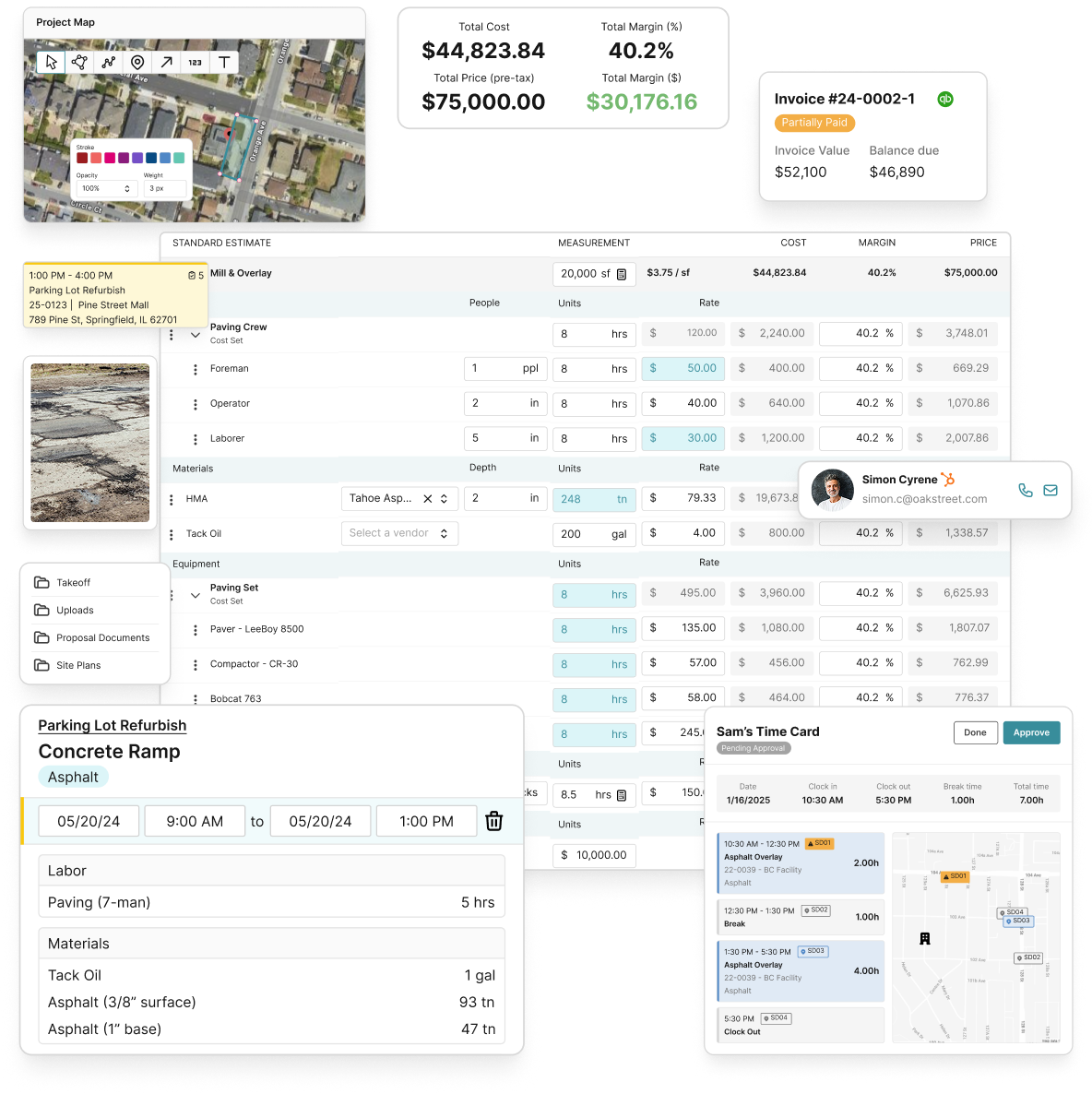
OneCrew gives commercial property managers and their contractors a single place to handle project estimating, scheduling, crew coordination, and client communication. With paving estimating software built specifically for asphalt work, you get accurate bids that reflect real material and labor costs rather than guesswork. The mobile field management app keeps crews updated in real time, reducing the costly delays and miscommunications that push projects over budget. When your paving decisions are backed by solid data, you spend less and get more from every surface you install. Book a demo to see how it works on your commercial projects.
FAQs
What asphalt paving service is best for heavy truck traffic areas?
Gap-graded mixes like SMA are best for heavy truck traffic due to their stone-on-stone contact, which resists rutting and structural deformation under repeated heavy loads.
Can cold mix asphalt be used for permanent paving?
No. Cold mix is a temporary repair solution only; any permanent commercial surface requires hot mix or warm mix asphalt for adequate durability and longevity.
How does porous asphalt improve drainage on commercial parking lots?
Porous asphalt is designed to allow water to drain through the surface instead of pooling, channeling runoff into a stone reservoir bed and reducing stormwater management costs.
What factors affect choosing the right asphalt mix for my property?
Mix selection depends on traffic volume and truck percentage, speed, climate conditions, existing pavement condition, and your budget across the full lifecycle of the pavement.
How long does an asphalt overlay typically extend pavement life?
An overlay can extend pavement life significantly when the base is structurally sound, typically at a fraction of the cost of a full pavement replacement.