Proven workflows for better paving client communication

Miscommunication frustrates clients and eats directly into your margins. A single missed scope update can trigger rework, payment disputes, and the kind of one-star reviews that follow your company name online for years. Commercial paving contractors who build structured communication workflows into every project phase see fewer surprises, faster approvals, and clients who return season after season. This guide walks you through every phase of a communication-first approach, from preconstruction kickoff straight through to post-project follow-up, with practical tools and templates you can put to work immediately.
Key Takeaways
- Start with preconstruction meetings. Align scope, responsibilities, and expectations before paving starts to minimize surprises.
- Use structured, regular updates. Consistent check-ins and digital tools keep clients informed and projects on track.
- Communicate disruptions with transparency. Handle weather delays and changes proactively with timely, clear notifications.
- Close out projects with care. Post-project follow-up, maintenance advice, and feedback increase client loyalty.
Laying the groundwork: Preconstruction communication essentials
Once you’ve acknowledged the real risks of poor communication, the first safeguard is a solid preconstruction workflow. Before a single machine rolls onto a lot, every stakeholder needs to understand what’s happening, when it’s happening, and who owns what decisions.
The Asphalt Paving Handbook NAPA April 2025 reinforces that preconstruction meetings are the cornerstone of successful project alignment, covering scope, timeline, budget, and individual responsibilities before work begins. Think of this meeting as your contract in verbal form. Everything discussed should then translate into a written document that all parties sign off on.
Key documents to finalize before mobilization:
- Written scope of work with specific quantities, materials, and exclusions clearly labeled
- Project timeline with milestone dates, not just a single completion date
- Budget breakdown showing line items, allowances, and change order thresholds
- Responsibility matrix listing who approves design changes, who handles permits, and who manages subcontractor coordination
- Site access plan with hours, entry points, and emergency contacts
Understanding contract essentials before you get into the field can save you weeks of back-and-forth later. It’s also worth reviewing paving project best practices so your team is aligned on execution from day one.
Client education is just as important as documentation. As noted in guidance on managing client expectations, clear written documents covering scope, pricing, and realistic outcomes — including curing time, settling, and weather impacts — are essential for preventing conflict later. Most clients don’t realize fresh asphalt needs 24 to 48 hours before vehicle traffic or that hairline cracks during the first season are normal. Spell it out in writing before work starts, and you eliminate most complaints before they begin.
Preconstruction documents: who owns what, and when it’s due
- Signed scope of work. Owned by the project manager, finalized on day one of kickoff.
- Client-approved timeline. Owned jointly by the PM and client, finalized before mobilization.
- Budget sign-off. Owned by the estimator and client, finalized before mobilization.
- Responsibility matrix. Owned by the PM, delivered within 48 hours of kickoff.
- Site access plan. Owned by the superintendent, delivered 72 hours before start.
Pro Tip: Assign a single point of contact on your side for all preconstruction communication. Clients get confused when emails come from three different people with different answers. One voice builds trust fast.
For surface preparation specifics, reliable surface prep protocols are worth reviewing, especially on municipal or mixed-use commercial sites where base conditions vary widely.
Keeping clients in the loop: Tools and workflows for ongoing updates
With preconstruction alignment in place, the next critical step is keeping clients informed as work progresses. The worst thing you can do mid-project is go silent. Clients who don’t hear from you will assume something is wrong, and they’ll fill the information gap with anxiety or frustration.
According to guidance from Permian Paving, effective mid-project communication relies on scheduled check-ins, a mix of formal and informal channels, a designated single point of contact, and consistent documentation of all correspondence including change orders. These aren’t optional extras. They’re the difference between a client who feels like a partner and one who feels like a bystander.
Recommended update schedule for commercial paving projects:
- Daily field log shared with the client contact (can be a brief email or portal update)
- Weekly formal check-in call or site walkthrough, especially for multi-phase projects
- Immediate notification for any change order, delay, or safety event within four hours of occurrence
- Progress photo package shared at each milestone completion
- Invoice cycle communications tied to completed phases, not arbitrary billing dates
Client portals are one of the smartest moves you can make for transparency. As Giordano Paving notes, digital client portals give clients real-time visibility into schedules, changes, and invoices, reducing inbound calls significantly. Self-performing contractors especially benefit since they can respond faster without subcontractor relay delays.
- Email. Best for formal updates and change orders. Moderate speed, excellent documentation trail.
- Text/SMS. Best for quick field updates and confirmations. Fast, but leaves minimal documentation.
- Client portal. Best for full project visibility, including invoices. Real-time, with excellent documentation built in.
- Phone call. Best for complex issues and relationship building. Immediate, but documentation is poor unless followed up in writing.
- Video update. Best for site progress and visual confirmation. Moderate speed, with good documentation value.
Managing digital document management through a centralized platform means your team spends less time hunting for the right version of a file and more time doing billable work. Exploring purpose-built paving software tools can dramatically cut down on the admin overhead that slows most paving operations.
Managing disruptions: Handling weather, change orders, and business operations
Even the best-run projects encounter disruptions. Here’s how to communicate them with expertise.
Weather is the most common unplanned variable in commercial paving, particularly across the US and Canada where temperature extremes, rain events, and freeze-thaw cycles can halt work with little warning. Understanding regional weather timing helps your team plan proactively, but you also need a communication protocol ready when conditions force a stop.
Guidance on proactive disruption management outlines a clear approach: weather delays require immediate proactive notification, a new estimated schedule, and written documentation of the reschedule. Change orders must be delivered in writing with clear breakdowns of cost and timeline impact. Business disruptions for active commercial properties require phased scheduling, tenant notices, and visual site maps showing access routes.
The contractors who win repeat commercial business are the ones who call before the client has to ask. Proactive communication in a disruption turns a potential complaint into a demonstration of professionalism.
Disruption communication checklist:
- Notify the client contact within four hours of any weather-related stop
- Provide a revised completion date in writing, never verbally only
- Include the reason, duration, and any cost impact in the written notice
- For change orders, get written approval before proceeding, every single time
- For active commercial sites, provide parking and access maps to affected tenants at least 48 hours in advance
- Post required ADA and safety signage before any lane, sidewalk, or parking area closure
Managing change order best practices is an area where many contractors lose money silently. They do the extra work, assume the client will pay, and then face a dispute at invoice time. Written approval before the shovel moves is non-negotiable.
For operations on busy commercial sites, reviewing strategies around minimizing disruptions for tenants and customers can give you a framework that’s both professional and practical.
Pro Tip: Build a simple weather delay email template and save it in your project management system. When a delay hits, you fill in three blanks and send it in under two minutes. That kind of speed signals competence to clients under pressure.
Closing strong: Post-project follow-up and ensuring ongoing satisfaction
Once work ends, the communication shouldn’t. All-star contractors close the loop to maximize client satisfaction and set up future opportunities.
Post-project follow-up is one of the most neglected phases in commercial paving. Most crews pack up and move on, leaving clients to figure out maintenance on their own. That’s a missed chance to build loyalty and generate referrals. Strong post-project communication also protects you legally by confirming client acceptance of the completed work.
Per the guidance in paving contractor email templates, post-project follow-up should include client feedback collection, maintenance tips, final walkthrough scheduling, and formal delivery of warranty documentation, all of which contribute to repeat business.
Post-project closeout follow-up steps:
- Schedule a final walkthrough within 48 hours of project completion, before any equipment demobilizes completely
- Deliver a written maintenance guide covering sealcoating timelines, load restrictions, and seasonal care
- Send warranty documentation in writing, clearly specifying what’s covered and for how long
- Request a brief satisfaction survey or online review within one week of completion
- Add the client to a seasonal outreach program for maintenance reminders and future project opportunities
Following up on post-project surface treatment options is a smart way to start that ongoing conversation. It positions your company as a long-term infrastructure partner, not just a one-time vendor.
Additional touchpoints worth building into your workflow:
- 30-day check-in call to catch any warranty-related concerns early
- Annual pavement condition review offer tied to seasonal timing
- Referral request message sent with a simple, no-pressure ask
Learning how to turn completed projects into new leads is covered well in resources on booking more paving jobs. Every satisfied client is a potential referral source if you give them the tools and prompt to share your name.
What most contractors miss about client communication in paving
Most paving contractors invest heavily in equipment, crew training, and estimating accuracy, but treat communication as an afterthought handled case-by-case. That’s a structural mistake. The clients who leave you for a competitor rarely do it because of pavement quality. They leave because they felt uninformed, unheard, or surprised by something that could have been explained upfront.
The contractors who consistently win large commercial accounts and retain them year after year treat field-tested communication as a repeatable system, not a personality trait. They use templates, portals, scheduled touchpoints, and documented workflows the same way they use quality control checklists on a job site. Communication becomes a process, not a guess.
If your team runs a tight field operation but loses clients at invoice time, or struggles to get repeat calls from past accounts, the answer is almost never better asphalt. It’s better communication, made consistent through the right systems.
Ready to streamline your paving communication workflow?
Implementing these steps is easier when you have the right digital tools in place.
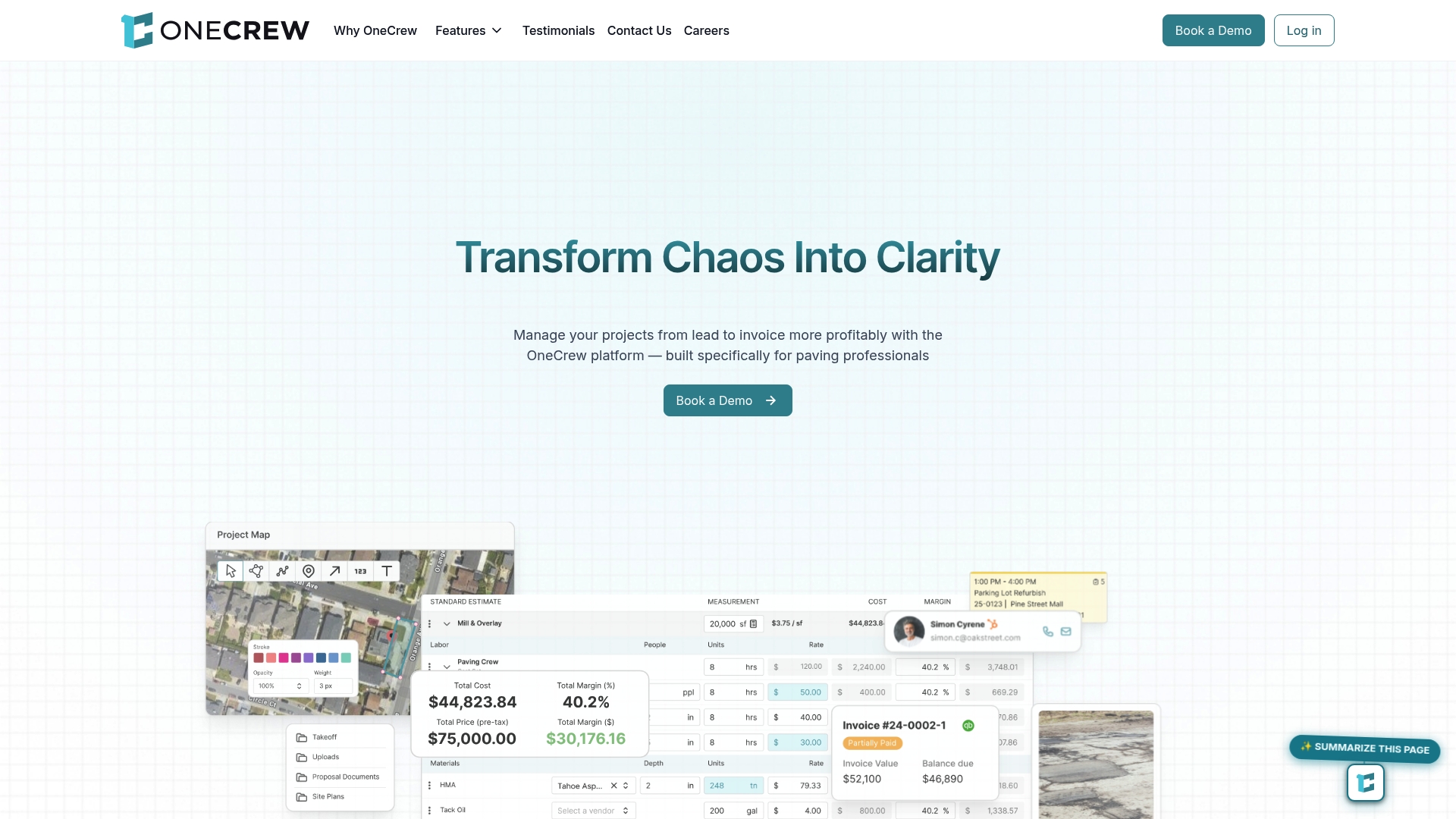
OneCrew is built specifically for asphalt paving contractors who want to turn scattered communication into a competitive advantage. From drag-and-drop scheduling tools that keep clients updated on crew timelines to a fully integrated construction CRM platform that centralizes every client interaction, the platform puts your entire workflow in one place. Visit OneCrew to explore how top North American contractors are using technology to close more jobs and keep clients coming back.
Frequently asked questions
What communication tools are best for commercial paving projects?
Digital portals and project management apps make it easy to schedule updates, share documents, and track project changes with commercial clients. Pairing those with a single point of contact on your team keeps communication consistent and accountable.
How should weather delays be communicated to clients?
Notify clients as soon as possible about potential weather delays, provide a new estimated date, and document all rescheduling in writing for accountability. Using a pre-built email template allows your team to respond quickly and professionally every time.
Why is documenting change orders important in paving projects?
Documenting change orders in writing ensures clear agreement on cost, scope, and timeline adjustments, reducing disputes with clients. Written change order approval before work proceeds protects both your margins and your client relationship.
What follow-up steps should be taken after a paving project completes?
Follow up with a client walkthrough, provide care and maintenance tips, share warranty documents, and ask for feedback to ensure satisfaction. As outlined in post-project best practices, these steps are what convert one-time clients into repeat accounts and referral sources.