Project Management Software Benefits for Paving Contractors

Choosing the right project management software is one of the most consequential decisions a paving contractor can make. The market is crowded, promises are plentiful, and not every platform delivers results that actually show up in your bottom line. New research makes it clear that PM software adoption delivers measurable profitability and efficiency gains for construction contractors — but only when the right tool gets paired with disciplined adoption. This article cuts through the noise and focuses on what actually matters for paving operations specifically.
Key Takeaways
Why the right project management software matters for paving contractors
Paving is not a simple one-truck, one-crew business. Even a mid-size asphalt contractor manages multiple crews across several active job sites, coordinates equipment availability, tracks material deliveries, handles client change orders, and processes invoices — often all in the same day. When those workflows depend on whiteboards, spreadsheets, or phone calls, things slip. A missed change order costs you money. A scheduling miscommunication sends a paving crew to the wrong address. A lost job photo leaves you exposed during a dispute.
The core problem is fragmentation. Information lives in too many places and moves too slowly between field teams and the office. Digitizing field workflows reduces errors, cuts manual workload, and eliminates delayed documentation that slows billing cycles and client approvals. That is not a theoretical benefit. It is an operational reality that paving firms see when they replace paper-based processes with connected digital tools.
Project management software changes the equation by centralizing everything. Centralized project data reduces miscommunications and budget overruns by giving every stakeholder — from the estimator to the foreman to the office manager — a single shared source of truth. Here is what that looks like in practice for a paving firm:
- Crew schedules are visible in one shared calendar, updated in real time
- Work orders are issued digitally and acknowledged by crew leads before they arrive on site
- Change orders are documented and approved through a structured workflow instead of a text message
- Job photos and field notes are captured on mobile devices and attached directly to the project record
- Invoices are generated automatically from completed work order data, cutting billing delays
Those are not cosmetic upgrades. They represent a structural shift in how your business operates day to day.
When field and office teams share the same data in real time, disputes shrink, billing accelerates, and job outcomes improve. The tool is only as powerful as the workflow it supports.” — Field operations best practice, asphalt sector
Explore how asphalt paving software is reshaping the way North American contractors manage jobs from bid to final invoice.
Top benefits: What the data shows for efficiency and profitability
Once you understand the pain points, the next question is obvious: what actually changes after paving firms make the switch?
Contractors who digitize their operational workflows commonly report meaningful overhead cost reductions and stronger profit margins after adopting project management software. Those are not marginal gains — overhead that stays in the business compounds across a full season.
On the field side, digitizing operational workflows reclaims a significant share of administrative time. Those are hours reclaimed every week — hours that can go toward bidding more work, managing more crews, or simply running a tighter operation.
- Reduced overhead costs for firms that fully adopt
- Improved profit margins for firms that fully adopt
- Substantially reduced admin time per project
- Faster change order processing through digital workflows
- Same-day or next-day invoice cycles with automation
The gains are not evenly distributed, though. The study is clear that the biggest results go to what researchers call “optimized adopters” — firms with strong training programs, standardized processes, and disciplined software usage across every team member. Contractors who buy software but never fully integrate it into their workflows see only modest improvements.
Pro Tip: Start with one workflow, such as work order management, and fully adopt it before expanding to scheduling or invoicing. Partial adoption is the number one reason firms underperform after implementation.
For a deeper look at how software drives real operational improvement, review top paving contractor software picks for a side-by-side breakdown of available tools.
Key features to look for in construction project management software
If you want to earn the kinds of gains covered above, you need to focus on software features that actually drive those results. Not every feature listed in a sales demo will move the needle for a paving contractor. Here is a prioritized checklist.
- Digital work orders. The ability to create, assign, and close work orders from a mobile device is foundational. Field crews need to receive job instructions and report completion without touching paper.
- Real-time scheduling. Drag-and-drop crew scheduling with live updates prevents double-booking and eliminates the “who is going where today” phone calls that eat up foreman time every morning.
- Job costing and budget tracking. Real-time cost visibility against estimates lets you catch overruns before they compound. This feature alone drives significant margin improvement for paving firms.
- Photo-based documentation. Mobile photo capture tied directly to a job record gives you before-and-after documentation for every project. This protects you legally and speeds client approval.
- Integration with estimating tools. When your estimate data flows directly into your project management system, you eliminate manual re-entry errors and maintain budget accuracy from bid through completion.
- Reporting and analytics dashboards. Aggregate performance data across all jobs so you can see which crew types, job types, or geographic areas generate the best margins.
Workflow standardization paired with centralized visibility reduces miscommunication, missed deadlines, and budget overruns across construction projects of all sizes.
Pro Tip: Ask any software vendor to show you how their platform handles a mid-job change order from field capture to client approval to invoice adjustment. If the demo takes more than a few clicks, the workflow is too complex for a busy crew.
Look at recommended scheduling tools to see which specific features are generating the most value for paving operations right now.
Real-world payoffs: How project management software changes the game for paving
Knowing the features is useful. Seeing how they play out on a real job site is better.
Imagine your crew is two days into a commercial lot resurfacing project. The client calls and requests an additional layer on a section that was not in the original scope. Without software, that request becomes a chain of phone calls, a handwritten note from the foreman, a manually updated estimate, and a revised invoice created from scratch days later. With project management software, the change order is logged in the field app within minutes, routed to the project manager for approval, and automatically reflected in the billing summary.
The financial impact compounds over a full season. Consider this before-and-after scenario:
Operational feedback loops that connect planning, execution, and documentation are a primary driver of profitability gains and project visibility in high-performing construction firms.
Strong crew management apps make these feedback loops automatic rather than something your team has to manually maintain.
Why adoption alone isn’t enough: The overlooked ROI factor in project management software
There is a troubling gap across the industry. While tool adoption rates are high across construction, “excellent” oversight ratings dropped 20 points since 2024. More contractors are using project management tools, yet fewer are satisfied with the outcomes they are seeing. That is not a software quality problem. That is an adoption quality problem.
The biggest winners are firms with robust training programs and tight workflow integration. Firms that purchase software and then let crew leads figure it out on their own — or allow workarounds to persist — capture only a fraction of the available value.
What separates the top performers from the rest is process discipline. They define what a completed work order looks like. They require field photos at the start and end of every job. They review job cost dashboards weekly, not quarterly. They treat software as the operating system of their business, not an optional convenience.
For context, a well-managed change order process is one of the clearest indicators of how seriously a contractor has embedded their software into real operations. If change orders still get handled informally, the software is not doing its job.
Our view is direct: software is a multiplier, not a solution. Weak processes multiplied by great software still produce weak results. Strong processes multiplied by great software produce the kind of gains the best operators consistently see.
Take your next step with the right project management solution
The benefits covered in this article are real and well-documented for paving contractors who make the right choice and follow through on adoption. The challenge is finding a platform built specifically for paving operations rather than a generic construction tool that needs heavy customization to fit your workflow.
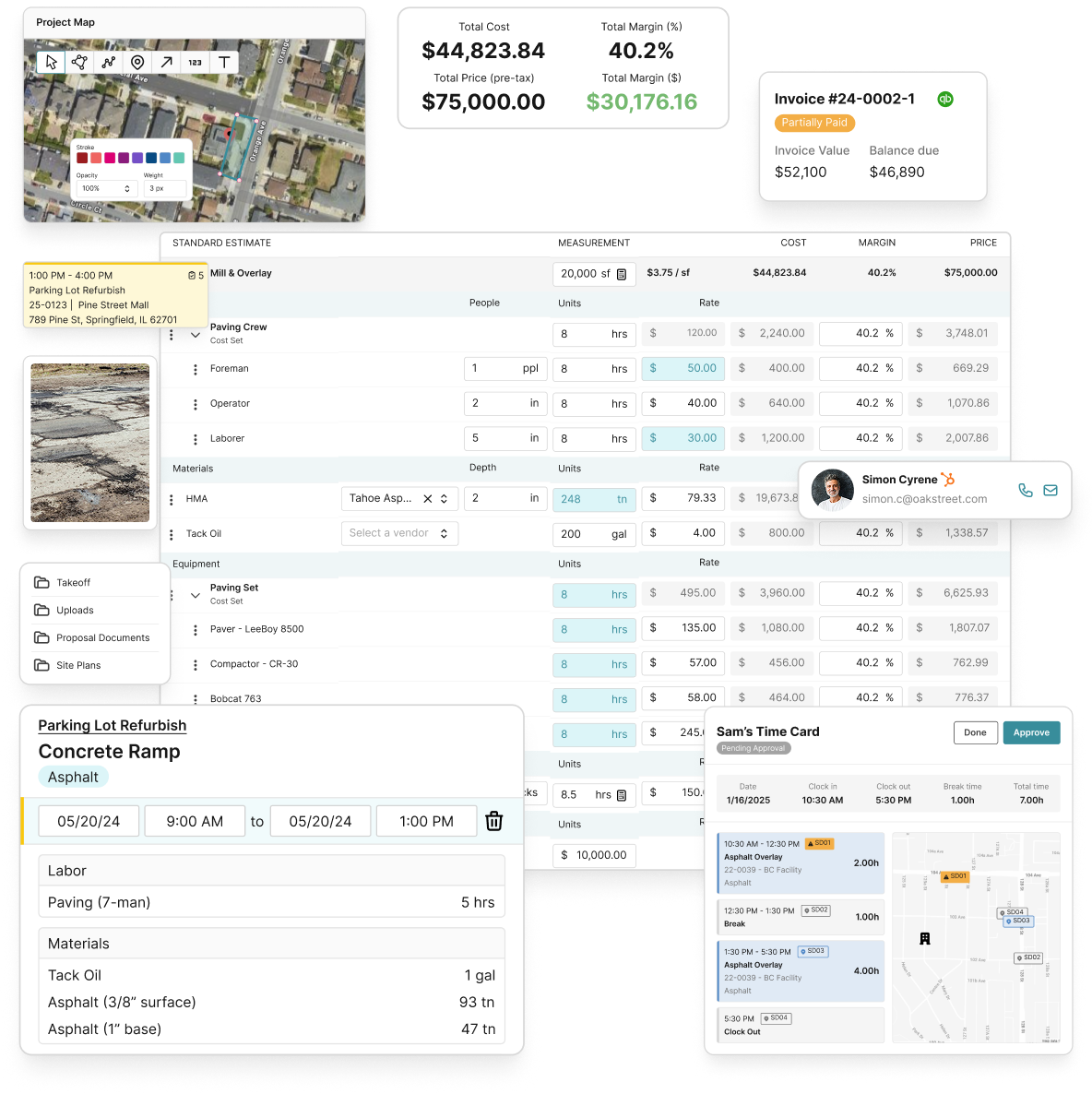
OneCrew is built from the ground up for paving and asphalt contractors. From estimating software that turns measurements into accurate bids without manual spreadsheet work, to a mobile field management app that keeps your crews connected and documented on every job, the platform covers the full job lifecycle. If you are ready to stop losing margin to scheduling gaps, billing delays, and change order chaos, the OneCrew all-in-one platform is worth a close look. Schedule a demo and see exactly how it performs in real paving scenarios.
Frequently asked questions
How much time can project management software save for asphalt paving contractors?
Asphalt contractors report a substantial reduction in administrative time when they digitize their field workflows, freeing up hours each week for estimating and crew oversight.
Which features make the most difference for paving operations?
Centralized scheduling, real-time job tracking, digital work orders, and photo-based reporting drive the largest gains, as these directly address the fragmentation problems that cost paving firms the most time and money. Centralized data reduces miscommunications and budget overruns across project types.
Does using software guarantee better project performance?
No. Top results depend on training and process integration, not just installation. Adoption without discipline consistently underperforms, which is why usage rates can climb while satisfaction stalls.
Can project management software reduce budget overruns?
Yes. Real-time cost tracking, workflow automation, and standardized visibility help catch overruns early, reduce miscommunication, and keep projects closer to their original budget estimates throughout execution.