7 Best Infrared Asphalt Heaters for Paving Crews in 2026

Cutting and removing ties up a crew for half a day and leaves a cold joint that lets water in by the first freeze. An infrared asphalt heater reheats the pavement you already have, so your crew rakes the same material back in and rolls it flat.
I pulled spec sheets, price lists, and rental rates from every manufacturer still building these units, then checked the pitch against an Ohio DOT field study. Here are the 7 best infrared asphalt heaters for 2026, what each costs, and where each fits.
7 Best Infrared Asphalt Heaters: TL;DR
Here is the short version if you are shopping this week. Two manufacturers publish real prices on their sites; the rest quote.
- Ray-Tech Infrared: Best for contractors who want published prices and a rental before they commit
- Kasi Infrared: Best for truck-mounted crews running infrared as a daily production service
- KM International: Best for folding self-trailering units a two-person crew can wheel by hand
- Heat Design Equipment: Best for cold-weather paving, joint heating, and skid steer mounting
- RynoWorx: Best for small crews buying their first infrared heater on a tight budget
- Trackless Vehicles: Best for municipal fleets that already run a tractor and want no propane
- Asphalt Reheat Systems: Best for one-person patch crews and stamped or decorative asphalt
How an Infrared Asphalt Heater Works
An infrared asphalt heater uses radiant heat to soften existing pavement in place, so a crew can scarify, re-level, and recompact the same material with no sawing and no haul-off.
The heater sits over the repair area, propane burners fire a ceramic or steel converter, and that converter radiates heat down into the mat.
No flame touches the asphalt, which protects the binder oils that keep the mat flexible and is why infrared patching leaves no cut joint behind.
Heating times land in a tight range across brands. Most units soften 2 to 2.5 inches in 5 to 10 minutes, and the hottest chambers reach full depth in 6 to 8 minutes. The brand-by-brand numbers sit in the reviews below.
The infrared repair process step by step
- Clear the area dry: Blowers, brooms, and wire brushes pull debris and loose material out of the repair. Water belongs nowhere near this step.
- Set the heater and run a cycle: Most units need 6 to 10 minutes, and a timer or heat cycling control keeps the burn consistent from patch to patch. Crews call that heated rectangle a window.
- Scarify and rake: Lift the heater, break up the softened mat with a rake or lute, and pull the edges in toward the middle. That softened ridge you pull in from the edges is a berm.
- Add rejuvenator and fresh mix: A light shot of rejuvenator restores the old binder, then top up with hot mix from a hot box or reclaimer.
- Level and compact: Rake to grade and roll while the mat is still hot, which fuses the patch to the pavement around it with no cut joint to fail later.
Ray-Tech puts a typical repair at roughly 20 minutes from the start of heating to final compaction, so heat cycles end up setting the pace of the whole day.
Where infrared earns its keep
The strongest case for infrared is patch survival. An Ohio DOT study that installed more than 60 test patches found infrared patches performed significantly better than throw and roll or spray injection patches, with a much longer expected life.
For permanent repairs, the same report found infrared can beat throw and roll on cost once you look past the first invoice.
Where infrared falls short
That same Ohio DOT report found infrared had much lower productivity than throw and roll and spray injection, so you trade patches per day for patches that last. Raveling showed up as the main distress in those infrared patches, and improper storage of the heater caused ignition problems that stretched repair times. A few more limits to weigh before you sign anything:
- Surface course only: Infrared works the top 2 to 2.5 inches, so a failed base still needs a full-depth dig-out.
- You need hot mix on hand: Without a hot box or reclaimer holding workable material, the heater sits idle.
- Weather still wins: Wind steals heat from the chamber edges, and standing water stops the job.
- Operator skill decides the outcome: Heat time, rake technique, and roller timing have to repeat the same way on the fortieth patch as they did on the first.
How I Researched These Infrared Asphalt Heaters
I built this list from manufacturer sites only: This includes current spec sheets, published price and rental pages, brochures, and manuals, checked in September 2026.
Where a company publishes no prices, I went looking for what it does publish instead, whether that is financing terms, dealer contacts, or rental rates.
Two names came up in searches and did not make the list. Falcon builds excellent hot boxes and recyclers but no infrared heater, and several large equipment retailers list infrared units at prices those retailers set themselves. Here is what I weighed:
- Heating area and depth: How much pavement one cycle covers, and how deep the heat penetrates
- Fuel and power: Propane cylinder count and pressure range, blowers versus natural draft, or electric elements
- Mount style and mobility: Walk-behind, folding self-trailering, trailer, truck, skid steer, or tractor attachment
- Price transparency: Published list prices, financing figures, rental rates, or quote-only
- Parts and support: Cartridge and converter replacement, dealer coverage, and rental availability
That mix tells you more about a machine than a features grid does, because in this category the real differences show up in coverage per cycle and in what you can find out before a salesperson calls you back.
7 Best Infrared Asphalt Heaters: Quick Comparison
1. Ray-Tech Infrared: Best for Contractors Who Want Published Prices
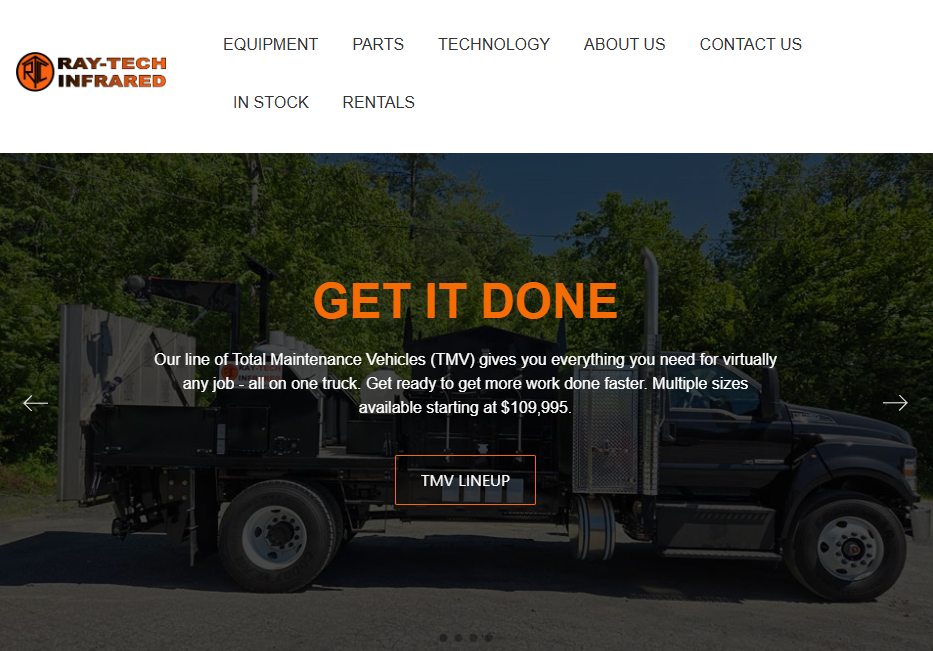
What it does: Ray-Tech Infrared builds walk-behind heaters, trailer and truck mounts, reclaimers, and combo units, and it posts real prices and rental rates on its own site.
Best for: Contractors who want to know the number before they take a sales call, and crews that want to bill an infrared job before owning a machine.
Ray-Tech runs the hottest chambers in this group and leans on that for speed. The lineup scales cleanly, so a walk-behind you buy this spring uses the same converters as the truck combo you might buy in three years.
Key features
- Welded ribbon converters: Chamber temperatures average 1,875 degrees Fahrenheit, which Ray-Tech credits for even full-depth heat in 6 to 8 minutes with no cold spots
- Stainless steel chambers: Every heating chamber is stainless with high heat tolerant materials, and Ray-Tech skips blanket-style elements
- Reclaimer pairing: Ray-Tech reclaimers hold hot mix at working temperature for up to 48 hours and bring stockpiled asphalt back to working temperature in 12 hours
- Joint heating line: Company testing puts joint density at 95 to 100 percent when heaters run alongside the paver
- Rent to own: Rental fees apply toward a purchase, which turns a trial into a down payment
Ray-Tech Infrared pros
- Published list and in-stock prices, which almost nobody else in this category does
- Rentals from $400 per week let you sell an infrared repair before you buy the machine
- Range covers a 14 sq ft walk-behind up to a 48 sq ft truck combo with a reclaimer
- Flat rate shipping of $995 anywhere in the lower 48
Ray-Tech Infrared cons
- In-stock pricing moves with inventory, so the discount you see today may be gone next week
- Rental units ship from Charlestown, New Hampshire, and quoted rates exclude freight
- Ignition is manual with a hand torch you supply
Pricing
Ray-Tech's in-stock inventory page listed the Mini Tech walk-behind at $13,995, the Mini Tech Xtend at $14,995, the Fusion MT at a $25,995 list price, and the Tech 24 trailer at $39,995 list or $34,995 in stock as of its September 2026 update.
A 2 Ton Combo with an 8-by-6-foot chamber and a reclaimer carried a $117,975 list price and sold off that page, so treat the combo tier as a quote. Rental rates run $400 per week or $1,250 per month for walk-behinds, $1,300 per week for the Tech 24, and $3,680 per week for the 2 Ton Combo.
Bottom line
If you are building a budget this week, start here, because Ray-Tech is the only manufacturer on this list where you can price a machine and a rental in the same afternoon.
2. Kasi Infrared: Best for Truck-Mounted Production Crews
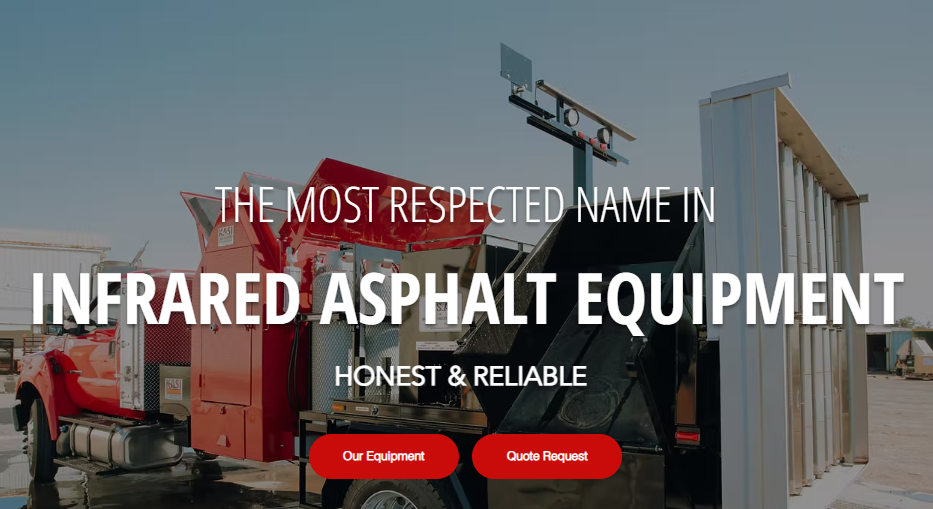
What it does: Kasi Infrared builds infrared heaters and self-contained truck-mounted restoration systems that carry the heater, reclaimer, tools, compactor, and waste bin on one chassis.
Best for: Contractors selling infrared repair as a service line, where a 2- or 3-person crew works a route all day without going back to the yard.
Kasi's pitch is that everything the repair needs rides on the truck. That matters most on scattered commercial work, where a return trip for mix or a roller eats the margin on a $600 patch.
Key features
- Patriot 3 and 5 ton: Truck-mounted system with a 6 by 8 foot, 48 sq ft heater, a 3 or 5 ton reclaimer, hydraulic controls, tool storage, and a dumping waste bin
- ProHeat Minuteman: A 3-ton reclaimer paired with the same 48 sq ft heater plus an optional compactor lift
- IR-480 trailer heater: Softens pavement for texturing in 5 to 6 minutes and reaches 2.5 inches of workable depth in 7 to 9 minutes
- IR-120 WB: A 3 by 4 foot, 12 sq ft walk-behind with three converters and 5 to 6 minute cycles about 2 inches deep
- Shared converters: Every machine in the lineup runs the same UltraGlo converters, so spare parts cover the whole fleet
Kasi Infrared pros
- One truck equips a crew of two or three for a full day of repairs
- Kasi reports 2 to 3 tons of hot mix staying usable throughout the day in its reclaimers
- The walk-behind gives you a low-cost way to test the process before buying a truck system
- Matching VIBCO GR-3200 roller available through the same dealer
Kasi Infrared cons
- No published prices anywhere on the site, only a quote request form
- Truck-mounted systems are the largest capital jump on this list by a wide margin
- Specs live in downloadable PDFs, so comparing models takes more clicking than it should
Pricing
Kasi publishes no prices and handles everything through a quote request or its dealer network. When you call, ask for the price of the truck system separately from the chassis, since a Patriot build depends on the truck you bring.
Bottom line
Kasi makes the most sense for the contractor whose calendar is already full of infrared work, and least sense for anyone still testing whether the service will sell.
3. KM International: Best for Folding Self-Trailering Units
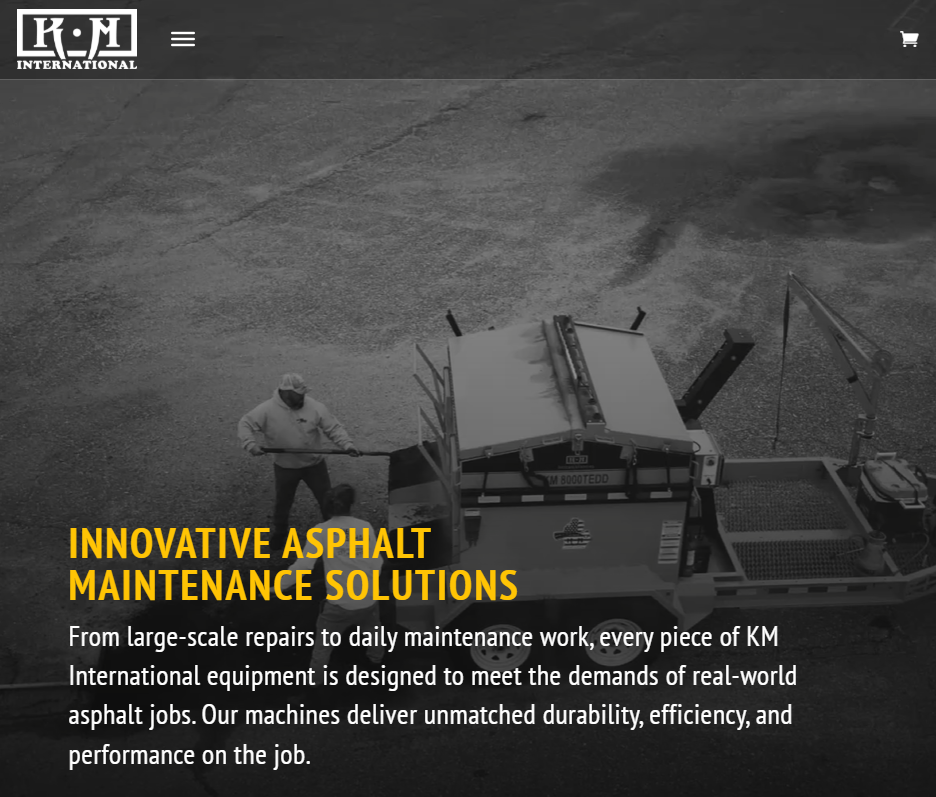
What it does: KM International builds folding infrared recyclers from 16 to 48 sq ft that tow behind a pickup and then roll on casters once you are on site.
Best for: Contractor crews of two who want trailer-size coverage without buying a dedicated trailer or truck build.
The KM 4-40 is the unit most asphalt contractors land on, and the folding design is why. It tows like a small trailer, then unfolds into a 40 sq ft heater a single operator can push into position.
Key features
- KM 4-40: 40 sq ft across four zones, 700,000 BTU output, 810 pounds, and it folds into a single-axle self-trailering unit
- Independent heating zones: Shut off the zones you do not need on small patches to cut propane use and heating time
- LB 2-16: A compact 16 sq ft unit sized for oil spots, bird baths, and small potholes
- KM 4-48: The 48 sq ft version, which KM recommends for templating and thermoplastic work
- Automatic pilot ignition: No hand torch required to light the machine
KM International pros
- Published financing figures, from $159 per month on the LB 2-16 to $379 per month on the KM 4-48
- Built in the United States with a distributor network plus Sourcewell and NCPA contracts for public agencies
- Free training documents, including an infrared profit model and a jobsite procedure guide
- Folding frame keeps a 40 sq ft heater towable behind a half-ton truck
KM International cons
- Monthly payment estimates are not list prices, and they assume 60-month lease terms through third-party lenders
- Casters on an 810-pound machine are hard work on slopes and rough shoulders
- Heat cycling depends on a 12V deep cycle battery somebody has to keep charged
Pricing
KM quotes by phone, through an online inquiry form, or through an authorized distributor. The KM 4-40 page lists payments from $339 per month based on 60-month lease terms from third-party finance companies, with links to Crest Capital and Stearns Bank applications.
KM also publishes an infrared profit scenario that prices repair work at $5.00 per square foot and models 20 heats a day at 40 square feet each, which pencils out to $4,000 in daily revenue against about $54 of cost per repair.
That is a manufacturer's model, so rebuild it with your own labor rate, propane price, and drive times before you use it to justify the payment.
Bottom line
I would put KM at the top of the list for a growing contractor buying one machine to do everything, as long as you read that monthly payment as a financing estimate on 60-month terms.
4. Heat Design Equipment: Best for Cold-Weather Paving and Joint Heating
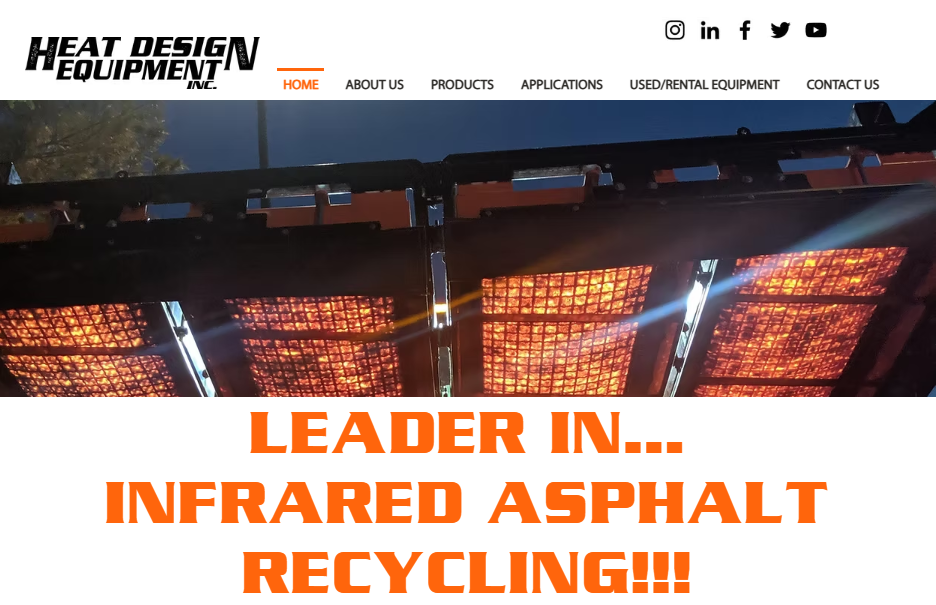
What it does: Heat Design Equipment has built infrared asphalt equipment since 1976 and covers patchers up to 110 sq ft, mini heaters, skid steer attachments, and joint heaters for new paving.
Best for: Paving contractors in northern climates who want to preheat before the surface course, heat longitudinal joints, and repair potholes with the same brand of equipment.
HDE is the one manufacturer here that treats paving and patching as the same problem. Its patchers preheat base asphalt so a contractor can keep paving when ambient temperatures fall below spec.
Key features
- P800 to P1600 patchers: 8, 12, or 16 independent heat zones covering 57 to 110 sq ft, softening 2.5 inches of surface course to 220 degrees Fahrenheit in 5 to 10 minutes
- Patented cartridge system: Replaceable ceramic cartridges last roughly 1,500 hours and swap out in under 20 minutes
- Mini heaters: The P300 and P400 UT run with no blowers or batteries at 5 to 50 psi, and HDE puts operating cost as low as $1.50 per hour
- Skid steer attachments: Five models from 600 to 1350 SSA with an in-cab remote, high and low heat selector, and emergency stop
- Cold-weather preheating: Heating the base before the surface course protects bond and density when the calendar turns
Heat Design Equipment pros
- Zone control on wide patchers cuts propane on small repairs
- Cartridge replacement keeps long-term repair costs low compared to full element swaps
- Mini heaters need no batteries or blowers, which removes two failure points
- Rental units available directly through HDE
Heat Design Equipment cons
- Quotes come by email or dealer only, with no prices published anywhere
- Manufactured in Kitchener, Ontario, so United States buyers deal with dealer coverage and cross-border freight
- HDE scatters model naming across several pages, and mini heaters turn up on two of them
Pricing
HDE publishes no prices. Quotes come through the company or a local dealer, and HDE lists rental equipment separately. Ask for cartridge pricing at the same time, since that is your recurring cost.
Bottom line
For a contractor whose season ends with the thermometer, HDE has the most useful lineup here. Pure patch crews will find simpler machines elsewhere.
5. RynoWorx: Best for a First Infrared Heater on a Tight Budget
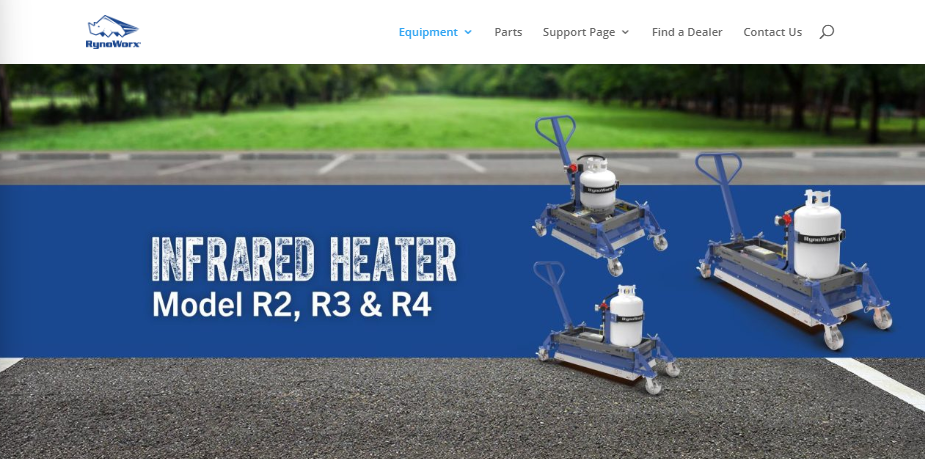
What it does: RynoWorx builds three small propane walk-behind infrared heaters, the R2, R3, and R4, that link together with caster assemblies to cover a wider area.
Best for: Sealcoating and crack fill crews adding infrared patching as a second service without financing a trailer-mounted machine.
These are the lightest units here by a wide margin, at 153 to 189 pounds. One person can move a heater, and the modular linking means you can buy a second unit next season instead of a bigger machine.
Key features
- R2: A 24 by 24 inch heater area, 50,000 BTU burner, 35 psi max, at 153 pounds
- R3: A 19 by 39 inch heater area, 75,000 BTU burner, 45 psi max, at 169 pounds
- R4: A 19 by 51 inch heater area, 100,000 BTU burner, 45 psi max, at 189 pounds
- RynoLink caster assemblies: Connect multiple heaters to cover larger repairs
- 8-minute heat cycle: RynoWorx says that brings asphalt back to original mixing temperature
RynoWorx pros
- Lightest and most portable option, easy to load with your crack fill gear
- Modular design lets you scale coverage one unit at a time
- Straightforward ceramic cartridge design with published specs on every model
- Dealer network handles service, so you are not shipping a machine across the country
RynoWorx cons
- Coverage tops out at 6.7 sq ft per unit, so parking lot production needs several heaters
- No published prices, and pricing varies by dealer
- No reclaimer or hot box in the lineup, so you source workable mix another way
Pricing
RynoWorx sells through dealers and lists no MSRP. Its dealer finder is the starting point, and prices differ by region. Ask two dealers, because there is no published number to anchor the conversation.
Bottom line
Buy RynoWorx for the season where infrared is still a test on your books. If potholes are already half your revenue, a 40 sq ft folding unit will pay for itself faster.
6. Trackless Vehicles: Best for Municipal Fleets Running Tractor Attachments
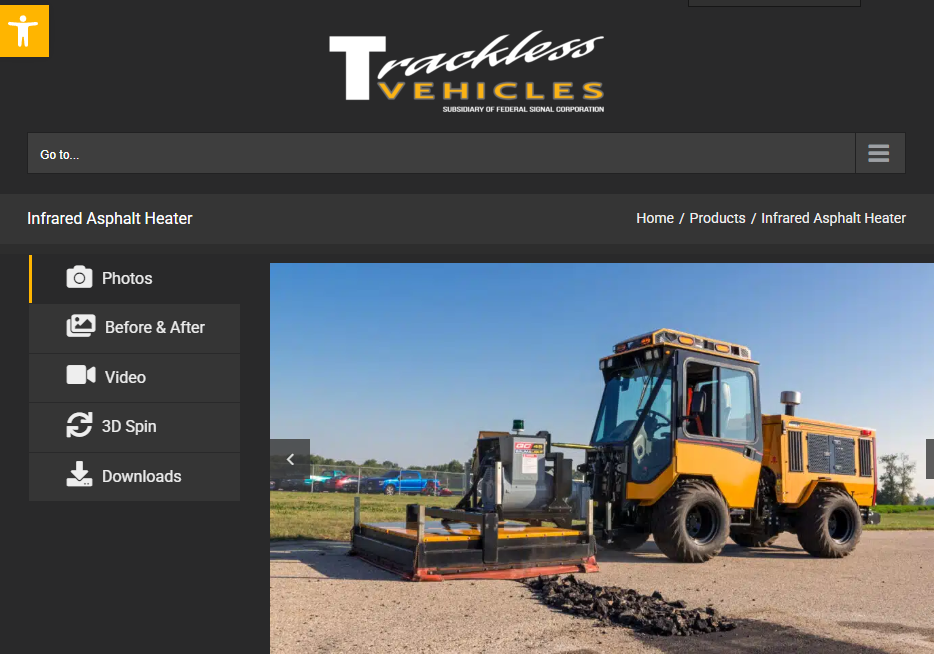
What it does: Trackless Vehicles sells an electric infrared asphalt heater attachment for its municipal tractors, powered by a PTO-driven generator, with no propane on board.
Best for: Public works departments and agencies that already run a Trackless tractor and want asphalt repair without propane on the truck.
Electric elements change the safety math. There is no open flame near catch basins or manholes where gas can collect, and nobody on the crew handles cylinders.
Key features
- 4-by-6-foot heating pan: 24 sq ft of coverage with 11 electric heating elements and 8 stainless deflector shields
- 5-inch ceramic insulation: Holds heat in the pan instead of losing it upward
- Rake-ready in 15 minutes: Set the cycle time, press start, and repeat that cycle patch after patch
- Detachable generator: Pull four pins and the 45 KW, 175-amp generator becomes portable power with 110V and 220V receptacles
- LED control panel: Cycle timer, jog control, and emergency stop, with security fencing around the tractor and generator
Trackless Vehicles pros
- No propane to store, transport, or exchange
- Generator doubles as jobsite or emergency power for pumping stations and shelters
- Operators need little training because there is no flame to manage
- Recycles the existing surface with no cut joints and minimal new aggregate
Trackless Vehicles cons
- Requires a Trackless municipal tractor, so the decision sits with the whole fleet
- The attachment weighs 2,045 pounds, and the generator adds another 1,100
- A 15-minute cycle is slower than the hottest propane chambers on this list
- Pricing comes through dealers and tender specifications, with nothing published
Pricing
Trackless publishes no prices for the infrared attachment. Quotes run through its dealer locator or a tender specification package, and Trackless sells the generator separately, which is worth confirming early since it drives a large share of the cost.
Bottom line
Trackless designed this one for agencies. If your fleet already runs Trackless tractors, the attachment is an easy yes. If it does not, the tractor requirement rules it out.
7. Asphalt Reheat Systems: Best for One-Person Crews and Stamped Asphalt
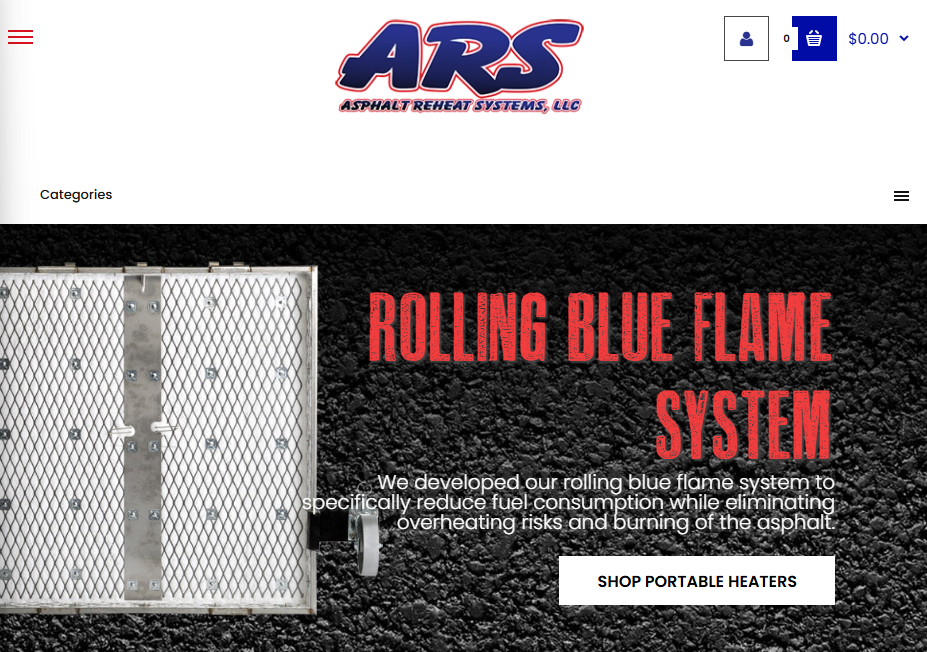
What it does: Asphalt Reheat Systems sells four sizes of portable heater panels online with prices listed, built around a rolling blue flame burner, which differs from the ceramic converters most units here use.
Best for: Small crews doing driveway and walkway repairs, plus contractors adding stamped or decorative asphalt as a higher-margin service.
Worth being precise here: ARS markets these as portable infrared heaters, and the heat is radiant, but the burner design is blue flame.
The company argues that approach reduces overheating risk and fuel use, which is the company's own claim with no independent testing behind it.
Key features
- 1x4 portable unit: The smallest and lightest panel at roughly 75 pounds
- 2x4 portable unit: 8 sq ft of heating area at just over 100 pounds
- 4x4 and 4x6 units: 16 and 24 sq ft, with the 4x6 offering the highest output of the four
- Online ordering: Prices, specs, and checkout all live on the site
- Decorative asphalt work: Reheat and stamp existing asphalt for textured surfaces without hot printing
- Stainless steel boxes: ARS backs them with a lifetime guarantee
Asphalt Reheat Systems pros
- Lowest entry price on this list at $5,695
- Prices published online, so you can build a budget without a sales call
- Light enough for a single operator to set and move
- Stamped asphalt opens a service line most paving contractors do not offer
Asphalt Reheat Systems cons
- Blue flame burner design, so compare it side by side with a true infrared converter unit
- The claim of being superior to standard infrared heaters comes from ARS with no third-party testing behind it
- Small coverage per panel, and no reclaimer or hot box in the lineup
- Site copy looks dated, so confirm current model availability by phone
Pricing
ARS lists prices directly on its portable heaters collection: $5,695 for the 1x4, $6,695 for the 2x4, $8,295 for the 4x4, and $8,995 for the 4x6.
Bottom line
ARS is the cheapest way onto this list, and for driveway work and decorative stamping that is enough. For commercial parking lot production, the coverage and the burner design both argue for something else.
Which Infrared Asphalt Heater Should You Choose?
The right infrared asphalt heater comes down to three things: how much pavement one cycle needs to cover, whether you are towing the machine behind a pickup or mounting it on something you already own, and how much you need to know about price before a salesperson calls you back.
Run the numbers on equipment ROI before you sign, because a heater that sits in the yard three days a week costs more than the payment suggests.
Choose Ray-Tech Infrared if you …
- Want a published price and a rental rate before you talk to anyone
- Would rather rent a walk-behind for a month and bill a few jobs than finance a machine cold
- Plan to grow from a walk-behind into a reclaimer combo on the same converter platform
Choose Kasi Infrared if you …
- Already sell enough infrared repair to keep a dedicated truck and crew busy
- Want the heater, reclaimer, tools, compactor, and waste bin riding on one chassis
- Run scattered commercial sites where a return trip to the yard kills the margin
Choose KM International if you …
- Need 40 sq ft of coverage that still tows behind a pickup
- Like zone control so small patches do not burn propane across the whole pan
- Buy through public agency contracts or want financing figures posted upfront
Skip infrared entirely if …
- Your failures are base failures, since infrared only reworks the top 2 to 2.5 inches
- You have no hot box or reclaimer and no plan to get workable mix to the site
- Patch count per day is the number your contract rewards, because the Ohio DOT data shows infrared trades speed for longevity
Final Verdict
Ray-Tech Infrared is where I would send most contractors first, because you can price a machine, price a rental, and start the math today instead of waiting on three quotes.
KM International is the better buy for a crew that wants one folding unit to handle everything behind a half-ton truck, and HDE wins outright if cold-weather paving and joint heating matter as much as patching does.
Run Your Paving Jobs the Way You Run Your Heat Cycles
Infrared work is small-ticket and high-volume, so a crew can close six repairs in a day and generate six separate invoices, each with its own photos, quantities, and sign-off. Let those pile up on a truck seat for 3 weeks, and you hand back the cash flow advantage you bought the machine for.
OneCrew is a platform built specifically for project-based asphalt and concrete paving contractors, and it ties your infrared repair operation together from the first site measurement to the final payment. Here's what OneCrew covers:
- Price infrared jobs with equipment time, propane, and reclaimer hours as real line items: OneCrew's estimating tools let you build estimates from aerial imagery or plan takeoff with configurable calculators for labor, materials, equipment, and subs.
- Schedule the infrared crew and the overlay crew without sending both to the same address at the same time: Running one heater across several sites in a week means somebody is tracking mix, propane, and crews, and OneCrew's scheduling feature assigns crews, roles, and equipment to specific job phases so your office and field stay aligned from mobilization through repair and final compaction.
- Send work orders, patch specs, and site addresses to the crew before the truck rolls: The field management tools push mobile work orders, GPS directions, and job details to crew phones and pull time, quantities, and photos back to the office as each repair closes out.
- Turn the estimate into a signed proposal before the pothole gets a second freeze-thaw cycle: OneCrew's proposals feature generates professional, branded proposals directly from your estimate.
- Keep every property manager and repair history so a patch job turns into a maintenance contract: OneCrew's CRM tracks every lead, conversation, past service date, and project record in one place.
- Invoice the same day the crew finishes and sync to QuickBooks without double entry: OneCrew's invoicing tools generate invoices from the line items already in the platform and sync invoicing and payment data with QuickBooks Online.
You need one platform that carries the estimate, the schedule, and the invoice at the same pace your infrared crew carries the repair itself. Book a demo and see how paving contractors run estimating, scheduling, and billing from the first call to the final invoice.
FAQs
1. How much does an infrared asphalt heater cost?
An infrared asphalt heater costs from about $5,695 for a small portable panel to roughly $118,000 for a truck combo with a reclaimer, based on prices published by Asphalt Reheat Systems and Ray-Tech.
Walk-behind units sit between $13,995 and $14,995, and a 24 sq ft trailer heater lists near $39,995. Most other manufacturers quote instead of publishing, and some post financing payments starting around $159 per month.
2. How long does an infrared asphalt heater take to soften pavement?
An infrared asphalt heater takes 5 to 10 minutes to soften pavement, depending on the machine and the depth you need.
Hotter chambers reach full depth in 6 to 8 minutes, and electric units run closer to 15 minutes. A full repair, including raking, adding mix, and compacting, takes about 20 minutes.
3. Can you rent an infrared asphalt heater instead of buying one?
Yes, you can rent an infrared asphalt heater, and rental is a smart way to sell a few jobs before you commit.
Ray-Tech rents walk-behind heaters for $400 per week or $1,250 per month, the Tech 24 trailer for $1,300 per week, and applies rent-to-own fees toward a purchase. Heat Design Equipment also lists rental equipment.
4. Does infrared asphalt repair last longer than throw and roll patching?
Yes, infrared asphalt repair lasts longer than throw and roll patching.
An Ohio DOT study of more than 60 test patches found infrared patches performed significantly better with a much longer expected life, though infrared produced fewer patches per day. The researchers logged raveling as the main distress in those infrared patches.
5. How deep does an infrared asphalt heater heat asphalt?
An infrared asphalt heater heats asphalt 2 to 2.5 inches deep, which covers the surface course on most parking lots and roadways.
Manufacturers reach that depth in 5 to 10 minutes without burning the surface. Anything below that depth, including base failures and subgrade problems, needs a full-depth repair instead.