How Seamless Payment Systems Benefit Contractors

Delayed payments are one of the biggest threats to profitability in commercial paving, yet most companies treat the problem as inevitable. The truth is, most payment delays are not caused by slow clients. They are caused by fragmented workflows where invoicing, lien waiver collection, and payment tracking live in separate systems or, worse, on paper. Learning to explain seamless payment systems for contractors means understanding how integrated software can close that gap entirely. This guide breaks down how these systems work, what payment methods to use and when, and how to build a process that protects your margins on every job.
Key Takeaways
Understanding the basics of seamless payment systems for contractors
A seamless payment system, in the context of commercial construction, is an integrated software environment where invoicing, payment processing, lien waiver collection, and payment status tracking all operate from a single platform. There is no emailing PDFs back and forth. No chasing down signatures before you can close out a job. The system triggers each step automatically based on where the project stands.
For paving companies managing multiple commercial contracts at once, this matters a lot. A single missed lien waiver or an invoice sent to the wrong contact can delay your final payment by weeks. That delay has a direct cost: crew idle time, delayed material purchases for the next job, and interest if you are carrying a credit line.
The business case is clear. Integrated contractor payment software sees strong adoption and tends to pay back quickly. Most paving companies start recovering the cost within the first year, often sooner once they eliminate manual invoicing cycles.Key capabilities you should expect from any real payment system include:
- Automated invoice generation tied to project milestones or progress billing schedules
- Real-time payment status dashboards showing what is outstanding, overdue, or in dispute
- Lien waiver generation and collection linked directly to payment events
- Accounting integration with platforms like QuickBooks or Sage for clean financial reporting
For a deeper look at how invoicing for contractors connects to these systems, there is more to consider than just sending a bill.
Comparing payment rails: ACH, cards, FedNow, and what multi-rail means for contractors
Not all payments move the same way, and the method you use has real cost and timing consequences. A “payment rail” is simply the network that carries a payment from payer to payee. The three most relevant rails for commercial paving are ACH, credit/debit cards, and FedNow.
ACH payments is the low-cost rail for high-value invoices, while cards carry a percentage fee that adds up fast on large amounts. On a large paving invoice, defaulting to ACH instead of a card can save meaningful processing cost.
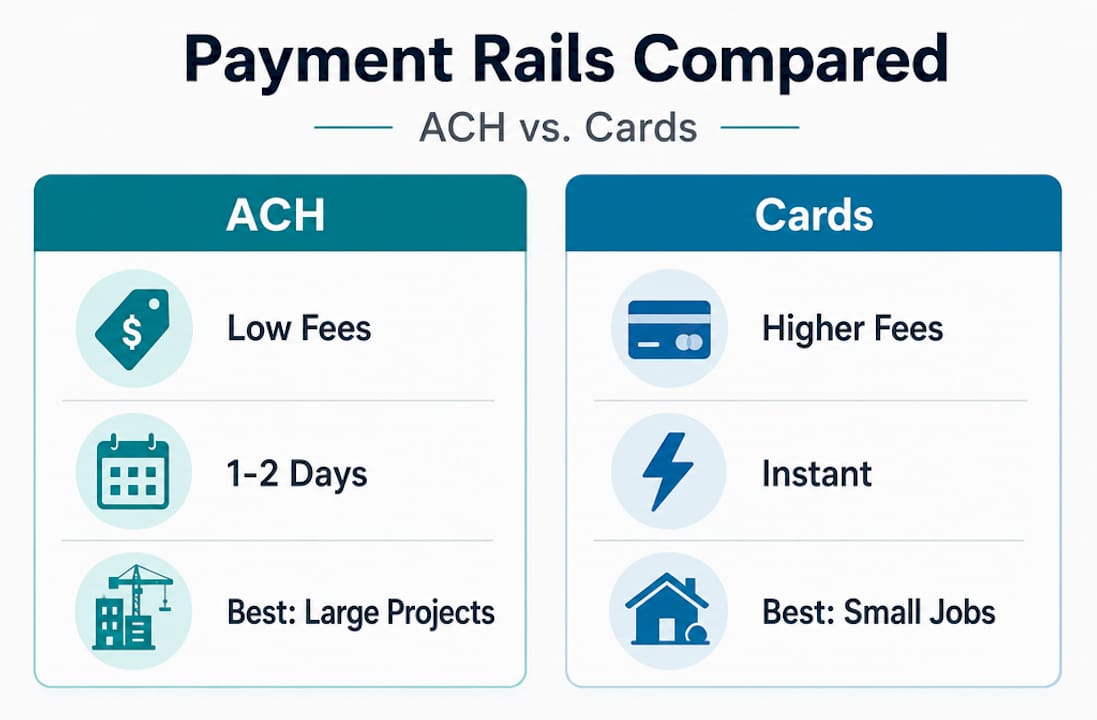
FedNow, the Federal Reserve’s real-time payment network, is newer but increasingly important for contractors who need instant finality. If you need to pay a material supplier to hold an asphalt delivery slot or release a subcontractor draw before a pour, FedNow eliminates the overnight wait.
Smart commercial firms use multi-rail support balancing instant card authorization, low-cost ACH, and FedNow’s real-time finality. This is what separates contractors who actively manage cash flow from those who just react to it.
The benefits of combining rails for your business include:
- Lower processing costs on high-value invoices by defaulting to ACH
- Flexibility to use card authorization for urgent client approvals
- Real-time vendor payments via FedNow when project timelines are tight
Pro Tip: Map each payment type to a specific project scenario before you choose software. If you do a lot of large progress-draw work, ACH should be your primary rail. If you manage faster-cycle commercial work, card and FedNow options matter more.
If your payment system also connects to your field scheduling, check how scheduling software that integrates with QuickBooks can keep your cost tracking aligned with your payment timing.
The critical role of lien waivers and holdbacks in seamless payments
Lien waivers are legal documents that waive your right to file a mechanic’s lien once payment is received. In commercial paving, they are not optional paperwork. They are the primary tool your clients use to protect property title, and they are often the last thing standing between you and a closed-out payment.
There are two types you need to understand:
- Conditional lien waiver: Submitted with a payment request. Rights are waived only if and when payment clears.
- Unconditional lien waiver: Submitted after payment clears. Confirms rights are permanently waived.
- Generate the waiver when the invoice is sent (conditional).
- Track payment clearing through your payment system or bank confirmation.
- Trigger the unconditional waiver automatically once funds are confirmed received.
- Store both documents in the project file with timestamps.
- Release final holdbacks only after unconditional waivers are confirmed.
“Automating unconditional waivers after confirmed payment is critical to protecting lien rights. Most owners mistakenly automate only conditional lien waivers.”
Most contractors automate only conditional waivers, which is the equivalent of locking the front door but leaving the back open. Unconditional waivers are where your actual legal exposure lives.
Your construction invoicing software should handle both waiver types automatically, with no manual follow-up required. The paving software benefits of automation here extend beyond convenience. They are about legal protection.
Pro Tip: In Canadian provinces with prompt payment legislation, build your waiver schedule to match the statutory holdback release calendar, not your internal billing cycle. Misalignment there is a common source of end-of-project disputes.
Applying seamless payment systems to improve cash flow and operational efficiency
Knowing how seamless payment works is one thing. Seeing what it changes day-to-day is another. For a paving company running five to fifteen active commercial contracts, the difference is measurable.
Lien waiver automation reduces manual cycles and cuts final payment delays significantly. That means less time in the office chasing paperwork and more time quoting and executing the next job.
The operational gains stack up across several areas:
- Dashboard visibility: See every invoice, payment status, and outstanding waiver in one view, not across spreadsheets and email threads
- Automated payment triggers: When a milestone is approved in the field, the system generates and sends the invoice without manual steps
- Lien waiver integration: Payment release is tied to waiver confirmation, so nothing slips through
- Real-time job costing: Payments are recorded against the correct cost codes, giving you accurate margin reporting per project
Real-time job costing and WIP reporting integrated with payment systems ensure proper holdback accounting and tax compliance. For paving companies filing quarterly or managing large year-end tax positions, this matters more than most owners realize.
Pro Tip: Use software that handles lien period calendaring and statutory trust fund accounting. These features are often buried in the platform settings but are worth activating on day one to stay compliant.
The asphalt paving software tools that best support this are the ones built for construction workflows, not adapted from generic invoicing platforms. Generic tools miss the lien and holdback logic entirely.
Why ignoring unconditional lien waivers and multi-rail strategies can silently drain your profits
Here is what we see consistently among paving companies that feel like their payment processes are “fine”: they have solved the easy part. They send invoices on time. They collect conditional waivers. They take cards and ACH. But they have left two significant profit leaks open.
The first is unconditional lien waivers. Failure to automate unconditional lien collection leaves companies exposed to lien risks even when conditional waiver automation is in place. Clients with sophisticated legal teams know this. When a dispute arises late in a project, missing unconditional waivers become leverage against you.
The second leak is payment rail complacency. Treat payment rails as an ongoing optimization strategy, not a one-time setup decision. Most contractors pick a payment processor at the start and never revisit it. But as FedNow adoption grows and ACH pricing shifts, the optimal mix changes. Running a large annual billing volume through card-heavy processing when ACH is available can cost you significant money each year with zero operational benefit.
The contractors who stay profitable year over year are not necessarily winning more bids. They are capturing more of what they already earn. That means tightening waiver processes, auditing payment rail costs annually, and connecting their invoicing for contractors workflow to real payment data so nothing gets left on the table.
Streamline your paving company’s payments with OneCrew’s all-in-one software
Most paving companies have the right instincts about payment efficiency. What they lack is a platform built around the actual workflows of a construction business.
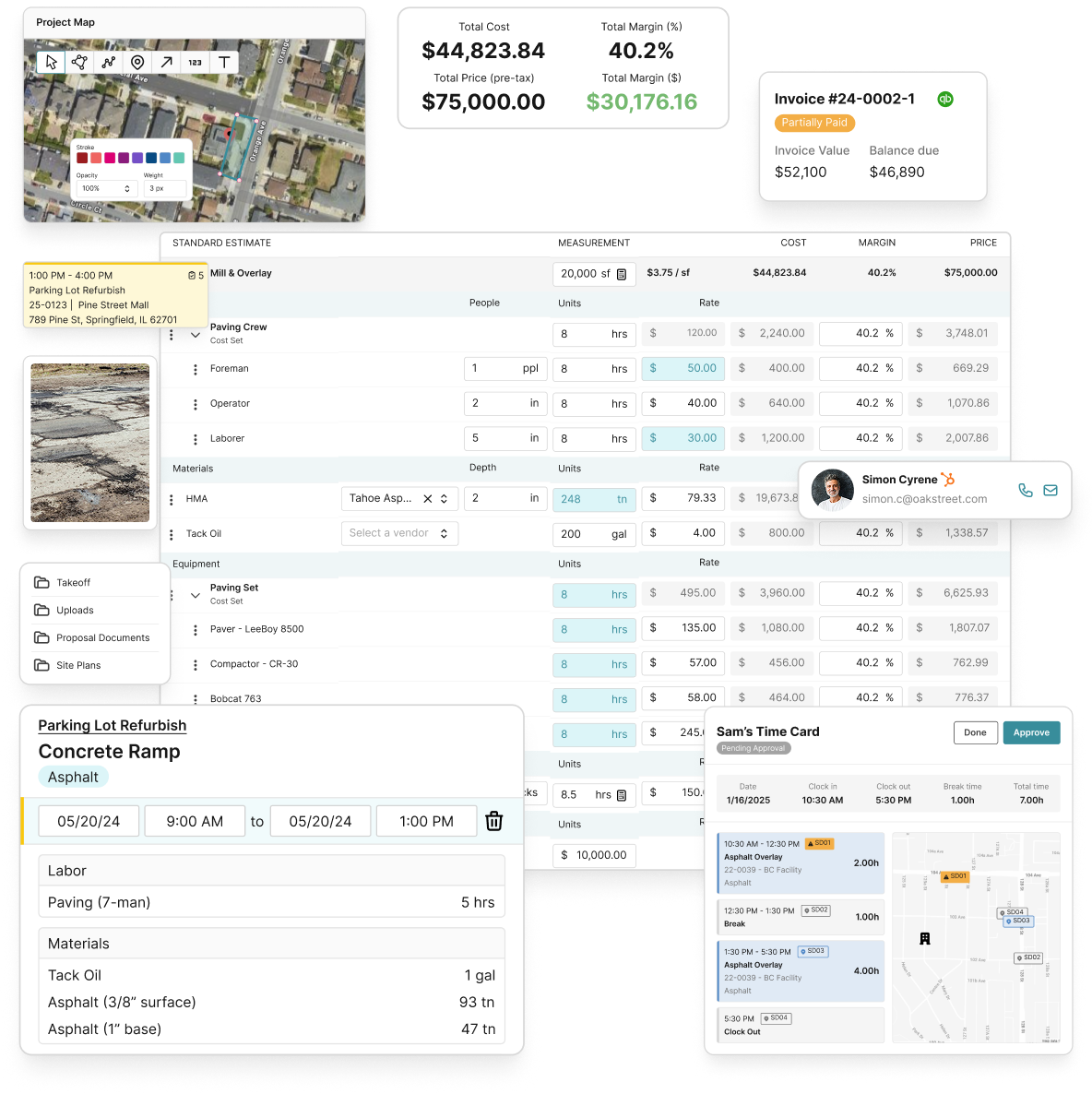
OneCrew is built specifically for asphalt and paving contractors, which means the invoicing, lien waiver automation, and progress billing tools already speak the language of your projects. There is no bolting together three separate tools or exporting spreadsheets between systems. The construction invoicing software connects directly to your estimates, field data, and payment history. The paving estimating software feeds accurate job costs into your billing so your margins are tracked from bid to final payment. And the mobile field management app lets your crews trigger billing milestones from the job site, cutting days off your billing cycle without adding admin work. Book a demo to see it on your projects.
Frequently asked questions
What is a seamless payment system for contractors?
A seamless payment system integrates invoicing, payment processing, and lien waiver management into one automated workflow, reducing delays and manual errors across the payment cycle.
How does multi-rail payment support benefit paving companies?
Multi-rail support lets contractors optimize payments by balancing cost, speed, and convenience across ACH, cards, and real-time systems. Smart commercial firms use multi-rail support to balance instant card authorization, low-cost ACH, and FedNow’s real-time finality.
Why is automating lien waiver collection important?
Automating lien waiver collection eliminates manual follow-up and protects your lien rights. Missing lien waivers are the primary cause of final payment delays in commercial construction, making automation a critical risk management tool.
What are the statutory holdback requirements in Canada?
In provinces with prompt-payment and lien legislation, such as Ontario, Alberta, and BC, owners must retain a statutory holdback on each progress payment and release it after substantial completion. The exact percentage and holding period are set by provincial legislation and vary by jurisdiction, so confirm the current rules for the province where you work.
How quickly does integrated payment software typically deliver ROI?
Most users see results faster than expected, with reduced payment delays and lower manual processing costs driving the return, often within the first year.
Recommended
- Construction Invoicing Software with Partial Billing | OneCrew
- Invoicing for Contractors: 9 Best Tools Compared in 2026
- All-In-One Software Platform for Asphalt Paving Crews - OneCrew