How Automation Boosts Asphalt Contractor Profits

Running a mid-sized asphalt paving operation means juggling tight project timelines, unpredictable crews, aging equipment, and clients who expect flawless results every time. Contractors in the $5M to $25M revenue range feel this pressure most acutely: you’re too large to rely on gut instinct, but not yet large enough to absorb costly mistakes. Automation is changing that equation fast, giving contractors measurable gains in efficiency, quality, and profitability without requiring a complete overhaul of how you run your business.
Key Takeaways
What is automation in asphalt projects?
Before exploring the benefits, it’s worth getting precise about what “automation” actually means in the context of paving. It’s not about replacing your crew with robots. It’s about using smart technology to handle repetitive, data-heavy, or error-prone tasks more consistently than any human can do alone.
Automation in asphalt improves paving process consistency, resulting in higher-quality road surfaces through technologies like thermal mapping, intelligent compaction, and GPS-based systems. These tools capture real-time data, flag deviations from spec, and help crews make faster, better decisions on the jobsite.
Here’s a quick breakdown of the main automation categories relevant to paving contractors:
- Process control automation: Manages material temperatures, mix ratios, and compaction passes to hit consistent density targets every time.
- Equipment scheduling automation: Coordinates machine availability, job sequencing, and maintenance windows to eliminate idle time.
- Real-time jobsite monitoring: Tracks crew location, material usage, and compaction progress as it happens so you can catch problems before they become rework.
- Predictive maintenance: Analyzes equipment sensor data to flag potential failures before they cause downtime or injuries.
- Resource and fleet optimization: Routes trucks, plans material deliveries, and balances crew assignments across multiple active projects.
How automation boosts efficiency and profitability
Now that we understand the tools, let’s see how automation tangibly impacts efficiency and profitability. These are the gains contractors at your scale are already pursuing.
Equipment scheduling automation can deliver a strong return for mid-size contractors, with meaningful annual savings against modest software costs — driven largely by cutting idle time that would otherwise eat directly into margin. That’s not a rounding error. That’s margin.
To know where you stand before adopting any tool, track these baseline metrics first:
- Average equipment idle time per project (hours and cost)
- Number of unplanned equipment failures per quarter
- Rework rate as a percentage of total job cost
- Crew productivity measured by square yards per crew hour
- Material waste as a percentage of total materials ordered
Once you have these numbers, automation ROI becomes easy to calculate and easy to justify to your finance team or ownership group.
Pro Tip: You don’t need to automate everything at once. Start with scheduling and fleet management, capture your baseline metrics, and let the early savings fund the next phase of implementation.
Learning how to boost profits through the right software stack is one of the highest-leverage moves a mid-sized contractor can make right now. Pairing that with purpose-built asphalt paving scheduling software turns the data into action immediately.
Quality control and jobsite safety improvements
Operational benefits are only part of the story. Automation also transforms quality and safety, and these two dimensions are deeply connected for paving contractors.
Automated monitoring minimizes rework by catching spec deviations in real time rather than during a post-project inspection. Real-time density monitoring and compaction automation ensure uniform compaction, reducing rework and the costs that come with it. One honest note: slow adoption does happen where skilled operator shortages limit the ability to maximize these tools, so training investment matters.
On the safety side, jobsite safety automation increases crew protection by enabling predictive maintenance, reducing equipment failures, and minimizing worker exposure via real-time data and remote monitoring. Fewer surprise breakdowns means fewer unsafe situations.
Here are the key safety benefits automation delivers on active paving projects:
- Predictive maintenance alerts reduce unplanned equipment failures by flagging issues days or weeks in advance
- Remote monitoring lets supervisors identify hazardous conditions without requiring physical presence in dangerous zones
- Automated compaction records eliminate manual data entry errors that could mask a quality or safety issue
- GPS tracking ensures equipment and crew are always accounted for, reducing risk during night paving or multi-lane operations
Automated predictive maintenance across a larger fleet can save significant cost annually while reducing unplanned delays and improving crew safety.
For contractors who want to understand how pavement maintenance planning integrates with these tools, the connection between maintenance data and automation is direct and profitable. If you’re doing your own density testing manually today, automated compaction monitoring is the logical upgrade.
Labor, sustainability, and workforce advantages
Beyond quality and safety, automation drives workforce and environmental advantages that are becoming harder to ignore, especially as labor markets stay tight and clients increasingly ask about sustainability practices.
The skilled labor shortage is real and getting worse in most North American markets. Automation helps attract younger, tech-savvy workers and addresses skilled labor shortages with smart features and controls that reduce the technical burden on each individual crew member. A younger hire who can operate an automated paving system is often more available, and more trainable, than a veteran operator who learned on analog equipment.
Smart automation in roadbuilding also reduces crew workload, increases precision and quality, optimizes material volumes and logistics, and requires fewer surveying resources on site. That means fewer people doing more work, more accurately.
Sustainability is becoming a real differentiator in contract bids, especially for municipal and state work. For $5M to $25M contractors, automation cuts idle time, which directly reduces fuel consumption and emissions. Less waste, fewer truck trips, and tighter material ordering all compound into a meaningful sustainability story.
Here’s what automation delivers on the workforce and sustainability front:
- Workforce recruitment: Tech-enabled jobsites attract younger workers who expect digital tools as part of the job
- Training efficiency: Automated systems provide real-time feedback, shortening the learning curve for new hires
- Material optimization: Precise volume calculations reduce over-ordering and leftover asphalt waste
- Fuel reduction: Eliminating idle time directly lowers fuel costs and carbon output per project
- Certification support: Accurate automated data logs support applications for green certifications or sustainability reporting requirements
Pro Tip: Use automated material tracking reports as supporting documentation when bidding on projects that include sustainability scoring criteria. Many public contracts now award points for demonstrable waste reduction.
For contractors ready to pursue sustainable paving practices formally, automation provides the data infrastructure that makes those programs credible and auditable.
Why mid-sized contractors can’t afford to wait on automation
Here’s the perspective that most industry articles skip: the contractors who are hesitating on automation are not being cautious. They’re falling behind without realizing it.
The common objection is integration complexity. Yes, connecting new scheduling software to your existing accounting system takes effort. Yes, training a crew that’s used to paper processes takes patience. But the ROI window for automation is already open and it won’t stay this favorable forever. When your competitors finish their own implementations, the cost advantage they carry will show up in their bids, and you’ll feel it in your win rate.
The case is straightforward. A strong return on scheduling software is not a gradual payback — it’s rapid recovery that most capital investments can’t come close to matching. And the operational gains, tighter schedules, better quality, lower rework, compound every year the tools are in place.
The honest reality is that field management software purpose-built for paving contractors has removed most of the integration friction that made this category hard in the past. The tools are more accessible now than they have ever been.
Pro Tip: Don’t wait for the perfect moment to start. Implement one automation layer, measure it for 90 days, and use those results to fund the next one. Incremental rollouts consistently outperform big-bang implementations for mid-sized teams.
Take the next step with automation tools
You now have a clear picture of what automation delivers: stronger margins, safer jobsites, better quality, and a workforce that can scale. The next step is putting the right tools in place.
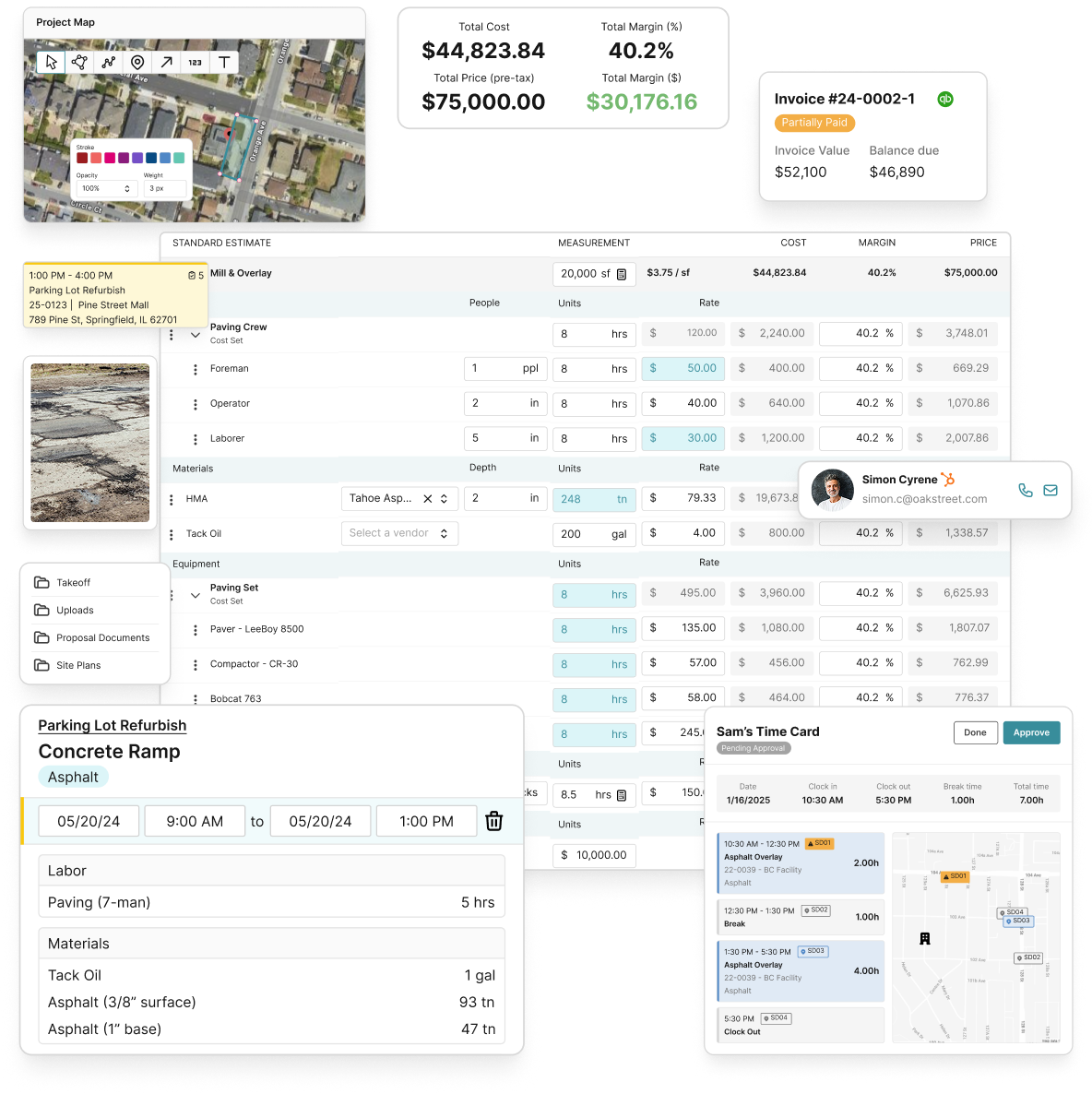
OneCrew is built specifically for paving contractors. The platform connects estimating software with scheduling, project tracking, and invoicing in one system. The field management app gives your crews real-time visibility and keeps office and field in sync without back-and-forth calls. If you’re ready to turn the benefits covered in this article into daily operational reality, the all-in-one paving platform is the logical starting point. Book a demo to see it in action
FAQs
What types of automation are most valuable for asphalt contractors?
Scheduling automation, real-time monitoring, and fleet management deliver the highest ROI, with equipment scheduling among the strongest returns for mid-size contractors.
How does automation improve safety on paving jobsites?
Predictive maintenance and remote monitoring minimize worker exposure and reduce equipment failures by catching problems before they escalate into dangerous situations on active jobsites.
Does automation help contractors address skilled labor shortages?
Yes. Smart automation features attract younger, tech-savvy workers and reduce the technical burden on each hire, making it easier to build a capable crew in tight labor markets.
Are the upfront costs of automation tools justified for $5M to $25M contractors?
Yes. Scheduling automation typically costs far less than the savings it generates in recovered idle time and tighter operations, making the payback period short for mid-sized operations.
How does automation impact sustainability in asphalt projects?
Automation reduces idle time, cutting fuel consumption and material waste while generating the accurate data logs contractors need to support sustainability certifications and green bid criteria.