
Best Way to Manage Paving Crews for Maximum Results

You’ve got two crews running simultaneously, a third mobilizing by noon, and your phone is already buzzing with a scheduling conflict before you’ve had your first coffee. Sound familiar? The best way to manage paving crews isn’t about working harder or micromanaging every roller pass. It’s about building systems that your crews can execute consistently, even when you’re not standing right next to them. This guide lays out practical strategies for effective paving crew management, from pre-job prep through daily execution and continuous improvement.
Key takeaways
| Point | Details |
|---|---|
| Build systems, not habits | Repeatable pre-job briefings and defined crew roles reduce errors and boost output quality. |
| Culture training beats skill drills | Training crews for attitude and teamwork creates steadier performance under pressure. |
| Coordinate trucks to paver speed | Matching truck arrival rates to paver speed is the single biggest lever for mat quality. |
| Measure and adjust quarterly | Targeting even a 10% improvement on one system per quarter compounds into real profitability. |
| Technology cuts hidden costs | Digital scheduling and dispatch tools reduce fuel waste and admin time that drain margins. |
Best way to manage paving crews starts before day one
The work that separates good paving managers from great ones happens before the first truck rolls. Preparation is the real job, and most of the mistakes you’ll fix on site could have been prevented in the office the week before.
Start with a detailed project plan that covers scope, timeline, equipment needs, and crew assignments. Know who’s operating what, who’s on screed, who’s flagging, and who’s responsible for mat quality checks. Ambiguity on site creates delays.
Here’s where many managers underestimate the payoff:
- Train for culture, not just skill. Crew training for culture leads to muscle memory and steady performance under stress. When your crew knows how you expect them to communicate, how they handle disagreements, and what accountability looks like, you get consistency without constant supervision.
- Set safety protocols before arrival. In hot climates, heat safety protocols like Water, Rest, and Shade are mandatory starting at 80°F and above. Don’t wait until someone’s struggling in the heat to figure out your rotation schedule.
- Define roles clearly. Every crew member should know their job and their backup’s job. Paving crews operating as a well-coordinated unit outperform crews that wing it, every time.
- Adopt digital tools early. Manual scheduling and paper-based dispatching eat hours you don’t have. Construction automation tools can replace spreadsheets with real-time visibility across all your active jobs.
Pro Tip: Create a pre-job checklist that takes under ten minutes to complete but covers equipment status, crew assignments, and weather conditions. Review it at the start of every shift.
On-site execution: running a tight paving operation
Once you’re on site, effective paving crew management comes down to rhythm and communication. Think of your crew as a paving train where every car depends on the one in front. When one role breaks down, the whole operation slows.
Start every day with a pre-job briefing. Keep it to ten minutes. Cover the day’s scope, any hazards on site, equipment status, and who calls what decisions. These briefings sound simple, but standardized pre-pave huddles consistently improve team efficiency across operations of all sizes.
Follow this execution sequence to keep things moving:
- Run equipment checks before the plant opens. Every roller, paver, and haul truck gets a visual check. A breakdown discovered at 7 a.m. is far better than one discovered mid-pour.
- Manage truck arrival rates. Matching truck arrivals to paver speed is the most direct way to prevent cold joints and mat quality failures. Too many trucks create traffic congestion; too few starve the paver.
- Standardize your callouts. Use radios or headsets. Define which signals mean stop, slow, and send. Standardized radio communication between plant, trucks, and paver avoids the kind of miscommunication that causes defects you’ll pay to repair.
- Optimize your dispatch routes. Fuel costs represent 5 to 15% of total operating budget. Automated dispatch and route management cuts that number without cutting corners.
- Assign a dedicated quality control role. A density technician or experienced screed hand who’s watching mat temperature and compaction patterns catches problems while they’re still fixable.
| Task | When to do it | Who’s responsible |
|---|---|---|
| Equipment check | Before plant opens | Lead operator |
| Pre-job briefing | First 10 minutes on site | Project manager |
| Truck arrival coordination | Ongoing during paving | Foreman or dispatcher |
| Mat quality check | Every 500 feet | Density tech or screed operator |
| End-of-day debrief | Last 15 minutes | Crew leader |
Pro Tip: Set a maximum wait time for the hopper. If it drops below a defined level, that triggers an immediate radio call to the dispatcher, not a casual mention at lunch.
Common mistakes and how to avoid them
Even experienced crews fall into patterns that quietly cost money and quality. Knowing what to watch for is half the battle when it comes to strategies for managing paving workers effectively.
- Rushing compaction. Crews under schedule pressure skip passes or reduce roller overlap. This is the single most common source of warranty callbacks. Set minimum pass counts and treat them as non-negotiable.
- Poor base prep. No amount of skilled laying fixes a weak base. If you’re inheriting a subgrade from another contractor, inspect it yourself before your crew touches it.
- Communication gaps during shift transitions. The handoff between morning and afternoon crews is where details get lost. A written shift log solves this without adding meetings.
- Ignoring equipment-level safety upgrades. Engineered safety controls like safety cages and traffic flow patterns protect your crew better than PPE alone. Relying on personal protective equipment as your first line of defense leaves real risk on the table.
- Letting crew burnout build. Paving is physically demanding. Rotating positions throughout the day, building breaks into the schedule, and recognizing when someone needs to be pulled from rotation prevents the kind of fatigue errors that cause injuries.
Managing crew morale isn’t soft management. It’s one of the most direct ways to protect job quality and reduce turnover costs.
For weather-related delays, have a protocol written down before the season starts. Who makes the call to stand down? At what rain rate or temperature? Decisions made in the moment under pressure are almost always worse than ones made in advance.
Review your asphalt safety practices at least once a quarter. Job sites evolve, crews turn over, and equipment changes. Your safety protocols should keep pace.
Measuring what actually matters
You can’t improve what you don’t track. Optimizing paving project workflow requires data, not gut feelings, and the good news is you don’t need complicated software to get started. You do need consistency.
| Metric | Why it matters | How to track it |
|---|---|---|
| Job cost vs. estimate | Reveals where time and materials are leaking | Weekly job cost report |
| Tons laid per crew hour | Measures production efficiency | Daily field log |
| Callback rate | Tracks quality failures over time | Customer service records |
| Fuel cost per job | Identifies route and dispatch inefficiency | Fleet management system |
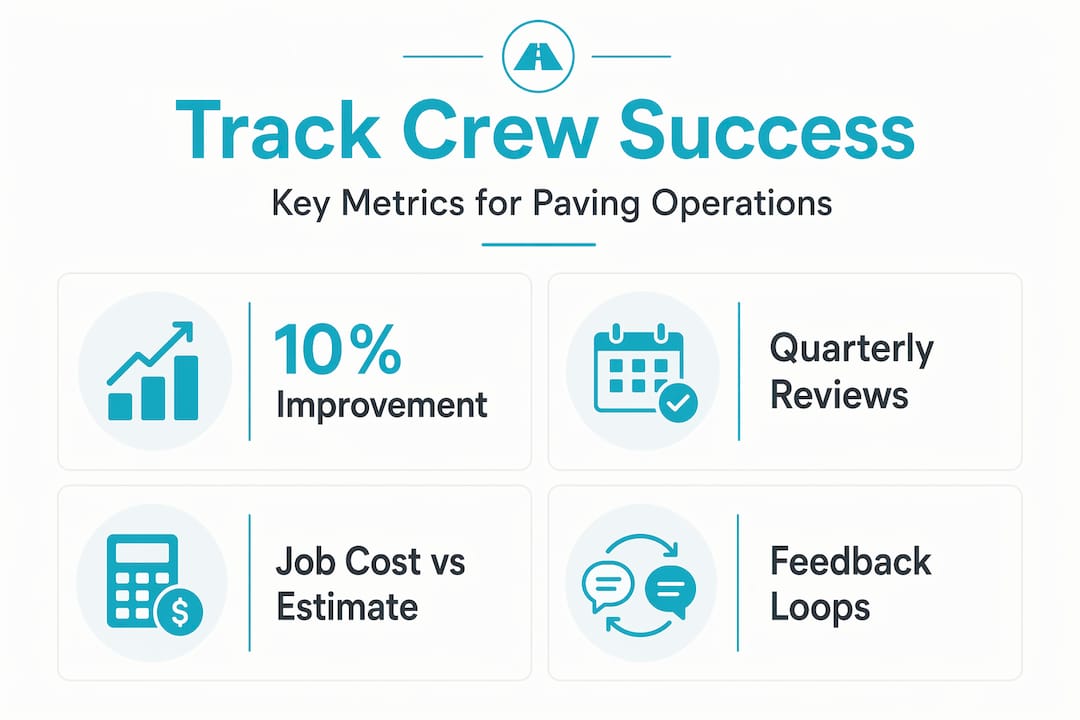
Targeting 10% improvement on one system per quarter sounds modest. Over two years, it’s compounding growth that most competitors won’t match. Pick one metric each quarter, diagnose it, and fix it. Then move to the next.
Build feedback loops into your crew structure. Your lead operators and screed hands see problems you don’t. Create a simple way for them to flag recurring issues, whether that’s a five-minute end-of-day report or a shared note on a job management app. Those front-line observations are some of the most valuable data you’ll collect.
Pro Tip: Review your paving project management practices alongside your job cost data. Patterns across jobs reveal systemic issues that one-off fixes won’t solve.
Our take on what separates great crews from good ones
We’ve watched managers run crews that looked chaotic on the surface but produced excellent work consistently. We’ve also watched tightly scheduled operations fall apart the moment something unexpected happened. The difference was never the equipment. It was always the culture.
In our experience, the managers who build the most profitable, stable paving operations stop firefighting and start building systems. They write things down. They debrief honestly. They invest in communication tools and safety upgrades before a near-miss forces their hand. Incremental safety and efficiency gains aren’t glamorous, but they’re what builds a business that lasts.
The crew culture piece surprises people. Training for culture reduces absenteeism, improves attitudes, and creates the kind of team that doesn’t need to be managed through every problem. That’s leverage that no piece of equipment can give you.
How OneCrew makes crew management easier
If you’re still tracking crew schedules in spreadsheets and dispatching by text message, you’re spending real hours every week on work that software can handle better.

OneCrew’s paving estimating software cuts the time it takes to prepare accurate bids, so you spend less time in the office and more time on site. The drag-and-drop scheduling tool makes crew assignment and dispatch straightforward, helping you reduce fuel waste and avoid double-booking. For field teams, the mobile field management app keeps crew leaders connected and job data accurate in real time. Everything the systems in this guide require, from pre-job briefings to job cost tracking, works better when it runs through a single platform built specifically for paving contractors. Book a demo to see it on your operation.
FAQ
What’s the most common mistake in paving crew management?
Rushing compaction under schedule pressure is the most frequent and costly mistake. It leads to warranty callbacks and mat failures that take more time and money to fix than the time saved.
How do you prevent cold joints on a paving job?
Truck arrival rates matched to paver speed keep the hopper supplied and the mat temperature consistent. Cold joints almost always result from supply gaps, not from crew skill failures.
How often should paving crews review their systems?
Quarterly system reviews targeting at least 10% improvement on one process at a time are the most effective cadence. More frequent reviews work too, as long as they lead to clear changes.
What role does crew culture play in performance?
Culture training creates consistency that skill training alone can’t produce. Crews trained on expectations, communication standards, and accountability perform steadier under pressure and require less day-to-day management.
How do digital tools improve paving crew coordination?
Scheduling and dispatch software reduces fuel costs, which can represent 5 to 15% of operating budgets. Mobile field apps keep managers and crews aligned without relying on phone calls or paper logs.

.png)