Why Use Construction SaaS: Benefits and ROI in 2026

Construction SaaS refers to cloud-delivered software platforms built specifically for construction workflows, giving project managers and field crews centralized, real-time access to project data, financials, and scheduling from any location. The construction SaaS market is growing at a 10.8% CAGR and is projected to reach $50.36 billion by 2036. That growth reflects a real shift in how construction businesses operate. Firms that still rely on spreadsheets, disconnected accounting tools, and paper-based workflows are losing time and margin to competitors who’ve moved to purpose-built platforms. This article breaks down exactly what construction SaaS delivers, where it pays off fastest, and what to watch out for before you commit.
Why use construction SaaS over generic software?
Construction SaaS is cloud-based software designed around the specific workflows of the construction industry, including scheduling, cost tracking, RFI management, and field reporting. Generic platforms like standard project management or accounting tools weren’t built with jobsite realities in mind, and that gap shows up in your data.
When you layer separate tools on top of each other, you create fragmentation. A Forbes Tech Council analysis found that disconnected generic systems erode forecasting confidence and require complex integrations that introduce reporting inconsistencies. That means your project manager sees one number, your accountant sees another, and nobody trusts either one.
Construction-specific SaaS solves this by linking project management, accounting, and field data in a single system. The result is a single source of truth that eliminates manual reconciliation and gives you accurate forecasts without the spreadsheet gymnastics. For construction project reporting, that consistency is the difference between catching a cost overrun early and discovering it at closeout.
What are the primary benefits of construction SaaS platforms?
The most immediate benefit is the reduction in IT overhead. With SaaS, vendors handle hosting, backups, security patching, and software updates. You don’t need an in-house IT team to keep the system running. That’s a real cost saving for mid-sized contractors who can’t justify a dedicated IT department.
Beyond cost, the operational gains are significant:
- Faster implementation. SaaS platforms deploy in weeks, not months, because there’s no on-premise infrastructure to configure.
- Automatic updates. Your team always works on the current version without manual upgrades or compatibility headaches.
- Real-time collaboration. Field crews and office staff see the same data simultaneously, reducing miscommunication across distributed sites.
- Subscription pricing. Monthly or annual fees replace large upfront capital expenditures, making budgeting more predictable.
- Scalability. You can add users, projects, or modules as your business grows without re-architecting your tech stack.
The ROI case is particularly strong around documentation. Automating RFI workflows cuts cycle time from 8.2 days to 1.8 days, with mid-sized contractors reporting over $387,000 in net annual savings and payback periods under six months. That’s not a marginal improvement. It’s a structural change in how fast your projects move.
Pro Tip: When evaluating platforms, ask vendors specifically about RFI and submittal automation. These two workflows alone often justify the entire subscription cost within the first year.
How does construction SaaS improve data integration and decision-making?
Most construction firms don’t have a data problem. They have a data fragmentation problem. Here’s what that typically looks like in practice:
- Project managers track progress in one tool.
- Accounting runs job costing in a separate system.
- Field supervisors log daily reports on paper or in a third app.
- Someone manually reconciles all three at month end.
That reconciliation step is where errors enter and where forecasting breaks down. Industry-specific SaaS platforms eliminate this by integrating project management, financial tracking, and field data into one connected system. When a field crew logs hours or materials, that data flows directly into job costing without a manual transfer.
SaaS ERP platforms provide unified real-time data for project management, financials, and field operations, enabling faster decisions and genuine transparency. For a construction business owner, that means you can pull a job cost report on a Tuesday afternoon and trust what it says.
What security and governance considerations come with construction SaaS?
SaaS shifts security responsibilities, but it doesn’t eliminate them. Under the widely used shared responsibility model, your SaaS vendor manages platform integrity, infrastructure patching, and physical security. Your firm remains responsible for data classification, user access controls, and endpoint security.
This is the most common misconception in SaaS adoption. Construction firms assume that moving to the cloud means security is “handled.” It’s not fully handled. It’s divided.
Practical steps your firm needs to own:
- Role-based access controls. Not every employee needs access to financial data or contract documents. Define roles before you go live.
- Regular access reviews. Remove permissions for employees who change roles or leave the company. Stale accounts are a real vulnerability.
- Endpoint protection. Field tablets and personal phones accessing the platform need mobile device management policies.
- Audit readiness. Even with cloud infrastructure, you need internal documentation of who accessed what and when.
Pro Tip: Build your access review process into your quarterly HR cycle. Tie permission audits to performance reviews so they happen on a predictable schedule without requiring a separate initiative.
Construction SaaS security governance requires active internal controls on user roles and endpoint protection, even when infrastructure management is fully outsourced.
How can construction businesses maximize ROI with SaaS?
The firms that get the most from construction SaaS are the ones that treat implementation as a process, not a purchase. Buying a subscription is the easy part. Getting your team to actually use it consistently is where most rollouts succeed or stall.
Documentation automation can deliver strong first-year ROI for mid-sized contractors. That return comes from compressing submission, review, and approval cycles, which directly impacts your project schedule. To capture that value, you need to migrate your existing document workflows into the platform from day one, not as an afterthought.
Key practices that drive measurable returns:
- Prioritize platforms with built-in document management to reduce manual handling and version control errors.
- Plan data migration before go-live. Importing historical project data takes time but is critical for accurate reporting from the start.
- Invest in user training. A platform nobody uses delivers zero ROI regardless of its feature set.
- Use mobile field access to keep field and office teams working from the same data in real time.
The best construction project management software options in 2026 all share one trait: they’re built for the field, not just the office.
What types of construction SaaS solutions are available?
Construction SaaS covers a wide range of operational needs. Understanding the categories helps you prioritize what your business actually needs versus what sounds useful in a demo.
Cloud ERP document control enables secure access and standardized workflows across distributed teams, improving auditability and operational speed. For paving contractors specifically, platforms that combine estimating, scheduling, CRM, and invoicing in one system eliminate the need to manage multiple subscriptions and integrations. Tools like contractor scheduling software show how purpose-built SaaS outperforms generic alternatives in day-to-day coordination.
Key takeaways
Construction SaaS delivers its strongest ROI when firms adopt construction-specific platforms that unify project management, financials, and field data rather than layering generic tools.
See how OneCrew handles this for paving contractors
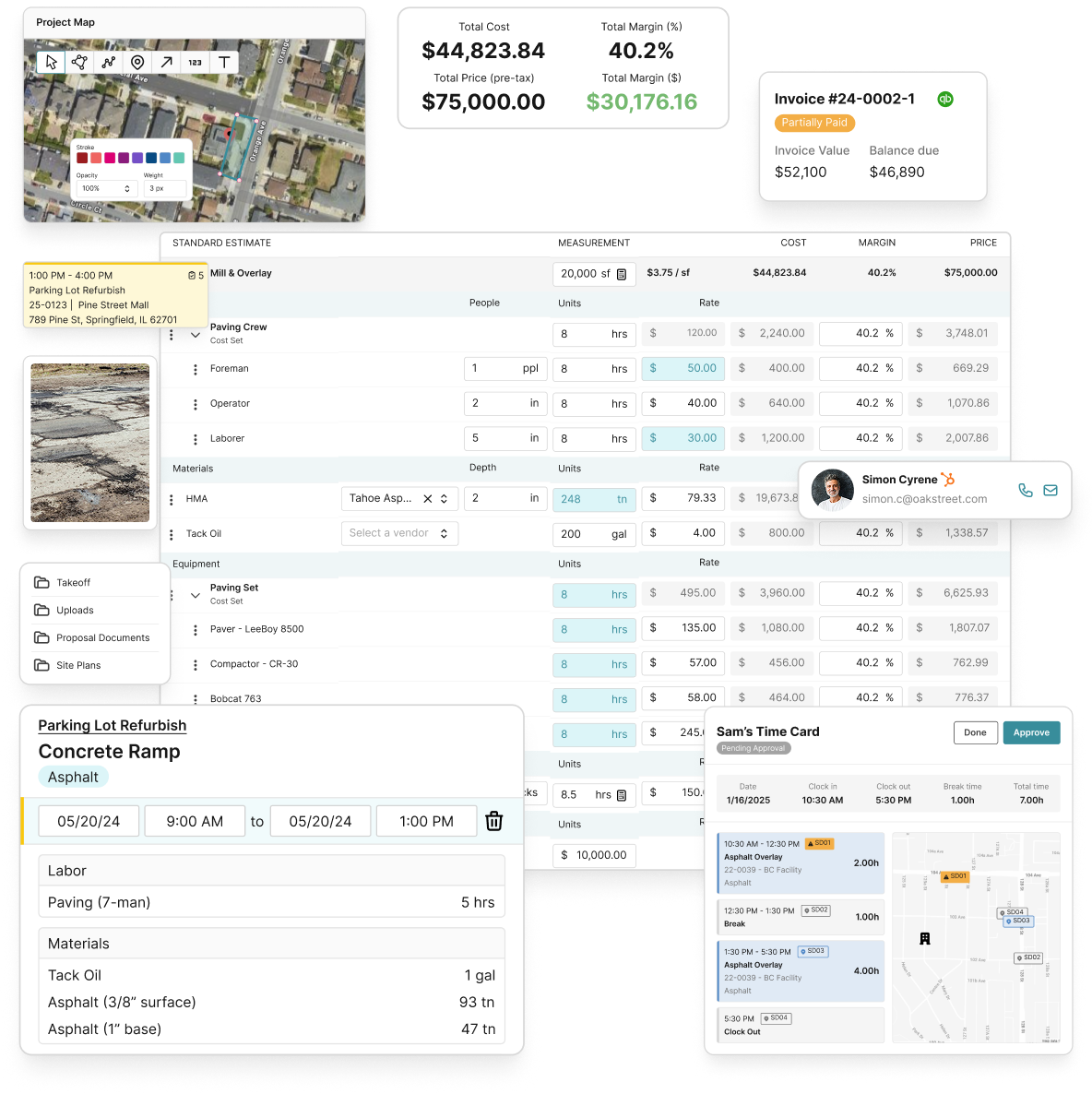
OneCrew is a purpose-built SaaS platform for asphalt paving and paving-related contractors. It connects estimating, scheduling, CRM, field management, and invoicing in a single cloud-based system, so your office and field teams always work from the same data. There’s no manual reconciliation between tools, no version control headaches, and no separate subscriptions to manage. If you’re evaluating construction SaaS for your paving operation, OneCrew is built specifically for the workflows you run every day. Book a demo to see it in action.
FAQ
What is construction SaaS?
Construction SaaS is cloud-delivered software built specifically for construction workflows, including project management, scheduling, estimating, and field reporting. It gives distributed teams centralized, real-time access to project and financial data without on-premise infrastructure.
How quickly does construction SaaS pay for itself?
Automating documentation workflows like RFIs sharply reduces cycle time, with fast payback for many mid-sized contractors.
Is construction SaaS secure?
Yes, but security is shared. Your SaaS vendor manages platform integrity and infrastructure, while your firm is responsible for user access controls, data classification, and endpoint security under the shared responsibility model.
Why choose construction-specific SaaS over generic tools?
Generic tools layered together create data fragmentation and require manual reconciliation. Industry-specific platforms link project management, accounting, and field data in one system, improving forecasting accuracy and reducing reporting errors.
What types of construction SaaS platforms exist?
The main categories include project management, ERP, document control, estimating, CRM, and field management tools. Many modern platforms combine several of these functions in a single subscription to reduce integration complexity.