How to Scale a Paving Business Beyond $500K

Scaling a paving business is defined as growing revenue beyond your current capacity by changing how your operations work, not just adding more jobs to the same broken system. Most commercial paving contractors hit a wall when the owner is still the daily bottleneck on every job. The path forward requires five simultaneous upgrades: pricing discipline, equipment strategy, labor structure, technology adoption, and financing readiness. Get all five right, and you’re building a production model that runs without you on every job site.
How to scale a paving business past the $500K revenue wall
Scaling past this threshold requires margin-protected capacity, not just more volume. Taking on more jobs at thin margins doesn’t grow a business. It exhausts one.
Pricing is where most contractors quietly bleed out. Two of the most common leaks are undercharging for mobilization and mixing residential and commercial rates into one flat price. Mobilization costs include travel time, equipment loading, and partial-day production losses. These are real costs, and they need to appear as line items on every estimate. Commercial projects carry different risk profiles and payment timelines than residential work, so they need separate pricing structures.
Here’s what a disciplined pricing approach looks like in practice:
- Raise rates when your backlog is running several weeks out. Demand is outpacing capacity. Your price should reflect that.
- Charge mobilization as a separate line item on every job, not buried in a per-square-foot rate.
- Separate residential and commercial pricing to account for bonding requirements, longer payment cycles, and site complexity.
- Track job creep weekly. Scope additions that aren’t billed are silent margin killers.
- Review crew efficiency per job. If a two-person crew is doing three-person work, you’re subsidizing the client.
Pro Tip: Set a rule that any backlog beyond 30 days triggers a pricing review. Contractors who don’t adjust rates during high demand leave significant money on the table every season.
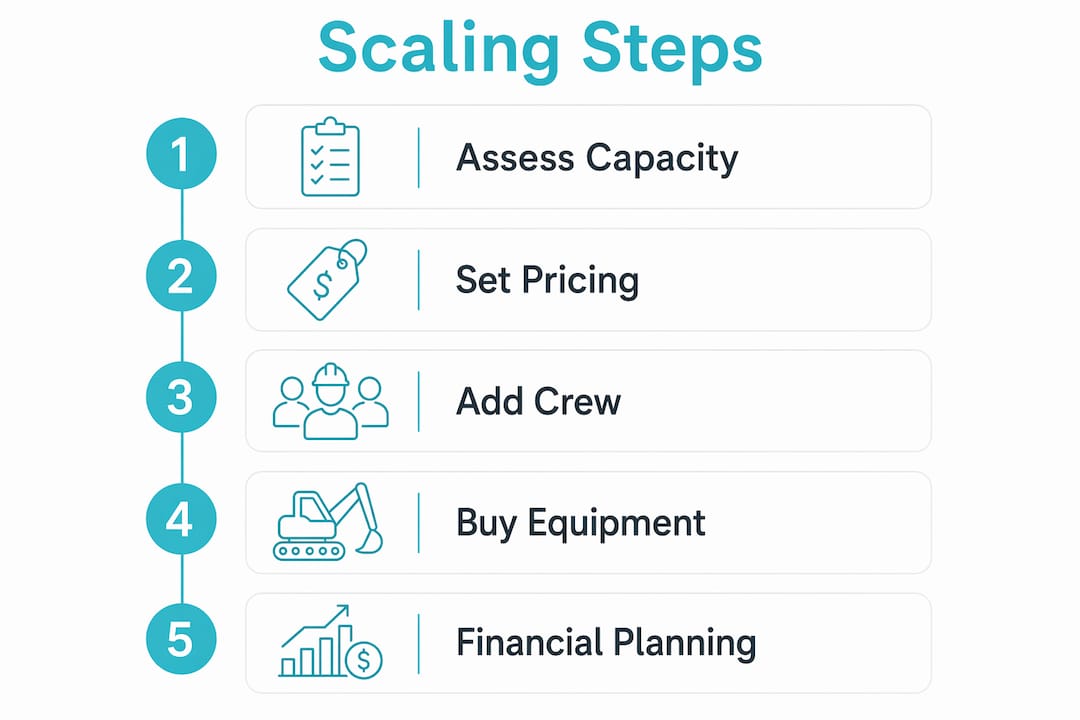
Adding a second crew is the right move when you have consistent backlog and the pricing to support it. Adding equipment without the backlog is how you end up overequipped and underpaid.
When does buying equipment beat renting?
Equipment decisions are one of the clearest signals of whether a paving company is scaling with discipline or just spending. The rule is straightforward: renting beats buying until a piece of equipment is needed regularly each week. Past that point, ownership starts to pay for itself.
A new paver can pay for itself within a single paving season once it removes a production bottleneck. The math works. What trips contractors up is buying before the work is there to justify it.
Technology upgrades follow the same logic. GPS grade control can sharply cut the hours a paving task takes by eliminating redundant grade-checking labor. That’s not a marginal improvement. It’s the difference between completing two jobs a day and completing one. Investing in construction automation tools like GPS grading and workflow software compounds the productivity gains from every other upgrade you make.
Pro Tip: Equipment availability and job readiness are not the same thing. Train your crew on new equipment before you accept the contracts that depend on it. Production failures on larger jobs cost more than the equipment itself.
Financial strategies that support paving business expansion
Money is the most practical constraint in paving business growth strategies. Materials, payroll, and equipment costs hit before client payments arrive. That gap is where undercapitalized contractors stall.
Working capital loans exist specifically to bridge this gap. Loan terms for paving contractors typically range from 3 to 24 months, and two loan types cover most scaling scenarios. Equipment loans are secured by the asset itself, which keeps rates lower and terms longer. Short-term working capital loans cover payroll and materials during seasonal ramp-up when revenue hasn’t caught up to expenses yet.
Here’s how to approach financing before you need it:
- Get pre-qualified before bidding larger jobs. Knowing your borrowing capacity lets you price competitively and commit to timelines with confidence.
- Separate equipment financing from operating capital. Mixing the two creates repayment pressure at the worst times.
- Prepare documentation in advance. Lenders want two years of tax returns, a current P&L, and a schedule of contracts. Have these ready before you apply.
- Understand bonding requirements. Larger commercial contracts often require surety bonds. Middle management gaps and bonding unreadiness are two of the most common reasons contractors lose high-value bids despite doing quality work.
- Build a cash reserve covering several weeks of operating costs. This is your buffer against slow-paying clients and weather delays.
Financing readiness isn’t about taking on debt. It’s about having the capacity to say yes to the right contracts when they appear.
What marketing actually drives paving contracts at scale
Scaling construction services without a lead system means growth depends on referrals and luck. Neither is reliable enough to build a $1M+ operation on. Successful paving companies invest meaningfully in SEO and paid advertising, adjusting budgets seasonally. That’s a real investment, and it produces predictable, exclusive leads.
The foundation is a professional, mobile-friendly website built to convert visitors into quote requests. Without that, every dollar spent on ads is wasted. Once the site converts, these channels drive volume:
- Google Business Profile: Keep it updated with photos, service areas, and recent reviews. This is the single highest-return local SEO asset for paving contractors.
- Local Service Ads (LSAs): Google’s pay-per-lead format for contractors. You only pay when a verified lead contacts you. LSAs work especially well for commercial parking lot and driveway resurfacing searches.
- Google Ads with geo-targeting: Run campaigns during peak season (April through October in most North American markets) targeting commercial property managers and facility directors.
- Reputation management: Maintaining fast lead follow-up and actively requesting reviews after every completed job compounds your close rate over time.
For a deeper look at building a consistent pipeline, the guide on generating paving leads covers the shift from referral-dependent to system-driven lead generation in detail.
Key takeaways
Scaling a paving business requires pricing discipline, equipment decisions tied to actual utilization, financing readiness before growth demands it, and a marketing system that generates predictable demand.
How OneCrew helps paving companies scale without the chaos
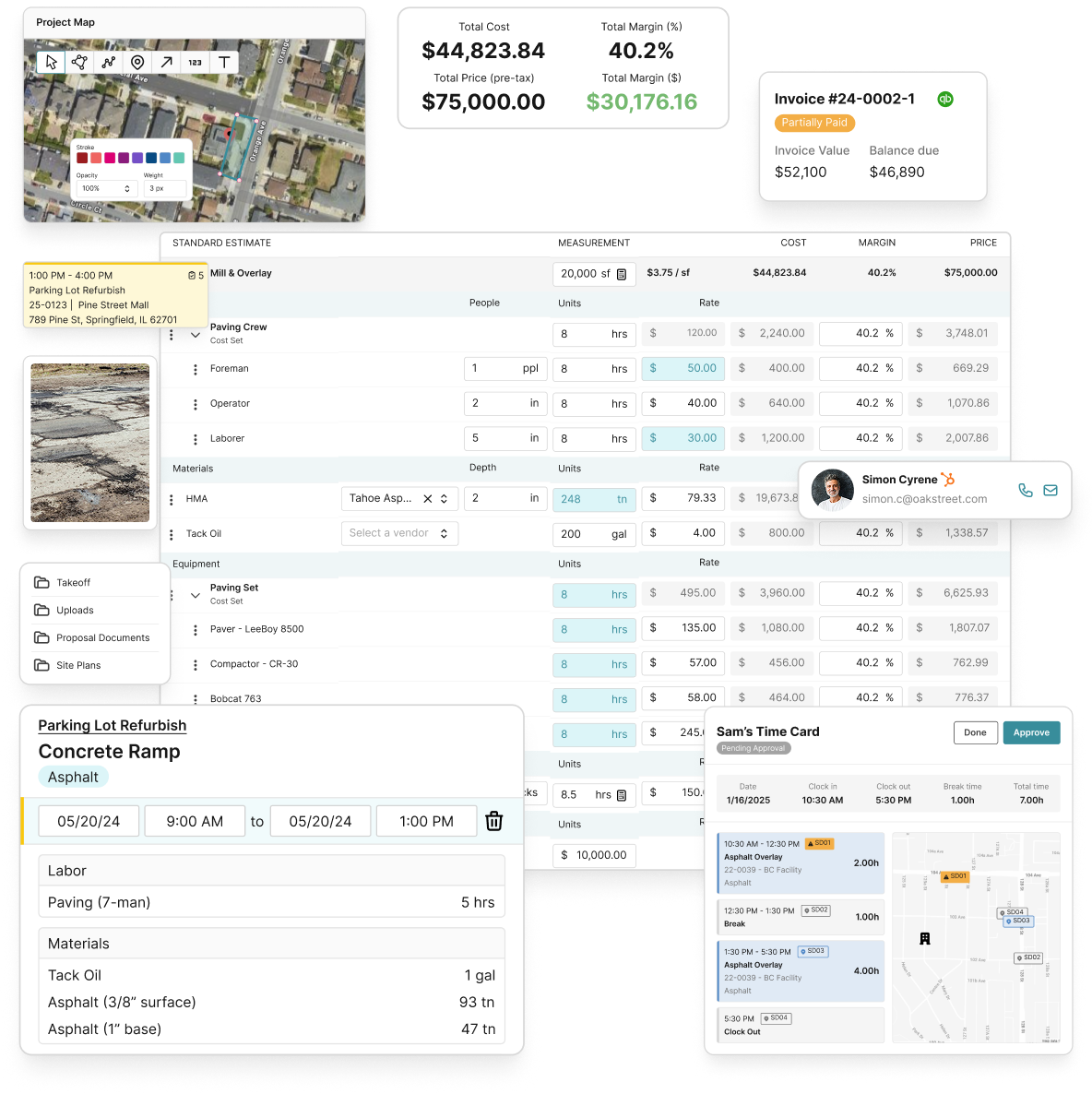
/When you’re managing two crews, multiple active jobs, and a growing estimate queue, the operational load compounds fast. OneCrew is built specifically for asphalt and paving contractors who need to run that complexity without adding administrative headcount. The estimating tools produce fast, accurate bids with built-in pricing controls, so you’re not underpricing mobilization or mixing up job types. Drag-and-drop crew scheduling keeps your field teams organized across multiple projects. Mobile field management and invoicing with partial billing close the gap between job completion and cash in the bank. If you’re serious about scaling, OneCrew gives you the operational backbone to do it without losing control of quality or profitability. Book a demo to see how it fits your growth plan.
FAQ
What revenue level signals it’s time to scale a paving business?
Most paving contractors hit a natural ceiling when the owner’s direct involvement becomes the limiting factor. That’s the point where pricing, crew structure, and equipment strategy need to change.
How do I know when to buy equipment instead of renting?
Buy when a piece of equipment is needed regularly each week. A quality paver typically pays for itself within one paving season once it removes a production bottleneck.
What type of financing works best for paving business expansion?
Equipment loans work best for machinery purchases since the asset secures the loan. Short-term working capital loans cover payroll and materials during seasonal ramp-up when cash flow lags behind active contracts.
How much should a paving company spend on marketing?
Established paving companies invest meaningfully in SEO and paid advertising, scaling budgets upward during peak season to maximize lead volume.
What’s the biggest operational mistake when scaling a paving company?
Accepting larger or more technical contracts before crews are trained on the required equipment. Equipment availability and job readiness are different things, and production failures on bigger jobs cost far more than the contract is worth.